Great example Derrel.
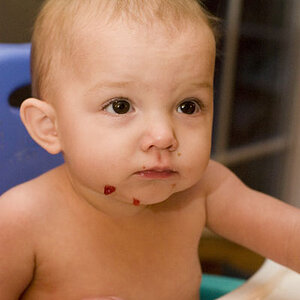
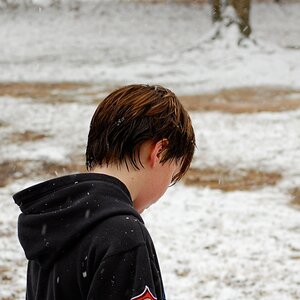
The key points are that he had more light on the background than on the subject and also that he had two lights (from the sides) on the background. If you use only one light on the background, it can tend to show up any wrinkles or imperfections, but when you cross light it, it's much easier to get a clean BG.
Thanks Mike. Everything you say is correct. The gray paper was lit by two lights, one on each side of the seamless paper about eight feet away from the background,and aimed at about 35-40 degree angle to the background paper. The lights were Speedotron M11 flash heads with the "old" standard 65 degree 11.5 inch reflectors; newer 11.5's have a 50 degree beam spread,and are not as good in a cramped garage like this shot was set up in).
One light is aimed from the back, left side of the set; It was an 11.5 inch 50 degree grid sttyle reflector with a 20 degree honeycomb grid and 2-door barndoors, aimed at the kid's forehead and left side area, and set at 8 feet high.
There is only one main light, camera right, a 40 inch Lastolite Umbrella Box. A 42x72 inch white fabric reflector is camera left, just outside the frame.
The two background lights had the most power. The main light and rim light were much lower-powered. Using speedlights, it would be like two Full-power flashes set to 35 or 50mm zoom cross-lighted on GRAY paper, and a main light and a rim light with diffuser or grid set to 1/4 power. A look at the power distribution from a similar old power pack tells me that this would have been lit with 240 watt-sec through each background light, and 60 watt-seconds through the main light and 60 through the rim light with grid. Rim light was roughly 2x the distance from the subject as the main light was.
If you start with pure white or cream-colored paper, you need much less light on the background to make sure it is fully white in the final shot than if you are lifting gray up to pure white.






![[No title]](/data/xfmg/thumbnail/37/37660-eb4529b6ea38a042c4e9b64866178d7b.jpg?1734170816)