LOL. Obviously incorrect, wake up and look around you. Either term, dpi or ppi is commonly used to specify pixels per inch (printing resolution for digital images).. It may have multiple uses, but the term is, and always was dpi, so it used to always only be dpi, but now all the digital camera newbies have corrupted things.

So now, due to a few jumping in to shout "wrong" when they have no clue, now the new necessity is that what is actually becoming common in educational efforts is the new term "dpi/ppi" (trying to make it very clear that these are completely interchangeable terms).
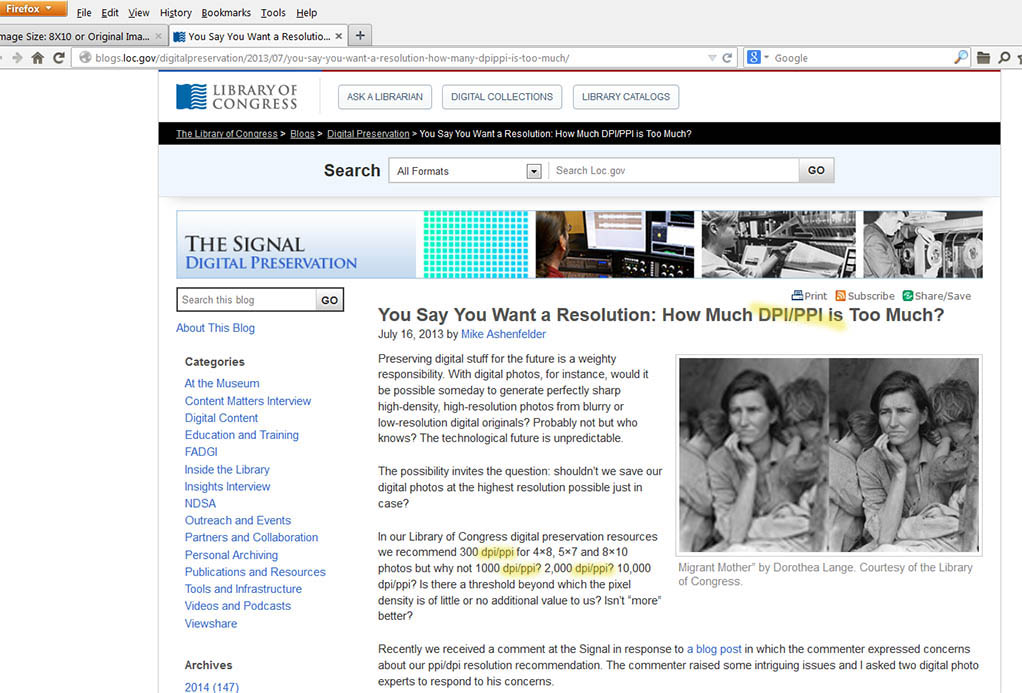
See for example, the
Library of Congress recently:
You Say You Want a Resolution: How Much DPI/PPI is Too Much? | The Signal: Digital Preservation
Who are we to believe, the Library of Congress, or some anonymous voice on the internet?
Here are many more (5530) examples of the "dpi/ppi" term (from various .gov governmental agencies):
"dpi/ppi" gov - Google Search
Note that the term is dpi first.... dpi/ppi.
The facts are obvious, however, clearly not everyone here knows this. Of course they are interchangeable terms. I do it all the time.
And I will continue doing so, because dpi has always been the name for image resolution (pixels per inch). Anyone not understanding this is going to have troubles understanding most of what they read.
dpi is extremely familiar to anyone using digital images (scanning) before digital cameras became popular, simply because that was always the only name of it.
The formal
technical specifications at the very heart of our digital imaging definitions use dpi to mean pixels per inch of image resolution:
- JPEG file specifications See page 2 and 5, dpi, "dots per inch", meaning pixels.
- TIFF file specifications See page 38, "dots per inch", meaning pixels.
- EXIF 2.2 specifications See pages 19, 90, 101, 104, 108, 112, "dpi", meaning pixels (the number 72 dpi there has no significance, it just means "blank, no information").
Repeating the obvious that is proven above, our most dear technical specifications obviously do use dpi for pixels per inch (because that has always been its name), and the Library of Congress too, so take your silly little problem to them.
But some newbies did have trouble differentiating between printer ink drops per inch, and image resolution pixels per inch, because both were called dots per inch, and they could not get the difference. Most words do have multiple meanings, defined by context. But some whippersnapper got the notion to invent the ppi term, and wanted to outlaw dpi for image resolution, I guess because they could not understand anything else. But not everyone agreed with the necessity, and use of dpi is sill of course extremely strong, rightfully so (that is the name of it). There is no issue understanding it, since the meaning of dpi is defined by context. If about printers, it means ink drops. If about images, it means pixels. Images have no ink drops in them. What's hard about that?
Scanner ratings also always call it dpi, also referring to pixels per inch of course. There are no ink drops used in scanners - scanners create pixels, and a scanner is rated maybe 4800 dpi. meaning pixels per inch capabilty.
Continuous tone printers (dye-subs, and Fuji Frontier types) don't print discrete ink dots of three colors like inkjet printers must - instead they mix the color of the pixel directly, and they print actual pixels (called continuous tone). There are no dithered ink dots then, just pixels. But these printer ratings still refer to the spacing of those image pixels with the term dpi, simply because dpi has always been the name for "pixels per inch".
Consumer inkjets have somewhat given up the dpi term now, and now printing quality menus are usually marked Best, Better, or Good, instead of dpi numbers. They should have done that in the first place.
So, don't believe everything you hear in some forum on the internet.
Check it out.
The importance to a newbie is they can use either term they prefer (dpi, ppi, interchangeable). But everyone else also uses whichever they prefer, so when reading,
it is absolutely necessary to be able to understand it either way. Just how it is. Like it or not.


 jo go tpf by SixNorthZines, on Flickr
 image size by SixNorthZines, on Flickr





![[No title]](/data/xfmg/thumbnail/34/34083-76406a409bc520ead3cc11af09ebd257.jpg?1734164516)

![[No title]](/data/xfmg/thumbnail/34/34137-37e6e29a844c1214e5b14ce322c7b716.jpg?1734164686)
![[No title]](/data/xfmg/thumbnail/41/41423-156eb6e5a056cd1cbcf60e12a03f9d56.jpg?1734175857)