What's new

Is It Lens Compression Or Are They Really That Close

smoke665

Been spending a lot of time on here!
Joined
Mar 29, 2016
Messages
17,050
Reaction score
10,444
Can others edit my Photos
Photos NOT OK to edit
Pulled this file up earlier today that brought back a good memory, took them in 2014 at a Blue Angels practice at Pensacola. I had never attempted photographing anything moving this FAST. Supposedly they are only allowed to fly at a maximum air speed of 700 mph (just under Mach I), but when you're standing on the ground that's like a blink of an eye. The only way I could catch up with them was to find their reflection on the horizon inbound, have the camera set to continuous shoot , and lead them like I was bird hunting. Plus they are all over the place coming in from all directions. If one happens to come in from behind you at deck level you'll never hear them coming, but I guarantee you'll feel it when they pass over. Try to concentrate on the shot after that!! The first shot was their trademark diamond pattern, the second they were in formation for a run down the field. So the question - At just under Mach I, If there's only 18" from the wingtip to the canopy of the plane next to it, should I really worry about compression effects from the 300 mm lens I was using?
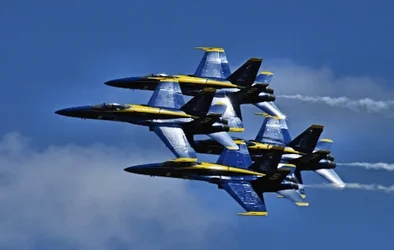
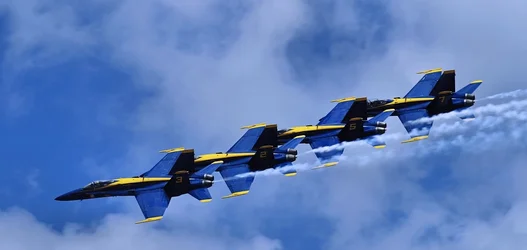
small 2.webp small upload.webp
 
Either way that's crazy-tight formation flying!
 
Mach 1 is the speed of sound.
If they fly faster than Mach 1 they break the sound barrier and cause a big BOOM ! ! !
Which is why they're not allowed to exceed Mach 1.

FWIW - the speed of sound is a variable affected by air temperature, pressure, and humidity.
"In dry air at 20 °C (68 °F), the speed of sound is 343.2 meters per second (1,126 ft/s; 1,236 km/h; 768 mph; 667 kn), or a kilometer in 2.914 s or a mile in
4.689 s."
Speed of sound - Wikipedia, the free encyclopedia.
 
The 2nd shot is very good. You shouldn't worry about compression effects from your 300 mm lens since no such thing exists. Lenses don't produce compression effects. What you're referring to as perspective compression is solely a function of your position relative to the subject -- your distance. All lens focal lengths would render perspective between the planes identically from the same camera position. Perspective is not a lens function it is entirely a function of camera placement in relation to the subject. Attributing it to the lens is a common misunderstanding.

Joe
 
Mach 1 is the speed of sound.
If they fly faster than Mach 1 they break the sound barrier and cause a big BOOM ! ! !
Which is why they're not allowed to exceed Mach 1.

So is that a yes or no? :1247: At NAS Pensacola, there is a wide paved area between the grandstands and the buildings were I was standing taking pictures. The one that got me, had come in behind me over the gulf. He kicked in the after burner and jammed the throttle to the wall just after he crossed above me as he went into a straight up launch in front of the grandstands, where he met the other three coming from opposing directions. It may not have been a sonic boom, but let me tell you I felt it in the bones, and it took everything my wife and I had to keep standing. After that everyone in the area kept looking over their shoulders.

You shouldn't worry about compression effects from your 300 mm lens

I'm sorry I'm new to this forum, and I forgot that some might not recognize my lame attempt at humor. They're flying so close they look like one, whether through the lens or eye, so it was a rhetorical question. I stand corrected on my improper terminology.
 
Amazingly, its possible to get even closer.
 
At just under Mach I, If there's only 18" from the wingtip to the canopy of the plane next to it, should I really worry about compression effects from the 300 mm lens I was using?

A train leaves from California travelling at 150mph. Another train leaves from Boston travelling at 135mph. How old am I?
 
At just under Mach I, If there's only 18" from the wingtip to the canopy of the plane next to it, should I really worry about compression effects from the 300 mm lens I was using?

A train leaves from California travelling at 150mph. Another train leaves from Boston travelling at 135mph. How old am I?
Squirrel.
 
If you'd like to see just how close they are, take a look at this Youtube video... it's absolutely amazing...

 
If you'd like to see just how close they are, take a look at this Youtube video... it's absolutely amazing...

but the OP did see how close they were in person and quoted they are only 18" apart from each other.

upload_2016-4-18_10-50-20.webp
 
Last edited:
If you'd like to see just how close they are, take a look at this Youtube video... it's absolutely amazing...

but the OP did see how close they were in person and quoted they are only 18" apart from each other.

Agreed, and the OP also asked "Is it lens compression or are they really that close". That video provides an additional perspective for the OP. Just trying to be helpful.
 
If you'd like to see just how close they are, take a look at this Youtube video... it's absolutely amazing...

I hadn't seen this one before, thanks for sharing. If you've ever seen them in action from the ground, it's amazing how deceptively slower everything is from the cockpit. The precision these guys have is unreal. Will be back down there the first of the month, hopefully they'll still be practicing.
 
Seeing them perform in person is on my bucket list. :)
 
but the OP did see how close they were in person and quoted they are only 18" apart from each other.

Per the announcer and the FAQ, I doubt I could move fast enough to check that fact.
 

Create an account or login to comment

You must be a member in order to leave a comment

Create account

Create an account on our community. It's easy!

Log in

Already have an account? Log in here.

Back
Top Bottom