What's new

Landscapes in low light

snapsnap1973

TPF Noob!
Joined
Jan 18, 2013
Messages
147
Reaction score
4
Location
Portland, Maine
Can others edit my Photos
Photos NOT OK to edit
How do you shoot landscapes if there's not much light? I was told you shoot shoot landscapes at a with a higher F stop, but wouldn't that make it harder in lower light conditions?

Say it's a cloudy day for example, what should be my F stop, shutter speed and ISO?

Just something rough to go by.
 
It's about achieving a balance using the three legs of the exposure triangle.

Close down the aperture? Compensate for it by using a longer shutter or higher ISO.
 
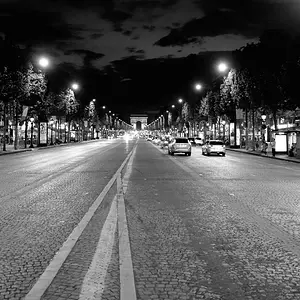
If you're trying to shoot a night country landscape with no moon and no artificial lights, you will probably need something like 32 minutes at f/8 at ISO 400 to get it to look like "daylight". But most people want their night shots to look like night, so probably 2 minutes at f/8, ISO 400 will be a good starting point.
 
If you're trying to shoot a night country landscape with no moon and no artificial lights, you will probably need something like 32 minutes at f/8 at ISO 400 to get it to look like "daylight". But most people want their night shots to look like night, so probably 2 minutes at f/8, ISO 400 will be a good starting point.
32 minutes? What are you smoking? Just saying bro....


Start out with F9 on your cam but use a tripod. Work your way up from f9 and see how they turn out/ 100 ISO will give best photos...
 
If you're trying to shoot a night country landscape with no moon and no artificial lights, you will probably need something like 32 minutes at f/8 at ISO 400 to get it to look like "daylight". But most people want their night shots to look like night, so probably 2 minutes at f/8, ISO 400 will be a good starting point.
32 minutes? What are you smoking? Just saying bro....


Start out with F9 on your cam but use a tripod. Work your way up from f9 and see how they turn out/ 100 ISO will give best photos...

The conditions I describe would give an EV of about -6, that is to say, no artificial light, and the light provided only by starlight. Under those circumstances, you do need a very long exposure to record enough light reflecting off the ground to give the image an exposure equivalent to 18% grey. Now if I was shooting the stars under the same conditions, I would have a much shorter exposure.
 
It's not just about the lens aperture.
The point of focus (PoF) used in landscape shots is rarely close to the camera.
DoF (depth-of-field) get deeper as PoF distance increases, even if the lens aperture used is a relatively large aperture like f/2.8 or f/4.
Lens focal length also affects DoF so a larger lens aperture and as lens focal length gets shorter.

The far limit of the DoF using a 50 mm lens on a 1.6x crop factor camera that is set to f/2.8 will be at infinity when the PoF is 155 or more feet from the camera.
Using a 24 mm lens on the same camera and at f/2.8 the far limit of the DoF will be at infinity when the PoF is as close as 40 feet from the camera.

You can check this by plugging numbers into a DoF calculator.

Note f/2 is a bigger number and a 4x larger lens aperture than f/8 is, because those numbers are fractions. F/2 means the lens aperture diameter is 1/2 the lens focal length. Or put another way, f/ represents the lens focal length and they use the f/ because not all lens are the same focal length.
 
Last edited:
The tripod is your friend.

Remember... if the subject isn't moving (and let's hope it's not or else you're having an earthquake) and if the camera isn't moving... then you have all the time in the world to capture that shot using available light.

There is a different problem at sunset or on some overcast days where the sky or clouds will still be bright, but the land will seem dim. The camera will tend to under-expose the land and if you bring up the exposure to get the land bright, then the sky is overexposed.

To compensate for that, you can either (a) use HDR, or (b) use something called a "Gradient Neutral Density" filter (or "Grand ND" or just "GND" for short.) This is a filter which is clear on one half, but tinted on the other half. It allows you to bring down the brightness on the sky without bringing down the brightness of the land. This helps balance the exposure differences between sky and ground. These filters are usually rectangular and slide into a holder that threads onto the front of your lens.
 
Thanks all a lot of great info! I gotta start using that tripod my mother got me for Xmas and do some longer exposures at dusk!
 
So when again should I use a tripod as far as exposure speed? Certain time and under?

Also, if I'm using a tripod and a longer exposure then I shouldn't touch the camera to push the shutter button?

How do I set the camera's timer to shoot for me if I'm using a slow shutter? To lazy to RTM.
 
So when again should I use a tripod as far as exposure speed? Certain time and under?

Also, if I'm using a tripod and a longer exposure then I shouldn't touch the camera to push the shutter button?

How do I set the camera's timer to shoot for me if I'm using a slow shutter? To lazy to RTM.

crap, I should've just looked here
 
If you are shooting long exposures you'll want to use your tripod when the shutter speed starts getting near 1/80th sec or 1/focal length (rule of thumb to prevent camera shake handheld)

If you do long exposures its worth getting a remote shutter release so you don't have to touch the camera at all (I tend to carry two: wireless for convenience and a wired backup just in case). The timer will do in the meantime though.

It's also worth looking at how to enable mirror lockup (to prevent slap making your images soft): it'll be in your manual.

Oh, and you'll want to look into filters. They really can make a big difference in landscape photography
 
How do you shoot landscapes if there's not much light? I was told you shoot shoot landscapes at a with a higher F stop, but wouldn't that make it harder in lower light conditions?

Say it's a cloudy day for example, what should be my F stop, shutter speed and ISO?

Just something rough to go by.

Basic: ISO 100-200 (Canon 100/Nikon 200), F8-16, Shutter 15-90 seconds. You will need a tripod and a remote shutter button if all possible. If you don't have a remote shutter button, use the built in timer.

Laymen's term/explanation, the idea with the wider/open F/Stop and longer shutter time is to allow the light to slowly soak. This is used on static or stationary scenes. Now clouds are always moving this will show some motion...makes them look softer or smoother. This has the same effect on water, the ripples/waves end up smoother.
 

Create an account or login to comment

You must be a member in order to leave a comment

Create account

Create an account on our community. It's easy!

Log in

Already have an account? Log in here.

New Topics

Back
Top Bottom