What's new

Larger sensor just a luxury?

To go back to the original contretemps, the main problem has been that we have had a failure to communicate. The OP seems to have read something somewhere, partly understood it, and tried to discuss it without explaining it very well. All that stuff about lens size and how much light? Is it a vague way of saying that you could make comparisons between formats by keeping the diameter of the entrance pupil the same. That's not an entirely invalid way of comparing. The smaller the format the faster the practical lens. When I shot 16 mm movie film my standard zooms were an f/1.1 2.5x, an f/1.6 5x and an f/2.2 10x - these were quite common lenses and none of them were unweildy. Their extra speed offset the greater DoF of the small format - or conversely the smaller format meant that the speed was not such a disadvantage when you wanted deep focus. (Of course it is always difficult to go beyond about f/0.9 even for very small formats, so that sets a limit to the comparison.)

Doing a 'same picture from the same place, enlarged to the same size' format comparison then looks different, and it isn't heretical or novel. Consider a comparison between full frame and a 2x crop sensor (for ease of calculation).

Lenses: 50 mm at f/2 vs 25 mm at f/1 - field of view the same, DoF the same ( ie same picture from same place), but the smaller format image is two stops brighter. That means that the sensor can be two stops less sensitive to use the same shutter speed at the same scene brightness. Is this beginning to make more sense - is this what the OP is trying to talk about?
 
Echoingwhisper,

I can't speak for anyone else, but I would find it easier to discuss this issue with you if you were able to explain your theories in a clearer manner. You seem quite confused, and you use vague and confusing phrases, such as "If the smaller sensor use a lens as large as the large sensor, it will get the same light." In this example, could you try to be more specific about the 'size' of the lens - if you mean its image circle, then say so, and also say whether the f-number stays the same or not. When you say 'same light' can you be more specific about what you mean - for example, do you understand enough to use terms like 'luminous flux' and 'illuminance' (or radiant flux and irradiance, if you wish)?

Best,
Helen

At the same equivalent focal length, and lens with the same size, the radiant flux would be the same no matter the size of the sensor. The total amount of light landing on a the sensor (radiant flux) determines the SNR, not the illuminance (which is determined by the fstop). If the radiant flux of both FX and DX sensor is the same, then their SNR would be the same (though FX sensor might get a bit advantage due to less gaps between pixels, but that is likely going to diminish due to technological advances).

I'm not sure about the terms I'm using, but understand it from the definition from Wiki.

So am I right? If not, can you explain to me how I am wrong? Using those terms you gave me to explain it would make it even clearer.
 
To go back to the original contretemps, the main problem has been that we have had a failure to communicate. The OP seems to have read something somewhere, partly understood it, and tried to discuss it without explaining it very well. All that stuff about lens size and how much light? Is it a vague way of saying that you could make comparisons between formats by keeping the diameter of the entrance pupil the same. That's not an entirely invalid way of comparing. The smaller the format the faster the practical lens. When I shot 16 mm movie film my standard zooms were an f/1.1 2.5x, an f/1.6 5x and an f/2.2 10x - these were quite common lenses and none of them were unweildy. Their extra speed offset the greater DoF of the small format - or conversely the smaller format meant that the speed was not such a disadvantage when you wanted deep focus. (Of course it is always difficult to go beyond about f/0.9 even for very small formats, so that sets a limit to the comparison.)

Doing a 'same picture from the same place, enlarged to the same size' format comparison then looks different, and it isn't heretical or novel. Consider a comparison between full frame and a 2x crop sensor (for ease of calculation).

Lenses: 50 mm at f/2 vs 25 mm at f/1 - field of view the same, DoF the same ( ie same picture from same place), but the smaller format image is two stops brighter. That means that the sensor can be two stops less sensitive to use the same shutter speed at the same scene brightness. Is this beginning to make more sense - is this what the OP is trying to talk about?

Yes, exactly. My English isn't very good. :/
 
EchoingWhisper said:
Longer focal length doesn't create less DOF at the same magnification. Larger sensor do seem to use to get less DOF because you could go closer to the subject at the same focal length. But a DX lens at the size of the FX lens but only covering the frame of DX would have similar DOF.

Lol, now that's stretched logic... The "real world" answer is that a 50mm achieves the same PRINT magnification on fx as a 35mm does on dx, and the 50mm on fx has noticably shallower dof due to greater OPTICAL magnification.

In the real world we care about prints not optical math. If people only printed photos to the exact deminsions of their sensor the OP would make sense, but they dont.
 
(One of our cats has just got sick - the poor little thing threw up all over the bed and woke me up. Funny how it's always me that gets woken up by the cats...)

I thought you meant entrance pupil. I think that learning a few of these optical concepts would not only help you get your thoughts across, but also help with your general understanding.

Anyway, yes, if the entrance pupil is fixed, then the luminous flux is fixed: it's a very simple relationship to conceptualise. The light from an object point spreads out and part of it goes through a hole and then gets focused onto the image. That hole is the entrance pupil, and the area of it determines the rate at which light energy passes through it and on to the image, if it stays in the same location. For a fixed entrance pupil size and location, the luminous flux from an object point will be the same, regardless of the focal length of the lens. (That's why entrance pupil size can be more important than f-number in astrophotography.)

Oops, she's thrown up again. Time to clean up...

(Oh, and if you keep the same entrance pupil diameter - 'lens size' as you were calling it - and field of view, the DoF is indeed the same between formats.)

Coverage is a red herring, and it is also a relephant.
 
EchoingWhisper said:
Longer focal length doesn't create less DOF at the same magnification. Larger sensor do seem to use to get less DOF because you could go closer to the subject at the same focal length. But a DX lens at the size of the FX lens but only covering the frame of DX would have similar DOF.

Lol, now that's stretched logic... The "real world" answer is that a 50mm achieves the same PRINT magnification on fx as a 35mm does on dx, and the 50mm on fx has noticably shallower dof due to greater OPTICAL magnification.

In the real world we care about prints not optical math. If people only printed photos to the exact deminsions of their sensor the OP would make sense, but they dont.

I don't wanna debate again. - just giving you a link - http://www.thephotoforum.com/forum/beyond-basics/267282-focal-length-depth-field.html
 
(One of our cats has just got sick - the poor little thing threw up all over the bed and woke me up. Funny how it's always me that gets woken up by the cats...)

I thought you meant entrance pupil. I think that learning a few of these optical concepts would not only help you get your thoughts across, but also help with your general understanding.

Anyway, yes, if the entrance pupil is fixed, then the luminous flux is fixed: it's a very simple relationship to conceptualise. The light from an object point spreads out and part of it goes through a hole and then gets focused onto the image. That hole is the entrance pupil, and the area of it determines the rate at which light energy passes through it and on to the image, if it stays in the same location. For a fixed entrance pupil size and location, the luminous flux from an object point will be the same, regardless of the focal length of the lens. (That's why entrance pupil size can be more important than f-number in astrophotography.)

Oops, she's thrown up again. Time to clean up...

(Oh, and if you keep the same entrance pupil diameter - 'lens size' as you were calling it - and field of view, the DoF is indeed the same between formats.)

Coverage is a red herring, and it is also a relephant.

Hope your cats are alright!

Yes, the DoF should be the same between format.
It is the photographer who alter the DoF when he/she try to frame the subject in the same way when using different format. So a head shot photo in larger format should have a shallower DoF than a smaller format (same head shot framing) because the subject to camera distance decrease when shooting with larger format medium.
 
(One of our cats has just got sick - the poor little thing threw up all over the bed and woke me up. Funny how it's always me that gets woken up by the cats...)

I thought you meant entrance pupil. I think that learning a few of these optical concepts would not only help you get your thoughts across, but also help with your general understanding.

Anyway, yes, if the entrance pupil is fixed, then the luminous flux is fixed: it's a very simple relationship to conceptualise. The light from an object point spreads out and part of it goes through a hole and then gets focused onto the image. That hole is the entrance pupil, and the area of it determines the rate at which light energy passes through it and on to the image, if it stays in the same location. For a fixed entrance pupil size and location, the luminous flux from an object point will be the same, regardless of the focal length of the lens. (That's why entrance pupil size can be more important than f-number in astrophotography.)

Oops, she's thrown up again. Time to clean up...

(Oh, and if you keep the same entrance pupil diameter - 'lens size' as you were calling it - and field of view, the DoF is indeed the same between formats.)

Coverage is a red herring, and it is also a relephant.

Hope your cats are alright!

Yes, the DoF should be the same between format.
It is the photographer who alter the DoF when he/she try to frame the subject in the same way when using different format. So a head shot photo in larger format should have a shallower DoF than a smaller format (same head shot framing) because the subject to camera distance decrease when shooting with larger format medium.

But that is offset by the larger fstop of smaller formats with the same entrance pupil size.
 
(One of our cats has just got sick - the poor little thing threw up all over the bed and woke me up. Funny how it's always me that gets woken up by the cats...)

I thought you meant entrance pupil. I think that learning a few of these optical concepts would not only help you get your thoughts across, but also help with your general understanding.

Anyway, yes, if the entrance pupil is fixed, then the luminous flux is fixed: it's a very simple relationship to conceptualise. The light from an object point spreads out and part of it goes through a hole and then gets focused onto the image. That hole is the entrance pupil, and the area of it determines the rate at which light energy passes through it and on to the image, if it stays in the same location. For a fixed entrance pupil size and location, the luminous flux from an object point will be the same, regardless of the focal length of the lens. (That's why entrance pupil size can be more important than f-number in astrophotography.)

Oops, she's thrown up again. Time to clean up...

(Oh, and if you keep the same entrance pupil diameter - 'lens size' as you were calling it - and field of view, the DoF is indeed the same between formats.)

Coverage is a red herring, and it is also a relephant.

Hope your cats are alright!

Yes, the DoF should be the same between format.
It is the photographer who alter the DoF when he/she try to frame the subject in the same way when using different format. So a head shot photo in larger format should have a shallower DoF than a smaller format (same head shot framing) because the subject to camera distance decrease when shooting with larger format medium.

But that is offset by the larger fstop of smaller formats with the same entrance pupil size.


What do you mean by offset by larger fstop of smaller format??

fstop stay the same regardless the recording medium.


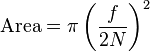
adcd8400b9cff8f5ae4ff1cac2074b07.png


Area of the aperture = Area
f = focal length (do not mix the equivalent focal length)
N is the f number.


As you can see, the area, which determine how much light enter has nothing to do with the recording format.

So if the focal length and the entrance pupil (AREA) keep constant, the f number stay the same.
 
Dao,

I tried to explain the situation that I believe EW is talking about in post #121. It refers to two pictures, each taken on different format from the same place, with the same field of view. The entrance pupils are the same size (ie the f-numbers are different). The DoF is the same.

Best,
Helen

PS, Ginger (the sick cat) didn't throw up any more after that. She seems OK this morning. Thanks for asking!
 
Dao,

I tried to explain the situation that I believe EW is talking about in post #121. It refers to two pictures, each taken on different format from the same place, with the same field of view. The entrance pupils are the same size (ie the f-numbers are different). The DoF is the same.

Best,
Helen

PS, Ginger (the sick cat) didn't throw up any more after that. She seems OK this morning. Thanks for asking!

Helen,

Ok, now I understand. I was talking about same f number with same focal length (=> same entrance pupil size). In order to keep the field of view constant, the photographer need to move. I guess too many things going on.
 
Copyright enfringement is condemned, but canabis use is ok? People is sentenced to ridiculous long sentences for marijuana possession and dealing everyday. The comment is out of place.

Yes. Cannabis use is okay... And no, no one gets sentenced for marijuana possession where I live. It's decriminalized and cops often don't feel like filling out the paperwork. They just tell you to take it elsewhere. Some might confiscate it and break your piece, but that's never happened to me.

Smoking weed never hurt anyone. :thumbup:

You are clearly living a different reality, probably from smoking too much.
Thousands of people die in Mexico so you can safely buy and smoke marijuana.

Inform yourself
 
Last edited by a moderator:
Drug talk ends now.
We don't need it on the site in general and we certainly don't need it derailing a thread. I would also like to advise members that admitting to known illegal activities is not suitable behaviour.
 

Create an account or login to comment

You must be a member in order to leave a comment

Create account

Create an account on our community. It's easy!

Log in

Already have an account? Log in here.

Back
Top Bottom