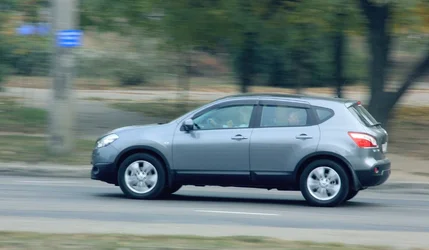
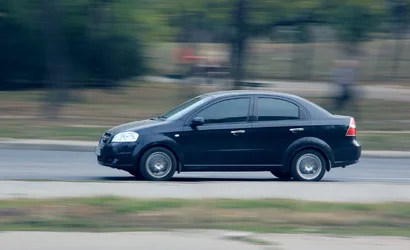
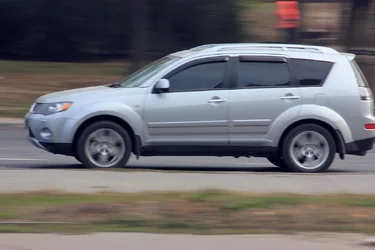
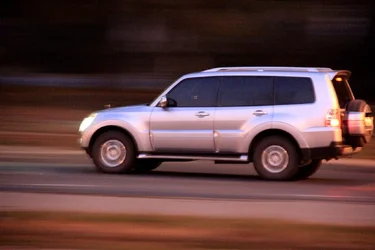
Yes, for a first time, pretty good. One of the most important things in these types of shots is to make sure to leave MORE space in front of the car than there is behind it--that makes it look "good". If the amount of empty space in front of the vehicle is less than that behind the vehicle, it tends to look very weird, odd, or even static.
What's interesting is how the background in a slow-speed panning shot is rendered; your last shot has a dark, simple background, and the light is much lower, later in the day, and the light looks warmer (more yellowish) on the silver vehicle, and I like that. The last shot is also a much slower panning shot, so the background is much more blurred due to the length of time the shutter was open and the camera was swinging. The location where the first three shots were made is "okay", but is not quite the best kind of background for panning shots of cars.
I used to shoot a lot of bicycles this way, 25 years ago, using slow, 64 ISO film. One thing I found, at slower speeds like 1/3 to 1/8 second...it's easier to swing the camera along and sight by looking right over the top of the pentaprism and NOT through the viewfinder on an SLR< since the finder is BLACK during the exposure. The slower the panning speeds are, the easier it is to lose track of the subject and swing too fast, or too slow; the secret to a good, reliable panning shot is to keep the camera moving along at EXACTLY the speed of the vehicle. Swing along in perfect speed synchronization is easy when the speeds are fast, like 1/125 or 1/60 or even 1/15. But once the speeds get into the slow range, like 1/8, and certainly 1/5,1/4,1/3 second, down to 1 second, it becomes MUCH easier to as I said, sight right over the top of the pentaprism., which keeps your eye on the subject. Try this and you will see, it works great!
I hope you continue with this effort, and that you do try some of the very slow-speed pans, like 1/6 to 1/3 second.




![[No title]](/data/xfmg/thumbnail/31/31750-f3936d67895e1ef2756eb06d7b15fe9c.jpg?1734160469)

![[No title]](/data/xfmg/thumbnail/34/34114-dd12be026979ccd4182c5f478bd91448.jpg?1734164566)
![[No title]](/data/xfmg/thumbnail/37/37609-a1984365804384f841d8245ae7e3b9a7.jpg?1734170735)