Yes, it is nervous bokeh. It's a characteristic of the Canon 50mm 1.8 EF-II lens and its overcorrected spherical aberration, which makes the images very sharp, and the clunky five-side diaphragm that the lens also has. Nervous bokeh doesn't look too awfully bad on a smooth, monochrome hedge like you have in your photo's background. Some backdrops would have made it much more intrusive.
Nikon's 28-200 G series zoom has the same issue of overcorrected spherical aberration, which makes the lens bitingly sharp at its best focal lengths, but it does not have the 5-bladed diaphragm like the 50 EF-II, but a 7-bladed one.
This article compares Canon's 50.1,4 EF versus their 50/1.8 EF-II, and has some nice photos that show how a 5-sided aperture renders out of focus highlights in the background
Canon EF 50mm – F1.4 vs F1.8 MK II - photo.net
One of the odd things about bright,green hedges is that the leaves themselves often have subtle highlights on them from the sky, small reflections if you will, that will disappear with a polarizer is used. Those highlights tend to render badly with the 1.8's five-sided aperture, not as graphically as with the lights at night as shown above, but enough so that the bokeh is not creamy, and the rendering is not what is called "with a roundness of detail". Canon's 85/1.8 EF gives much smoother bokeh than their economy 50/1.8. One of the *worst* 50mm lenses for bokeh is the expensive Zeiss 50mm f/1.4--it has a Double Gauss optical formula, and is very sharp, but the bokeh is extremely harsh and hashy.



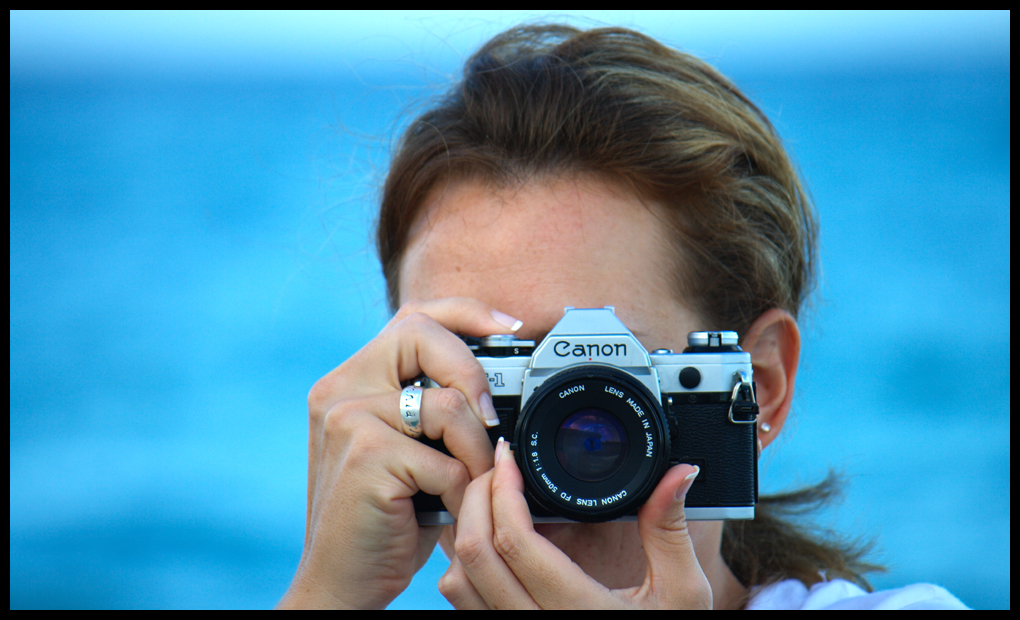
 I didn't really want to "pose" her, so we were just walking around taking pictures of each other.








![[No title]](/data/xfmg/thumbnail/40/40306-ea393f71adcd88a9abb9fb16dc6af2d5.jpg?1734174714)