What's new

NEF Mode.. Yikes.. how do I undo that?!!

Hiding head in shame.. Im so bad. .. ..
 
I know im losing image quality. and its a shame.. This stuff is going to stick someday.. Im sorry my details are lost. Like I told my DH. Its like learning to speak a very complicated language. Im definitly not fluent yet.
 
Yes Im a Noob.. and yes I still not understanding everything. So Im unfortunately.. probably wont learn everything .. well it wont stick anyways. unless I just repeat repeat repeat. Learning.. My camera is less than a month old. Im sorry if Im trying the patience.. lol.

Nope, you aren't trying anyone's patience. We ALL started at the beginning and we ALL had to learn the basics. We ALL made mistakes and we ALL learned from them. We ALL had trouble getting things to stick in our minds, and we ALL manged to get through it by repetition. Don't sweat it, take it one step at a time and learn from your mistakes.
 
I'm just sad. the opportunity for a great pic was there but I'm missing the boat with my execution . tapping when I should be swinging and and smashing when I should be finessing. blundering.. That hawk came out of no where and was swooping the field within easy reach of someone who knows what they are doing.. F8 or 11 then?
 
Last edited:
Well, if it makes you feel any better, I've been shooting for more than 50 years, and I still make at least one boner (photographically speaking of course) almost every day. Except with all that experience, I figure out what I messed up pretty quickly. And Scott hit it right - Don't sweat it. Keith also has it right - go to your manual and read it thoroughly. And again. And again. Of course, taking pictures the whole time you're going through it is probably an excellent way to make sure that what you're reading is sinking in. If you're really not happy with what you're getting, put the camera into auto mode. Get a bunch of pictures exposed by the algorithms programmed into the camera. Then, start taking back some control by going into one of the semi-auto modes (aperture-priority is a good one). Try to be systematic about it, varying only one thing at a time and seeing what that change affects. Fairly quickly you'll start seeing the patterns.
 
CSC_1047 | Flickr - Photo Sharing! That was a priority.. Was it because the ISO was too low or that the aperture was wrong.? . Like I said I had no time to adjust it and he was there. It looks 2 dimensional instead of 3d.
 
CSC_1047 | Flickr - Photo Sharing! That was a priority.. Was it because the ISO was too low or that the aperture was wrong.? . Like I said I had no time to adjust it and he was there. It looks 2 dimensional instead of 3d.

Focus is off. Not sure by how much (if you cropped then it's probably not off by very much). If your lens is a bit soft (depending on which lens you're using), that can contribute to the appearance of lack of focus. If you shot in RAW and boosted your exposure later that could also influence things. If you're shooting as jpeg and not in RAW, you'll eventually want to learn how to edit RAW files (not too complicated at all) -- but as far as this photo goes, I think the main thing is the focus was off.
 
CSC_1047 | Flickr - Photo Sharing! That was a priority.. Was it because the ISO was too low or that the aperture was wrong.? . Like I said I had no time to adjust it and he was there. It looks 2 dimensional instead of 3d.

Well just a guess but I think you may have missed the focus point on this one - my guess is the focus point was probably set for the center and the lens was focusing on something other than the bird. Since the aperture is pretty wide open here, 4.5, and the bird is not on the same horizontal plane as the object that the camera was focused on (most likely the sky) the bird is out of focus. A higher F stop would have brought the bird more into focus despite the missed focal point but of course that also decreases the light coming into the lens, which will eventually lower the shutter speed, and if your shutter speed gets low enough then it starts adding in motion blur.

Ok, first, take heart. A bird in flight is one of the most challenging things to try and capture in wildlife photography. I have so many where I've missed the focus point or had some other mishap it's not even funny. Generally you don't have a lot of time to react and as a result getting good shots of birds flying is not an easy task even for a veteran wildlife photographer. One thing that can help in a situation like this, assuming you have the time, is to switch the camera's autofocus settings to Autofocus-Area. When your shooting birds against a nice blue sky it generally works great.

Shooting birds in trees? Eh, not so much. Then the autofocus gets confused and will often pick the wrong area to focus on - that's when your better off choosing your own focus point. Also you can often use post processing software to apply sharpening filters and make other edits that will make a big difference for shots like this - I grabbed a copy from flickr and did a quick and dirty edit for you to show you what I mean, just used photoshop and applied a sharpening filter to it and adjusted the contrast a bit. Could probably do better with a bit more time but this was just a real quick adjustment to show how much of a difference a little post processing could make. I'll attach a copy of the edited version for you and then delete it from my drive.
 
Last edited:
I prematurely shot.. Lol. Not giving it enough time to focus then. Before pressing completely. I was too excited!lol
 
As so many others have said, you're not trying anyone's patience and you absolutely have NO reason to "hang your head in shame," lol! You are learning, and it simply takes practice to learn any new skill. Sometimes something clicks with just a little practice; sometimes it takes much, much longer.
I've been involved in photography on some level for MANY years, and got really serious about it nearly two years ago now. I've been doing a LOT of bird photography for about 18 months. So, getting my settings right for good exposure may be relatively easy for me, and knowing HOW (though not always executing it!) to get decent bird shots may be second nature, but there are plenty of things I'm clueless about! My current learning curve is being realized on off-camera flash; I'm still struggling to get to where I truly understand how to use my flash to really enhance portrait work.
So yeah, there's always something all of us could still stand to learn--at least you're working on learning!

On that shot you mentioned: Your shutter speed was really high--usually people don't use a shutter speed that's fast *enough* but yours was too fast. I'd say anything between about 1/1250 to 1/2000 would have been just fine to capture the bird, and it *might* have helped to bump your aperture a bit, maybe a stop or two at least; that may have made it a little easier to get focus. Pan with the bird and TRY to focus right on the eye.

You certainly have one thing in your favor--you're willing to post here and ask for help and advice!

I've now realized that nothing I've said really had a thing to do with your actual question about NEF files--sorry about that! Perhaps I should hush and wait until you actually ASK a question about a particular photo before spouting off. :D

Welcome to Hotel TPF, by the way!
 
A HUGE part of advanced photography as a hobby is the constant CHALLENGE in improving your skills. If you get hooked on the hobby (seems like you already are), then you better buckle in... you've got at least 20+ years of challenges ahead of you lol. God forbid you get addicted to snapping wildlife in general... it's unpredictable and VERY challenging in general!

Just stick with it and the learning process will be very rewarding. The frustration just comes with the reward. A word of advice: Save all of the images that you have now that you think are your "very best" and then go back and look at them in 1 month, 6 months, 1 year etc. Critique what's good and bad about the images and you'll quickly realize how quickly your skills are improving.
 
CSC_1047 | Flickr - Photo Sharing! That was a priority.. Was it because the ISO was too low or that the aperture was wrong.? . Like I said I had no time to adjust it and he was there. It looks 2 dimensional instead of 3d.

Looks like a good Northern Harrier, I believe it's a juvenile one too.

nothing wrong with your aperture or ISO, you did well keeping your shutter speed up, but you just missed focus on it. exif says 150mm, I'm guessing this was heavily cropped unless the flyby was really close to you?

probably a contributor to why you missed focus is your focus settings, I'm guessing they are all as the factory set them? I've never really liked AF-A (the factory default) mode personally....

it just takes practice and learning. the better you get, the higher percentage of keepers you'll get, but everyone misses shots here and there in wildlife shooting. BIF (bird in flight) shots are some of the most difficult ones too...

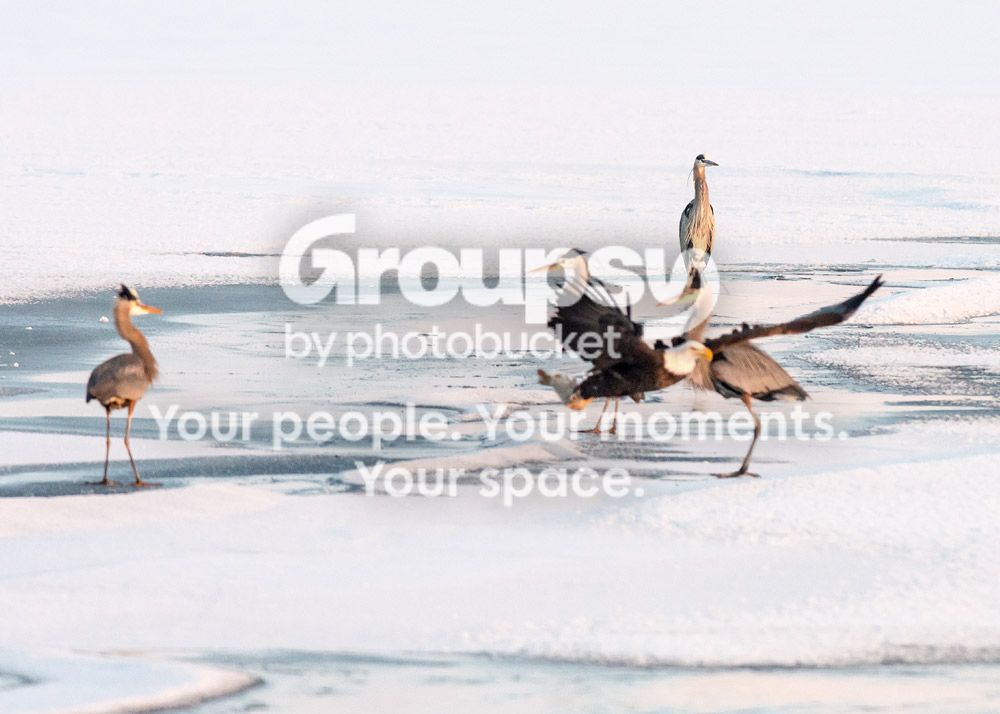
here's a great action image that I VASTLY missed focus on, I was shooting the eagle stealing a fish from the group of great blue herons, and accidentally hit focus on the background heron instead of the eagle! argh, it still bothers me...
eagle5_zpsbd26fafb.jpg~original
 
I think everyone feels that their particular photographic niche is the most difficult. I know that as a bird and wildlife photographer I like to convince myself that this niche is difficult, but fast-paced sports are difficult, portraits are difficult, weddings are difficult, they are ALL difficult in their own way. Just keep in mind the old saying" If it were easy anyone could do it. This is evident in the millions of crap photographs on Facebook and other places. You've chosen to take a step up and move away from the mundane point-and-shoot "Stuff" that anyone CAN shoot to the next level of photography where the burden is on you to make the difference between mediocre and good.

The differences inherent between a point-and-shoot and a DSLR are significant and crossing that gap as a photographer can be difficult. Many don't make it and they go back to the ease of a point-and-shoot or a cell phone since it is easier than facing the challenge of learning to use a DSLR to create better photographs. Remember that point-and-shoot cameras got their name because that is truly all you have to do: Point the camera and push the shutter release. Not so with a more advanced system. A DSLR is capable of far better images than a P&S but only when the person behind it is willing to learn to use it properly.

You have a huge advantage over many of us because your camera know a lot more about photography than you do at this point. It has built-in features that you can use to your benefit that many of us only dreamed of when we started out. Take advantage of those tools and learn from them. When the situation allows you to do so take two shots, one in fully automatic mode and one in one of the semi-automatic modes such as Aperture Priority or Shutter Priority or Full Manual. Look at both of them, compare them critically, and figure out WHY the automatic mode shot looks better than the others. At some point you'll start to notice that the photos you shoot in a semi-auto mode or manual look as good or better than the auto-mode shots and that's when you know you are really starting to learn and improve.

As I mentioned above, we ALL had to start somewhere but you have the advantage of a built-in mentor in your camera. Use that and learn from it. Trust me, it was a LOT more difficult decades ago.
 
I agree with Scott, all genres will be 'difficult' in one aspect or another, so saying one specific type of photography is difficult doesn't really mean others are 'easy' it just means they are different...and each photographic genre will take a different specialized skill set along with the knowledge of general photography, and equipment usage, etc...

OP, what would benefit you a lot is to read through your camera manual and find out how to change your settings, and how to access them quickly...and try out different settings, find what works best for you, your skills and technique. we all could tell you what AF settings we use, and what metering settings we use, but for the most part everyone will have something different that works for them, and the way we found what works best is by experimenting. and like scott mentioned, when you're looking at automatic or semi-automatic modes, pay attention to what the camera is doing, is it raising the ISO? changing apertures? shutter speeds? and understand why it is doing it, and even try switching to manual mode and trying it yourself, and don't feel bad or worried about making mistakes, take the mistakes, analyze them, and learn from them...even non-mistakes, how could they be improved, what makes it good that you can continue to expand on in future shoots? stuff like that...

and don't hesitate to ask questions either, there is a wealth of knowledge on the boards here that are willing to help, but be willing to accept the critique and help that is offered (people who get into arguments/issues on the board typically expect nothing but praise and get defensive when people don't fawn over their images.)
 
I look at photos and know I have leagues to go .. Lol no worries I know even if I take a technically great photo. Maybe the subject matter won't be appealing to everyone. Art is like that. I'm just trying to master the technicals right now.. I know I probably like a hunter need to aim where I see it's going and half press for focus once focused press to take the pic. Just want that photo though frustrating when the shot is missed. I'm having trouble with lower shutters right now. So I'm sledgehammering my action photos ..with to high a shutter speed. I will start taking two shots though auto and a priority or c model when I can. :)
 

Create an account or login to comment

You must be a member in order to leave a comment

Create account

Create an account on our community. It's easy!

Log in

Already have an account? Log in here.

New Topics

Back
Top Bottom