Why is it that no powershots (or similar) has been made (from manufacturers) with a sensor capable of very high resolutions? (for example with the 41MP in a superzoom I imagine it would do wonders for capturing details when documenting the smuggler boats far out at sea).
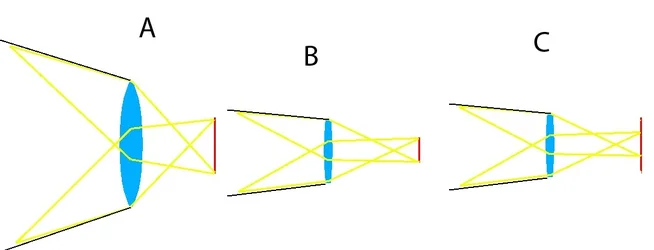
A = A full frame lens made for a full frame 35mm sensor. Let's say this is a 40mm lens, whatever. The yellow lines are the two most extreme points that will show up on the sensor, and the black lines indicate its field of view.
B = A lens of the exact same curvature (40mm), designed for a small sensor. Note that it is massively smaller. Could easily weigh like, 1/10th as much. But the outsides are curved the same amount. Since it is smaller though, the most extreme objects that can be seen are not as extreme. So it's field of view is narrower (by the crop factor). Objects as far out as in A would fall outside the sensor and not be registered.
C = a lens made for a small sensor placed in front of a large sensor. it can still only capture objects in the NARROW range. Thus, it only projects an image on a tiny circle in the middle of the sensor.
The other 90% of the sensor or whatever would just be black.
So why are there no 41 MP superzooms? Well:
1) Superzooms are only possible to make for small sensors. Why? Because look how much smaller that piece of glass is. You're gonna need like 18-25 or so of those pieces of glass to make a decent superzoom, and it's only reasonable with the small pieces of glass. If you had 18-25 of the larger pieces of glass, your lens would weigh a good 70 pounds and cost as much as a house.
2) Lenses are only capable of achieving some maximum amount of resolution. They can't distinguish detail at infinitely small scales. A lens might have, let's say for example, 120 line pairs / mm of maximum resolution, before the glass just isn't perfect enough anymore. Well, if your sensor is 35mm wide, then that means you can have about 8400 pixels across before the pixels stop being useful. But if your sensor is only 10mm across, then you can only have 2400 pixels before more pixels stop being useful, because a millimeter is a millimeter is a millimeter and the glass has the same limits in both cases.
So for a 35mm x 24mm sensor (full frame) in this example, the maximum pixel count that the lens could resolve at = 48 megapixels.
But for the 10mm x 7.5mm sensor (something similar to a small point and shoot or whatever), the maximum pixel count that the lens can optically resolve at = maybe 4 megapixels.
if you have more pixels than your lens can resolve, the pixels are useless. A single maximally small detail from the lens will just smear across multiple pixels without achieving any meaningful extra resolution.
So you have to CHOOSE:
Lots of megapixels that can actually DO anything, OR
A superzoom that is possible because it doesn't weigh 70 pounds.
Why is it that there is not an busy industry of people buying turning in parts to workshops- or classes in how to assemble them into camera equivalents of Frankensteins monster (for example a SX50 with a 41MP sensor from a Lumia) or some other custom made configuration?
Because DSLRs look like this inside:
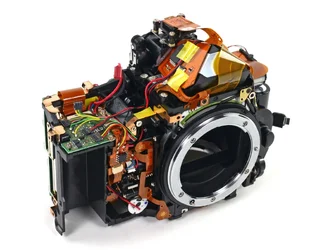
You're gonna need a helluva lot more than a "workshop" to do anything with that other than turn it into an interesting paperweight.
And because doing things like putting a 41MP sensor behind a massive superzoom designed for an 8MP sensor will not work, for optical reasons described in part 1 of this post. All it will do is give you photos that are 90% black with a tiny little image in the middle that is BEST CASE the same as having taken it with the original camera, and WORST CASE even lower resolution and crappier than the original camera (because larger sensors usually don't just add pixels. They have larger pixels as well by some amount, so the number of pixels in the projected image area may actually be lower than in the tinier superzoom camera)
Your magnificent 40 megapixel frankencamera might produce images something like this:












![[No title]](/data/xfmg/thumbnail/41/41926-7b67b67ec3a4ea78149adc9ca76efe76.jpg?1734176285)