Joe I'm going in to this knowing absolutely nothing about your experience level or what problems you're currently facing. Since you have a handle on daylight photography I would think you could at least tell me what's happening if you can't show me.
Some common problems with night photography are blurred subjects, blurred entire images, shallow depth of field, image noise, and exposure.
To answer your original question, you will generally want faster f-ratios and higher ISO, but even that depends on available light. There is no rule of thumb like there is for daylight. The moon is never in the same phase. Each phase has a different amount of light. A single street light is vastly different from shooting in a city with lots of lights. A campfire is different still. The toughest thing about night photography for me is exposure. Exposing properly for somebody standing 10' away from the campfire is going to make anyone closer than 7' overexposed and anyone further than 15' underexposed. Light falloff is extreme compared to daylight photography. Same if you use your flash. Different objects will be exposed based on their proximity to the flash.
The image blurring is fixed by using a tripod or shorter exposures by using faster lenses and/or higher ISOs.
Subject blurring is fixed by shorter exposures by using faster lenses and/or higher ISOs.
Shallow depth of field is caused by using faster f-ratios, so the only way to fix without losing light is higher ISOs or longer exposure.
Image noise is caused by using too high ISOs or too low of an exposure. This is fixed by longer shutter speeds or faster f-ratios.
Everything has a fix at the expense of something else.
Did any of this help in the slightest?
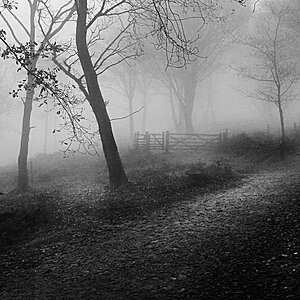
Here is a shot with 3 different light sources: street light, house light, and moonlight. Because of the different light sources, there's no way to get a correct color balance throughout the image, so you kind of have to wing it.





![[No title]](/data/xfmg/thumbnail/31/31746-12607d714ca2713b95250821c881aea9.jpg?1734160460)
![[No title]](/data/xfmg/thumbnail/34/34593-f9e16dc135ec1fcde87624f30e703802.jpg?1734165595)
![[No title]](/data/xfmg/thumbnail/32/32174-b57e340fadfeea99045595146efd64b1.jpg?1734161047)
![[No title]](/data/xfmg/thumbnail/42/42017-05f80a89ca2890969b5dc7cc47872581.jpg?1734176398)

![[No title]](/data/xfmg/thumbnail/34/34591-00eecceb873550182f83f33a45a9460c.jpg?1734165580)