1) Generally, when you hand-hold, you want a wide aperture (low f/number) to get as much light as possible and therefore a shorter shutter speed duration. But when you have the camera on a tripod, your shutter speed can be quite long, so the aperture can be set depending on the depth-of-field you need. As well, as has been pointed out by several posters already, most lenses are sharper somewhere in the middle of the aperture range. This means that you can set the aperture to 1) get the correct DOF you need, and 2) to get a sharper image.
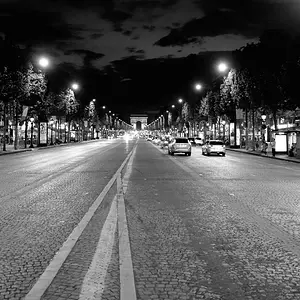
In your case the widest aperture you can get is f/3.5, but the lens will not be sharpest at this value. Better to close the aperture down to f/8 or f/11, and adjust your exposure time accordingly. As for depth-of-field, at f/8, the hyperfocal distance using 50mm focal length is 54 ft., meaning that if you focus on an object at 54 feet, everything from about 25 ft. to infinity will be in focus. This would cover pretty much anything you want to photograph at night.
2) Unfortunately, much to my surprise, your lenses do not have either the distance scale on the barrel, nor any mark indicating the infinity position (I checked the user manuals for the lenses). The best that you can do, is set your mode to Av, set your camera to display Live-view, turn off BOTH the autofocus (AF) and image stabilization (IS), and manually focus (using the 5x or 10x liveview magnifier) on some distant target. If it is more or less 50 ft. away, then you will have adequate DOF for sharp focus from about 25 feet to infinity.
3) When shooting long exposures, it is common to get hot pixels which are individual pixels that are fully on, and other non-linear effects. By enabling thie option C.Fn-4, you are instructing the camera to take two shots one with the shutter open (this records the image), and another exposure called a dark frame, with the shutter closed. The camera then subtracts the artifacts in the dark frame from the first exposure, giving you a cleaner looking image.
Noise is a function of the amount of gain (amplifier) of the signal being read from the sensor array. You see the gain as an increase in ISO, but what is happening is that the amplifier increases both the signal AND the noise. As well, the individual pixels dont all responds exactly the same, so some pixels will have a stronger response, and some weaker. This inconsistency from pixel to pixel is what you see as noise. The way to minimize noise is to increase the signal which is the amount of light each pixel collects. And that is done by lengthening the exposure, allowing each sensor pixel to accumulate more photons before the signal is read out.
4) Proper exposure is determined by the total amount of light, which is controlled partly by the aperture, and partly by the shutter speed. So when the light is low, you need to keep the shutter open for a long time to accumulate enough light to create a strong-enough signal. When your camera is on a tripod, and therefore unmoving, you can keep the shutter open up to 30 seconds using the shutter timer, and longer if you use a remote shutter release and the BULB setting in manual mode.
High ISO is needed when you cannot use the tripod, and therefore must keep the shutter speed short enough to prevent camera shake blur and/or subject motion blur. When hand-holding, your longest shutter speed should be 1/30 sec or more, even with a bright lens, and the only way to get a usable image is either to boost the ISO, or to use supplemental light (flash).



 is highly recommended, since pressing the button to take the picture is often the main source of camera shake and, ultimately, blur. If you don’t have a remote switch for your camera, put your camera in timer mode so the shutter will release a few seconds after you press the button. Canon wised up and added a 2 second timer mode on their newer cameras for this purpose so you don’t have to wait the full ten seconds every time you want a stable release.


![[No title]](/data/xfmg/thumbnail/42/42017-05f80a89ca2890969b5dc7cc47872581.jpg?1734176398)
![[No title]](/data/xfmg/thumbnail/31/31748-63241c520f250328a5ec32959b8f53d0.jpg?1734160467)

![[No title]](/data/xfmg/thumbnail/32/32713-7df5aadb952fa8e00260cc48bbf6ab0b.jpg?1734162330)
![[No title]](/data/xfmg/thumbnail/32/32714-c30959d32073fa735ae7520dd978cd3b.jpg?1734162336)
![[No title]](/data/xfmg/thumbnail/32/32174-b57e340fadfeea99045595146efd64b1.jpg?1734161047)