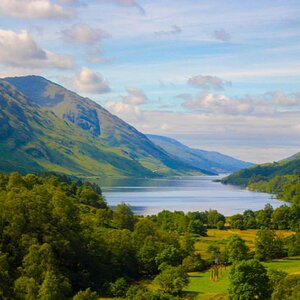
If you wish to improve, I think two technical and artistic suggestions would help you the most. The first suggestion is to avoid so frequently defaulting to the 18mm focal length of your 18-35mm zoom lens (I suspected this, and later when I looked at your EXIF, my suspicion was confirmed on the majority of your images in this post). The 18mm focal length setting makes the foregrounds physically large on-sensor, but it also makes the background objects very small, and less-impactful, as well as increases the physical width of the background angle of view in relation to the foreground width. I find wide-angle landscapes often quite boring, with very little detail visible beyond 20 to 50 feet...this is the single,biggest problem I see in landscape photos from many,many people, especially in this type of forest/woodland type of landscape genre.
The second issue is to avoid using long shutter speeds and creating blurry clouds; frequent use of Neutral Density filtration as a way to create drawn-out shutter times is has now fallen into the category of over-used technique in the modern era, and this type of blurred cloudscape rendering immediately injects the photographer's technical decisions right into the heart of the photo, and steals from the realism of the scene, which I think is counterproductive most times. Too much blurring of water and clouds strikes me as contrived and formulaic. There's a fine line between too much, and just right as far as water goes. When clouds start being rendered as blurry...the shutter time's typically too long. IMO.
When people are, as ac12 writes, "trying to figure out the subject or composition", I think this is often because short focal length lenses used in many landscape scenarios create a wide,vast image, with everything that's beyond 20 to 25 feet being rendered as tiny, and with very little visual impact.
If you want to make better landscapes, start thinking about more frequently using a 35 to 180mm focal length range lens selection on the D800.




![[No title]](/data/xfmg/thumbnail/42/42026-4f14b406e4eb9c886f454721fb021fba.jpg?1734176410)

![[No title]](/data/xfmg/thumbnail/37/37092-c446ffb89610a57384a51ac5254beffd.jpg?1734169827)
![[No title]](/data/xfmg/thumbnail/36/36397-b2aca1c8ba1009853020154d6dd4b0e5.jpg?1734168782)