Light quality and direction are about the 2 most important things to evaluate before you release the shutter.
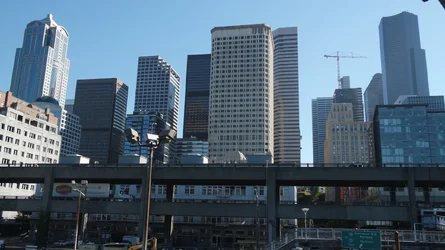
In the cityscape the side of the most of the buildings that are facing the camera are in shadow.
A basic tenet of visual art is "Light advances, dark recedes." The human eye is naturally first drawn to the brighter parts of a scene.
Or put another way our primary subject should have the most visual weight than secondary or tertiary subject matter. One way ensure our main subject has the most visual weight ion a scene is to make sure it is the brightest thing in the scene.
Note too that Joe used editing tools that corrected the distortion (tilted buildings and light posts) induced by the lens you used.
I wonder if you had the camera aimed upwards some, which would add some keystone distortion to whatever distortion your lens has.
I would likely have used an diffused off camera flash to add some fill to the foreground on the second photo.
With my camera on a tripod I could hand hold the off camera flash and experiment with both the height of the flash and it's direction.
The fill light would help accentuate a sense of depth in the scene and separate the edge of the bluff from the background, strengthening the sense of height.




![[No title]](/data/xfmg/thumbnail/36/36666-189f65b1addbb68da2a43dc6f7206a01.jpg?1734169172)