I'll give you the advice my old boss gave me when I was a photography apprentice (and this goes back a couple of years). It was one of the best pieces of advice I ever learned:
When you look through photos (online, in magazines, etc.) you'll find that most of the time you just skim through them. From time to time you'll come across a photo that makes you stop and linger on it for a bit. This is usually called "stopping power". THAT is an image that caught your attention (the rest were just "ok").
STUDY THAT IMAGE! Study everything about how they were posed.
Try to figure out where every light must have been located.
Look at their body positions... in detail (which leg has their weight... which leg is relaxed? Same for arms. Where is their head and how is it angled relative to their shoulders? How are their hips and overall torso positioned? How are the shadows? Where are their eyes looking?
I could go on and on... but hopefully you get the idea.
Posing also isn't a "one size fits all". There are poses that tend to look for feminine vs. masculine (as well as exceptions). But even then... there are deferents based on physical traits. Based on the physical characteristics of the subject, there are techniques to select poses or alter the lighting to suit that particular subject.
For example... if someone has a large nose and you position their face so that the profile of their nose extends beyond the profile of the rest of their face (in other words imagine the photo is converted to a silhouette -- you wouldn't want to see their nose in the silhouette) ... otherwise their nose will look especially large. That's just one example.
You'll probably also want to make sure you have a fairly decent understanding of lighting (use of off-camera lighting, lighting modifiers, etc.). There are techniques for lighting which also vary based on physical traits (how you might light a "round" face vs. a "narrow" face, etc.)
All of this assumes "posed" subjects.
At this point in my life I had worked for the studio for years (I started as an apprentice (mostly carrying gear, reloading film magazines, etc.) at the age of 15. At this point I think I'm probably around 25. I had done hundreds of weddings and I had taken loads of posed photos... and then one day I met Alfred Eisenstaedt at an exhibit of his work (see:
Alfred Eisenstaedt - Wikipedia ) and was asked to get some photos of him with some of the people at the event. So I did what I always do... and was immediately scolded by Mr. Eisenstaedt ... who was STRONGLY opposed to "posed" photographs. He was happy to have me take his photo with others... but was against being "posted" for them. He wanted me to capture life as it happened. I suspect his gentle scolding was his way of giving me some advice on how to capture better images.
Another famous photographer, Arthur "Weegee" Fellig (see:
Weegee - Wikipedia ) had a quote referring to advice on how to capture good photos that is often still used today... "f/8 and
be there". I'll skip the "f/8" part and just talk about "be there".
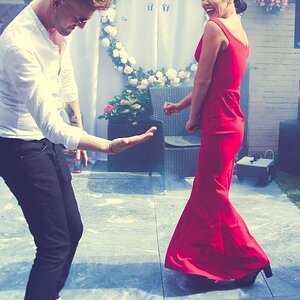
"Be there" is usually accepted as referring to the energy of the event. What's the mood? What's INTERESTING? Identify that mood... and capture it. It doesn't matter if the mood is somber or exciting. Often the act of "posing" people will destroy the mood (or certainly at least fail to capture the mood). From time to time you'll encounter people who mistakenly think that "be there" means you just have to show up.
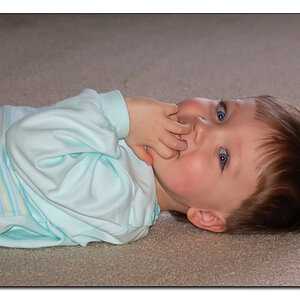
So there's a few things to think about as you develop your style. Certainly learn posing... just keep in mind that compelling photographs often don't just capture an image of the person... they capture the energy along with it.



![[No title]](/data/xfmg/thumbnail/41/41903-5ec48c22a1b66968c94f056b8ad647f2.jpg?1734176268)
![[No title]](/data/xfmg/thumbnail/36/36394-700ff78d7b45c663863e641a9bcf1fe1.jpg?1734168775)