What's new

Question about noise...

JeffieLove

No longer a newbie, moving up!
Joined
Feb 8, 2010
Messages
1,601
Reaction score
15
Location
Elkton, MD
Can others edit my Photos
Photos OK to edit
This is probably a really stupid question... Almost as stupid as "what settings should I use for this situation?"... Anywho, I'm gonna ask anyway just to confirm my suspicions...

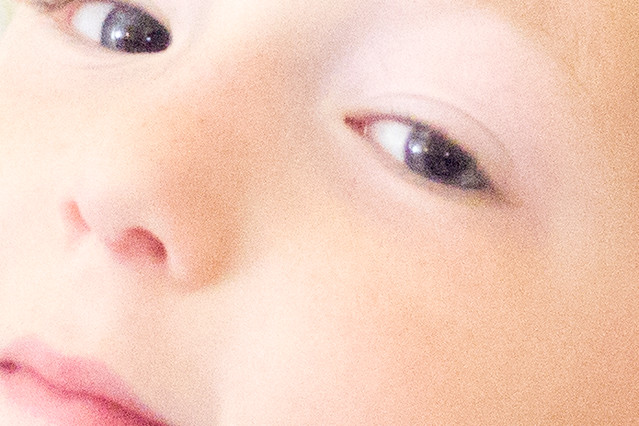
If you have a photo with a lot of noise due to high ISO, will the focus seem somewhat soft even if you know for sure that you had the focal point at the right spot and used a tripod with a lower shutter speed (like 1/40 or 1/15)??

One last edit for settings:
ISO 6400 f/1.8 50mm 1/15SS Exposure Compensation at +2
this is SOOC:

6044263516_b723ef69a8_z.jpg


1:1 crop:
6043714451_c964dc8ea5_z.jpg
 
Last edited:
wow! thats pretty noise for what looks to be such a well lit room. i would obey the 1/focal length rule, use maybe iso 200-400, and maybe a tripod if it calls for it (in that order btw)
 
I was just seeing what my 60D looked like at 6400 ISO. This isn't something I'd do on a regular basis... I had the exposure compensation set to overexpose by 2 stops. There are no lights on in the room ;)
 
LOWER ISO # = Better clarity

What was ur specs on this shot? I would have lowered the ISO shot it a little dark and brought up the color in post... Its better to shoot a little dark and a lower iso. As long as you are shooting in RAW u can bump up the exposure and its not going to lower the quality more than what the higher ISO will do.
 
Yes, excessive noise can definitely make a well focused image look soft. I'd say that's definitely the case with this image.
 
I was just seeing what my 60D looked like at 6400 ISO. This isn't something I'd do on a regular basis... I had the exposure compensation set to overexpose by 2 stops. There are no lights on in the room ;)

HAHA NEVERMIND! now u tell us!
 
LOWER ISO # = Better clarity

What was ur specs on this shot? I would have lowered the ISO shot it a little dark and brought up the color in post... Its better to shoot a little dark and a lower iso. As long as you are shooting in RAW u can bump up the exposure and its not going to lower the quality more than what the higher ISO will do.

This is almost never the case. Raising the exposure in RAW further amplifies the noise that was already converted to a digital data. Raising the ISO amplifies the analog data that the sensor actually captures prior to it being converted to digital data.

In this case, it might be a wash, but generally, to reduce the noise and maximize the sensors capabilities, you shoot the shot as bright as you can without clipping highlights and then reduce exposure in RAW if necessary.

Noise always appears in underexposed areas the most because those in areas the signal to noise ratio of the sensor is very low. Any amplification of an image with a low signal to noise ratio will always result in excessive noise.

Heck, I can easily take a shot at ISO 3200 that has a lot less noise than an image taken at ISO 200 under the exact same lighting conditions with the same subject. It's all about the signal to noise ratio and what you do in post processing.

In any case to reduce noise, the answer is always the same. Maximize the exposure in camera by maximizing the amount of data the sensor can record. This means a longer shutter speed, a larger aperture or adding light.(raising ISO does not increase data to the sensor)
 
Last edited:
LOWER ISO # = Better clarity

What was ur specs on this shot? I would have lowered the ISO shot it a little dark and brought up the color in post... Its better to shoot a little dark and a lower iso. As long as you are shooting in RAW u can bump up the exposure and its not going to lower the quality more than what the higher ISO will do.

This is almost never the case. Raising the exposure in RAW further amplifies the noise that was already converted to a digital data. Raising the ISO amplifies the analog data that the sensor actually captures prior to it being converted to digital data.

In this case, it might be a wash, but generally, to reduce the noise and maximize the sensors capabilities, you shoot the shot as bright as you can without clipping highlights and then reduce exposure in RAW if necessary.

Noise always appears in underexposed areas the most because those in areas the signal to noise ratio of the sensor is very low. Any amplification of an image with a low signal to noise ratio will always result in excessive noise.

Heck, I can easily take a shot at ISO 3200 that has a lot less noise than an image taken at ISO 200 under the exact same lighting conditions with the same subject. It's all about the signal to noise ratio and what you do in post processing.

In any case to reduce noise, the answer is always the same. Maximize the exposure in camera by maximizing the amount of data the sensor can record. This means a longer shutter speed, a larger aperture or adding light.(raising ISO does not increase data to the sensor)


Im sorry I should have explained better what I was trying to say. I had a long response written out and then lost it... I didnt mean dark I more so meant darker like 3 clicks down, still bright enough to capture the detail.
 

Create an account or login to comment

You must be a member in order to leave a comment

Create account

Create an account on our community. It's easy!

Log in

Already have an account? Log in here.

New Topics

Back
Top Bottom