What's new

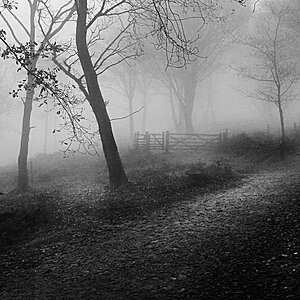
River Flows Past Gollum's Cave....

even yet another thing to consider, do you do the lens profile correction in your raw edit?
 
Ernicus said:
dof is all inclusive man...not just center point and back and forth.

also consider the lens, you may be having fall off as well.

Fall off?
 
Ernicus said:
how close were you in RC Wood 9.jpg ?

About 3...4 feet max
 
what lens you using? 55-200 or 70-300?
 
for that image, one I noticed oof areas, you were 75mm, f/11 at 3 feet. that gives you dof of .2ft. thats like 2.5 inches dude. to try to get you thinking in terms of dof as a whole, not just center, forward, and back....look at that image. there are spots on that wood that are more than 2.5 inches front to back. for instance the knot or knoll in the bottom left vs the cave area of upper right. upper right in in focus...for the most part, bottom left not so much. from point closest to you and point furthest away, looks about a good 3 to 4 inches...clearly not in your dof range.
 
Ysarex said:
Very nice shot.

It's not underexposed so you can keep both your eyes. It is however flat. It' lacks normal contrast. Look at a histogram for the photo (inset illustration) and you'll see that it falls far short of the right corner. That means the photo has no highlights. Simple Levels correction to shift the histogram over (again inset) and balance the tone response.

Joe

<img src="http://www.thephotoforum.com/forum/attachments/general-gallery/13694-river-flows-past-gollums-cave-low_contrast.jpg"/>

I appreciate the critique Ysarex. I have a few comments/questions in return. I only shoot this sort of thing in cloudy skies...always grey. I try to get my pictures to emulate that mood, so I generally use a lot of grey tones. Bright whites I am not too keen on, personally, when it comes to this sort of thing. I am confused about the levels. Is it a rule-of-thumb to make sure you have the entire range of tones in an image/histogram? This is something I have always been unclear on.

Secondly, I used the flat image on purpose, as I thought the flat element would worlk better with this composition. I have about 100 variations of this image on my computer, with all different aperatures. I am having a big focus issue though....something I feel I should know the answer to. I have found that when I use large aperatures, the focus is crystal clear toward the middle, but blurry as hell as you move away from the center of the frame. With smaller f-stops, the edges maintain some sort of focus, which is why this image apperars flat.

Please, any suggestions/tips for getting sharp images on the ENTIRE frame with large f-stops, not just the center. I have resorted to using f9 or f10 for these shots, but this is making me crazy!


You've got two separate issues here and possibly some confusion between them. One issue is tone response and the other is sharpness/DOF across the entire frame.

Let's start with sharpness. First test your lens. If it's a zoom lens you have to expect some degree of sharpness loss out to the corners, but it should clear up pretty well 2 stops down from wide open. To test the lens find a brick wall and put the camera on a tripod in front of the wall at say 15 to 20 feet. Make sure the camera is level to the wall. That's why bricks help -- if you can get all the mortar lines in the bricks straight with the frame edges in the viewfinder you should be pretty level to the wall. Take a sequence of shots at each f/stop (put the camera on A priority). You're hopping to see sharp bricks across the entire frame but don't be too disappointed if the corners fuzz out a little at maximum aperture (unless that lens has a gold ring around the front).

The next complication in the sharpness issue is DOF -- Ernicus gave you a link.

Now tone response: This is not linked to the sharpness issue and/or f/stop in use. Now we're talking about the range of tone from black to white and all the grey tones (colors) in the middle. In terms of technical characteristics upon which a photo is judged good or bad this is the most critical. It's much more than a rule of thumb. The expectation is that a good photo will have as expansive a tonal range as possible and with rare exception it will extend from black to white. There are exceptions to all rules of course but there are few exceptions to this one. The lighting condition (cloudy versus sunny etc.) does not qualify as grounds for an exception. Your choice to take the photo under overcast light is good, but the photo should still make the range from black to white.

Joe

P.S. I see more info was added while I typed. I would expect that lens to exhibit some sharpness loss at the corners, but Ernicus is correct given the conditions you described -- you're likely experiencing some DOF loss.
 
you would need f/20 or f/25 at that distance, and with that lens and your surroundings, you would not have enough light. so...you could have backed up to about 6 feet at f/8 would give you about 1 foot of dof, more than enough for that image and that lens and lighting.

IF...that didn't work...then it is motion blur or something else. But you have to rule out dof before you can even start troubleshooting the other things.
 
Let's start with sharpness. First test your lens. If it's a zoom lens you have to expect some degree of sharpness loss out to the corners, but it should clear up pretty well 2 stops down from wide open. To test the lens find a brick wall and put the camera on a tripod in front of the wall at say 15 to 20 feet. Make sure the camera is level to the wall. That's why bricks help -- if you can get all the mortar lines in the bricks straight with the frame edges in the viewfinder you should be pretty level to the wall. Take a sequence of shots at each f/stop (put the camera on A priority). You're hopping to see sharp bricks across the entire frame but don't be too disappointed if the corners fuzz out a little at maximum aperture (unless that lens has a gold ring around the front).

Joe

Good info, but if you trust others with a lens of equal type, you can see others reviews and not have to do the "test" yourself. Ken Rockwell does great tests. Down toward bottom he covers distortion. He usually used the brick wall method, for some reason on this one he chose a different shot for the test.

Nikon 18-105mm VR
 
Ysarex said:
You've got two separate issues here and possibly some confusion between them. One issue is tone response and the other is sharpness/DOF across the entire frame.

Let's start with sharpness. First test your lens. If it's a zoom lens you have to expect some degree of sharpness loss out to the corners, but it should clear up pretty well 2 stops down from wide open. To test the lens find a brick wall and put the camera on a tripod in front of the wall at say 15 to 20 feet. Make sure the camera is level to the wall. That's why bricks help -- if you can get all the mortar lines in the bricks straight with the frame edges in the viewfinder you should be pretty level to the wall. Take a sequence of shots at each f/stop (put the camera on A priority). You're hopping to see sharp bricks across the entire frame but don't be too disappointed if the corners fuzz out a little at maximum aperture (unless that lens has a gold ring around the front).

The next complication in the sharpness issue is DOF -- Ernicus gave you a link.

Now tone response: This is not linked to the sharpness issue and/or f/stop in use. Now we're talking about the range of tone from black to white and all the grey tones (colors) in the middle. In terms of technical characteristics upon which a photo is judged good or bad this is the most critical. It's much more than a rule of thumb. The expectation is that a good photo will have as expansive a tonal range as possible and with rare exception it will extend from black to white. There are exceptions to all rules of course but there are few exceptions to this one. The lighting condition (cloudy versus sunny etc.) does not qualify as grounds for an exception. Your choice to take the photo under overcast light is good, but the photo should still make the range from black to white.

Joe

P.S. I see more info was added while I typed. I would expect that lens to exhibit some sharpness loss at the corners, but Ernicus is correct given the conditions you described -- you're likely experiencing some DOF loss.

Joe..that's awesome info..thanks a ton. I am actually gonna depart this forum now and do the wall test before it gets too dark. I'm gonna do the entire range of apertures and various focal lengths....and get to the bottom of this. God I love digital and it's developing costs. Doing this test with my old N90s would cost me like $50 !!
 
Ernicus said:
you would need f/20 or f/25 at that distance, and with that lens and your surroundings, you would not have enough light. so...you could have backed up to about 6 feet at f/8 would give you about 1 foot of dof, more than enough for that image and that lens and lighting.

IF...that didn't work...then it is motion blur or something else. But you have to rule out dof before you can even start troubleshooting the other things.

Ya...that's kinda what I thought. But no matter how still you hold the camera at f-22...the image will never be as sharp as f-5.6..right?
 
Ernicus said:
you would need f/20 or f/25 at that distance, and with that lens and your surroundings, you would not have enough light. so...you could have backed up to about 6 feet at f/8 would give you about 1 foot of dof, more than enough for that image and that lens and lighting.

IF...that didn't work...then it is motion blur or something else. But you have to rule out dof before you can even start troubleshooting the other things.

Ya...that's kinda what I thought. But no matter how still you hold the camera at f-22...the image will never be as sharp as f-5.6..right?

Not true.

I have many flowers in the 20's tack sharp.

I usually use a tripod though...but even freehand...same thing. The key in stepping down that far is having the lighting to support it...or a great piece of glass too...lol. with these kit lenses and cheap zooms...not a slam, just reality...it can be tough when we test them that hard.
 
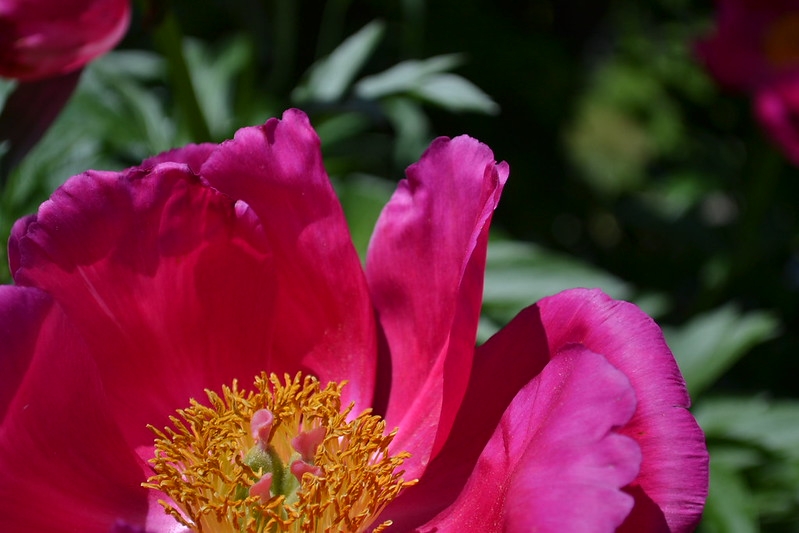
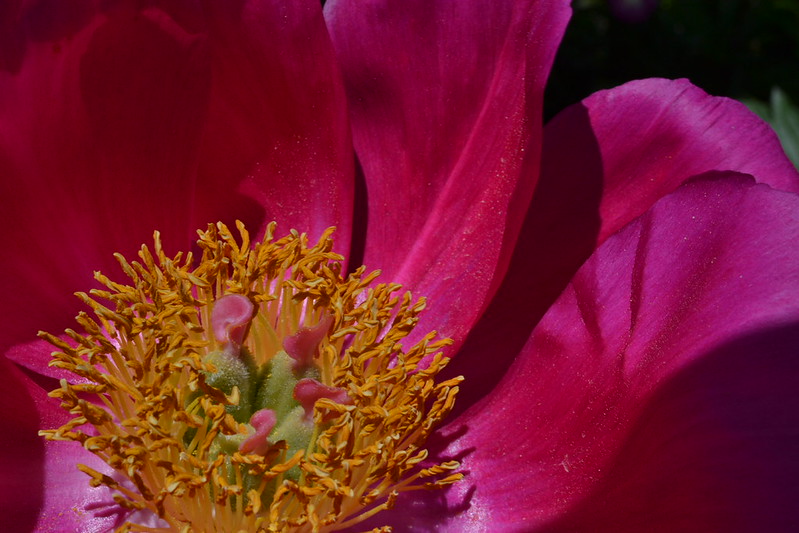
Here's two samples I could find quicky, kinda, my chit is soooo unorganized. but this was a test I was doing on the very thing, dof. These are unedited test shots, so comp sucks and they overall suck...but shows dof issues.

first was at f/5.6 (the inners are in focus for the most part, but the outer petals are not)
7565578528_bdc9520378_c.jpg


second at f/18 (was at 1/80 sec so I think I got a it of motion blur seen in the outers...but I was concentrating on the inner parts of flower.) The inners and outer petals are in focus ... minus the motion blur that is slightly evident if you really look for it)
7565575762_62af80071d_c.jpg


*edit*

first was at 55mm second at 35mm and I got a tad closer on second one, but even if I had not, all of the flower parts would have been in focus if all of it was shown like in shot 1.
 
Ernicus said:
Not true.

I have many flowers in the 20's tack sharp.

I usually use a tripod though...but even freehand...same thing. The key in stepping down that far is having the lighting to support it...or a great piece of glass too...lol. with these kit lenses and cheap zooms...not a slam, just reality...it can be tough when we test them that hard.

That's good news...I always shoot multiple f-stops just in case. I was hoping that a Nikon lens would make up for some of my shortcomings..LOL
 
Charlie, do you have/use a tripod?
 

Create an account or login to comment

You must be a member in order to leave a comment

Create account

Create an account on our community. It's easy!

Log in

Already have an account? Log in here.

Back
Top Bottom