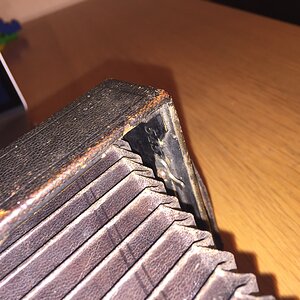
Here's a side-by-side.
On the left is my Lee 1-stop (0.3 density) "soft" grad. On the right is the 1-stop "hard" grad. (BTW, keep in mind that these 1 stops probably look more like a 2 stop because you're seeing light go through and have 1 stop reduced, to hit the paper... then reflect back out and have another stop blocked on the way back. A 1 stop filter won't block this much light when the light only passes through the filter once.)
View attachment 95043
Hopefully the very gradual change vs. the somewhat rapid change are extremely obvious.
As for why you'd care...
Imagine you are shooting a landscape and there's a very obvious horizon line in the shot... you'll probably reach for the filter on the right. This allows you to get somewhat even darkening of the sky without dimming the land and helping balance the image.
But now imagine you're shooting an image where elements from the ground are breaking the horizon line and extending up into the sky - say... a tall building. If you use a "hard" edge grad, you'll see this obvious point on the building where the building suddenly goes dark as you follow up from bottom to top. If you switch to the "soft" edge grad, you won't notice any abrupt change in brightness.
Here's a pretty good video to watch to help understand the filters and while the start with examples... one of the examples is in a forest and they show how a soft-edge is the better option in that scenario.




![[No title]](/data/xfmg/thumbnail/35/35224-c14babe4157e05767660f47e7de82aef.jpg?1734166901)
![[No title]](/data/xfmg/thumbnail/39/39438-1eb8b5f82b59d9d0c72ae9025778ed4c.jpg?1734173528)