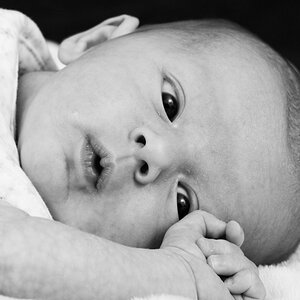
I learned that too in a grad level course in B&W darkroom work; the instructor taught us to have a 'black' black and a 'white' white somewhere in the photo (could be a very small area but should be there). Once when I slid a piece of paper in the developer and it instantly went coal black she said, save that, it's your black black. lol I'd forgotten to turn off the light on the enlarger before I got out my paper. Anyway I use it as a starting point to adjust contrast and then go from there.
This seems a little light gray (very light) and black rather than white. At least I've found to not adjust for the the 'white' white in reflections or highlights (such as in her eyes), if I use a highlight as my 'white' the whole thing seems to be too dark and I found it works better for me anyway to find a white white somewhere else in the image.
I've always liked B&W photography, I learned in general from reading/studying photographers incl. Ansel Adams (who was one of my first favorite photographers although not doing landscapes I later got interested in other photographers' work). Some of the old B&W movie still photos are pretty cool, there are quite a lot on Turner Classic Movies website. Usually if I'm going to shoot B&W I think about the subject or scene and if I think it will work well in black and white, if it has some nice dark and light to it.
Lovely portrait by the way. And an E type?!! I don't know much about cars but I know that one, what a beauty of a car.





![[No title]](/data/xfmg/thumbnail/37/37622-530e264cdd98e6648079b89d7d3cd356.jpg?1734170746)