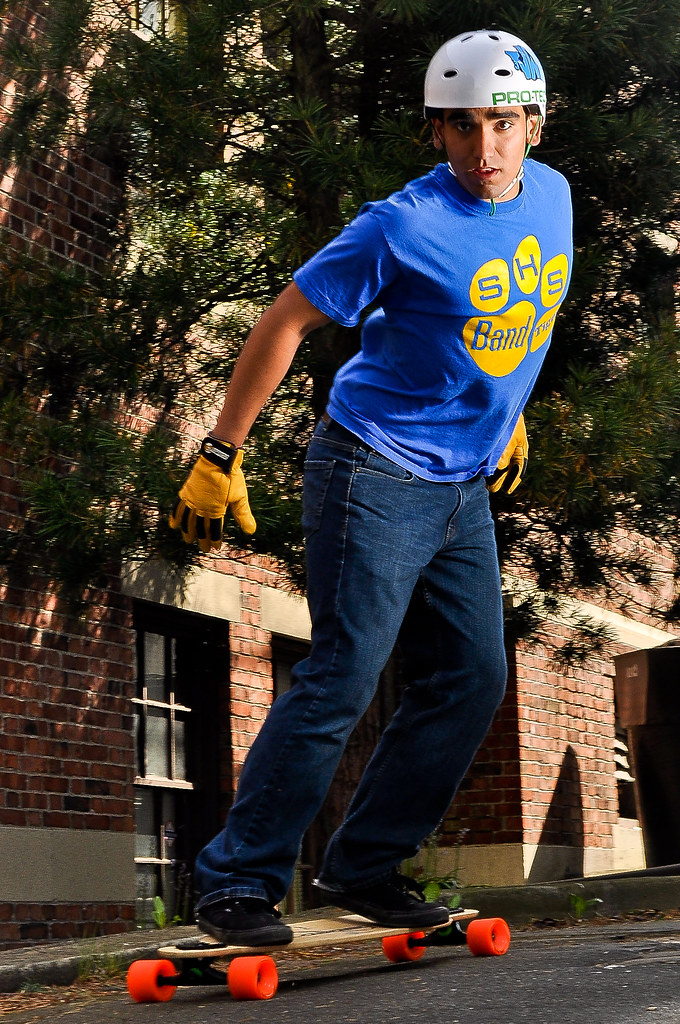
Wow! Thanks Derrel for the advice. This was at about 1:00pm so I was having trouble overpowering the sun with my flash. I wanted to get a slower shutter speed but wasn't able to figure out how to do it properly lol. Working with flash is tons of fun and I love how the images come out afterwards. It's definitely not as easy as some make it (Zach Arias for expample).
I want more blurring as you suggested but how would I go about that exactly? Slower shutter speed would make it so I would get too much ambient light in correct? I would then have to have a larger aperture to compensate right? Or do I have that backwards?
Well, getting more blur on the subject can be tricky: with most speedlight flash units, it's hard to overpower daylight if the daylight is bright, and at 1:00 in the afternoon, even in partial shade, the ambient light levels with an ISO 200 camera are pretty bright. So, you have to wait for dimmer lighting conditions, or find dimmer lighting.
Adding a Neutral Density filter will cut down on the amount of light, which will allow you to use a slower shutter speed, which will make the background blurrier as you pan the camera; pine needles that are backlighted, fence posts, backlighted deciduous trees, and some other types of backgrounds REALLY show panning blur quite well. Adding a Polarizer, or Neutral Density filter will allow you to open up the lens aperture to a wider hole, and will reduce the depth of field and help blur the background, OR will allow you to use a slower shutter speed....but the Catch-22 is that the filter will also in effect lower your flash power. Still, it does allow you to use either a wider lens opening OR a slower shutter speed, and the shutter speed is what gives the "blur", while the flash unit's power and distance,and the lens f/stop and the ISO setting, all make up the "flash" part of the exposure.
If you shot this same shot very early or very late in the day, your ambient light exposure might be f/6.3 at 1/4 second, and the flash would be just the same as it was in the shot you posted. A long,slow speed like 1/4 second will give a pretty big "blur" on a moving subject, and the flash will give a crisp image. This is a tricky area, combining daylight + flash + moving subjects...the shutter's speed limitations on most cameras limit you somewhat. Your original shot was pretty good...I just think "blurrier" conveys more motion and movement, but it's pretty subjective.




![[No title]](/data/xfmg/thumbnail/35/35870-e324e80cd11d99176357e12cd2ba3b8a.jpg?1734167596)

![[No title]](/data/xfmg/thumbnail/34/34056-de7cd932b4cd702c2f77e0f5c9ec1aa2.jpg?1734164470)
![[No title]](/data/xfmg/thumbnail/32/32007-77c44b6b6edb5db977381096a2ffe54b.jpg?1734160805)
![[No title]](/data/xfmg/thumbnail/40/40285-2ce5915035c220ccb3485030863b62d0.jpg?1734174700)


![[No title]](/data/xfmg/thumbnail/37/37119-95714aab9befe33ecb7b951366bedc94.jpg?1734169832)
![[No title]](/data/xfmg/thumbnail/34/34060-c81fb16d207094738be9b89a70ae1331.jpg?1734164477)