What's new

Understanding exposure

amolitor

TPF Noob!
Joined
May 18, 2012
Messages
6,320
Reaction score
2,131
Location
Virginia
Can others edit my Photos
Photos OK to edit
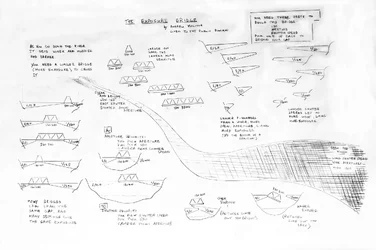
Here's a whack at replacing the "Exposure Triangle" which I, um, don't like.

The "Exposure Bridge".

$Exposure Bridge.webp
 
I think it is crap for a learning tool (compared to the exposure triangle), but I have to applaud the effort and the creativity!
 
This could work as a theory but I see problems:

1) You are making a bridge of 3 segments, but each segment is measured with a totally different value which will be a confusing concept.

2) You've no basis for adding those 3 components together so that a person can understand how "wide" the bridge is supposed to be to fit the gap. You need a value for the width and a mathematical way to add the 3 components together to equal that width so that people can grasp the concept.
 
  • Thread Starter 🔹
  • Banned
  • #5
The river in the center of the infographic is the central metaphor. The river gets DARKER as it gets WIDER. Without that, it makes no sense. Perhaps this central idea needs to be made a lot more obvious?
 
I'm not sure if the river creatively works as such. I get the idea, but I think its going to end up trying to link the "river" metaphor too much into the creativity side of things. People will start debating on how the "river" changes the creativity and then on what parts of the river reflect bits of the creative view that you get at the end.

I'm concerned that whilst the underlaying concept is neat, the overall metaphor has too much breadth and thus too much room to start connecting bits here and there and suddenly you're connecting bits that don't quite link up; which breaks the metaphor
 
I'm sorry you spent any amount of time on this.
 
I like it.

I think the filling in the gap metaphor is apt.
 
Looks like on of those explanatory or memorization aids that you can understand after you've understood what it is explaining. I had this reaction to a lot of math mnemonics - I could only remember them by starting with the information they were supposed to summarize and working backward, e.g., SOHCAHTOA for the sine, cosine and tangent definitions - I just had to go through the actual definitions in my head to reconstruct the mnemonic.
 
Looks like on of those explanatory or memorization aids that you can understand after you've understood what it is explaining. I had this reaction to a lot of math mnemonics - I could only remember them by starting with the information they were supposed to summarize and working backward, e.g., SOHCAHTOA for the sine, cosine and tangent definitions - I just had to go through the actual definitions in my head to reconstruct the mnemonic.

OMG, SOHCAHTOA! The good old Trig days, I remember them well. I have not heard that one in a long long time. My son is only 14 so in a year or two I/we should be there. Hmmm, wondering how much I will have to spend on that calculator?
 
I understand exposure just fine... But I don't understand what you did here.

Misses the mark for all the reasons already explained.

Exposure triangle is much simpler, cleaner, and just makes sense.
 
I drew this because the exposure triangle makes no sense at all and is a worthless pedagogical tool. It seems to help some people who already know how exposure works, but it's a confusing and worthless drawing for people who do not know how exposure works already. Teaching is something I do, sometimes for money. Pedagogy is a topic of interest to me, therefore, and photography is simply shocking in how poorly it's taught, and how shamelessly all the would-be teachers copy stupid, wrong, and meaningless stuff from one another.

Suppose I am a n00b. I understand that there's a shutter speed, an aperture, and something called ISO. I have them set to 1/125, f/5.6, and 100 respectively and things seem to be working pretty good.

My friend says I could "stop the action" better with a faster shutter speed, which with a little thinking, I decide means 1/500.

Now I consult the exposure triangle. It says that shutter speed, aperture, and ISO are inter-related, somehow. So, I guess I have to adjust aperture or ISO somehow. Can I just adjust one of them, or do I need to adjust both? And in what direction? Help me, exposure triangle! Help me!

The exposure triangle provides zero intuition into how any of this stuff work. It literally just says 'there are three things, related to one another, somehow'

 
"Ehhhhhhhhhhhhh!!!!!!!!" loud, irritating buzzer sound, indicating Game Over.

Sorry, nice effort, but no sale. I still prefer the old "drinking glass + faucet + clock" illustration concept.

For decades "Exposure" was thought of as being Exposure = Intensity X Time.

Now, in the digital era, some young whippersnapper saw fit to add an unneeded third leg...adding in ISO value.

Exposure is really pretty simple. All one needs to do is to learn that there is an Intensity...as in the flow rate of the water. And a Time, as in the length of time the water is allowed to flow into the vessel (the drinking glass, or the film, or the pixel wells). One can fill the glass in at wide-open in two seconds, or fill the glass in with the faucet at half-open in four seconds, or fill the glasswith the flow at one-quarter flow in eight seconds.

The whole "triangle" concept is relatively new. I'm not sure that adding in ISO sensitivity really helps neophytes understand the idea of equivalent exposure; if anything, I think it might cloud the waters for the less-astute thinkers, at least at the start of their learning process.

Sensitivity can be thought of as the capacity of the drinking glass that we are filling with our pretend water faucet: High-sensitivity film requires very little "water" and is represented by a small glass.

Oh hell...let's just scrap this all and build a bridge instead...and we'll truss it up using some cool triangular-array trusses that we fab outta' recycled railroad rails!!!

Addendum: in the time it took me to type my post, I now see that amolitor has added another post; one with which I agree with in the first point very much: the exposure "triangle" in not a very useful tool for neophytes.
 
Yeah, I like the cup and faucet too. It's a fine word-picture metaphor.

What I was looking for was a graphic, a visual that the newbie can hang some intuition on, and I couldn't see a GOOD way drawing the cup and faucet. For a graphic, you really need SOME notion of 3 things that go end-to-end to make a length, or a circumference, or something. You need to be able to demonstrate that:

- adjustments to ONE parameter can be compensated with adjustments to EITHER OR BOTH of the other two
- a given exposure can be obtained with a variety of combinations of settings

These are, I think, the two conceptual hurdles for the neophyte. These two concepts, plus simple memorization of the rather confusing numerology of shutter speeds and f-stops, and you've pretty much got the stuff you need to know.
 

Create an account or login to comment

You must be a member in order to leave a comment

Create account

Create an account on our community. It's easy!

Log in

Already have an account? Log in here.

New Topics

Back
Top Bottom