Just so you'll know, "Neutral Density" filters come in 3, well, 4, varieties. They all act to
decrease the amount of light coming through the lens in a given time frame, thus allowing either a LONGER shutter speed, to obtain the classic silky water effect, or to
balance a scene with a wide variation in brightness.
Graduated ND filters have one half that starts out darkest at the edge, and gradually lightens towards the middle, where it turns clear. There are two types -
soft and
hard. A hard grad has a very clear and sharp delineation between the dark and light. A soft grad has a gradual change. Most situations call for a soft grad, so that's what most people use.
A soft grad is often used when shooting a sunset, where the dark area is used against the sun/sky/clouds top part of the image. This allows your camera to get a proper, or at least, better exposure of the foreground area, which is usually darker relative to the bright(er) sun/sky/clouds top half. Use of a grad will very often slow the shutter speed as well, so a sturdy base or tripod is often called for. You adjust the camera angle until the gradation on the filter is appropriate for your scene.
A non-graduated neutral density filter, usually just called an "ND" filter, is completely dark, and they come in various strengths. There are two ways they are described, and they both have to do with the amount of light being deflected, and how many 'stops' of aperture they make up for. You may see an ND filter described as an
ND2 or
ND4 or whatnot, or a '
3-stop" filter, or even a
'.9 ND' filter. Either way, the higher the number, the darker the filter.
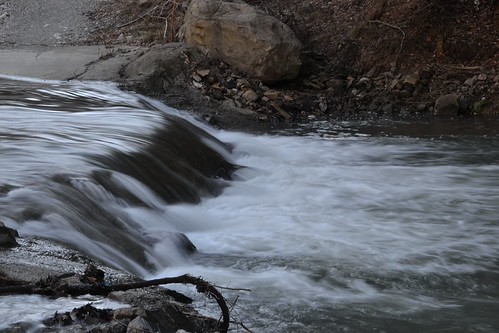
An ND filter is used to produce the "silky water" effect, by allowing you to use a shutter speed of 1/2 to 2 seconds or more, without over-exposing the scene. Unless you prefer to clamber around on slippery rocks in the dark, there is no other way to get this kind of shot during daylight hours. (except of course, having an aperture of f/50 or so..)
There are two form factors with these filters - round filters which screw onto the threads at the front of your lens, and square filters that fit in a holder which itself screws into the front threads. Round filters must be sized for the front of your lens - 58mm, 67mm, 72mm, 77mm, whatever. The front element diameter is often printed on the front rim of the lens, and it looks like one of the above standard numbers and a large zero with a slash through it. You can also buy inexpensive "step" rings which allow ONE filter to fit on multiple sized lenses. For example, if you have a 72mm lens, a 67mm lens, and a 58mm lens, rather than have to buy THREE filters, you buy one 77mm filter (always buy the LARGEST size), and a step up ring that goes 67mm-->72mm, and a ring that goes 58mm-->72mm. Then you just use the ring and the filter, as appropriate.
The other type of form factor uses a square piece of glass or acrylic that fits down into a holder. LEE and COKIN are well known makers of this type of filter. The advantage to this type of filter, especially with a graduated filter is that you can adjust where the transformation from light to dark happens in your scene. Obviously, with a round screw in filter, you get half and half only, and must adjust the camera angle, which may affect composition. With the drop-in filters you can have just the top 20% of the scene covered with grey, for example.
Another advantage of these types is that you can 'stack' filters a little more easily. To get a really dark effect, for example, you can buy two ND2 filters and an ND4 filter, and get an ND2, ND4, ND6 or ND8-level of darkening.
Most of the square or drop-in type of filter holders allow up to three filters. They also, obviously, must be sized for your lens diameter, but you can buy adapters just like step rings for them. I have the Cokin system for example, with rings for 58, 67, 72, and 77mm lenses.
There is a fourth type of ND filter, called a "variable" or "Vari-ND", which is kind of tricky but can sometimes be just the ticket. It's actually two
polarized filters attached to each other, and by rotating them, you adjust the level of darkness from very little, to almost completely black. This is a completely round effect, obviously.
Plain ND filters are relatively inexpensive, especially the drop-in type. Since their idea is to BLOCK light, as long as they do it evenly, they're fine. Grads are also not something that you NEED to spend a hundred bucks on, in my experience.
But if you really want to go nuts, Singh-Ray makes a variable ND/warming filter that will set you back a cool $400. Many fancy landscape photographers swear by them.
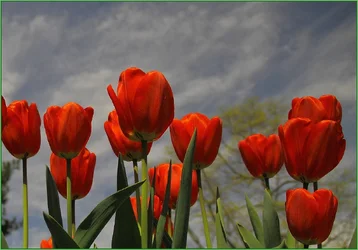
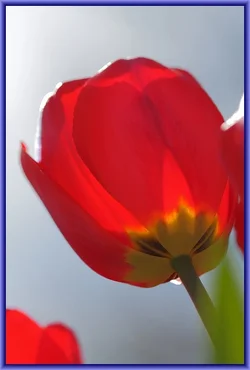
Here's an example of what a $7 vari ND can do, if you get the right angle. This was a very bright, sunny April morning, and I shot straight up into the sun. I was looking to get a 'transparent' effect through the part of the tulip. The second shot is a little OOF because I was laying on my back poking the lens up at the flower, and a bug crawled down the back of my shirt just as I snapped the shutter..






 really nice photo




![[No title]](/data/xfmg/thumbnail/42/42462-2adb6efc01a19638fca25cd3000f5575.jpg?1734176997)
![[No title]](/data/xfmg/thumbnail/42/42464-98a778e864f4e6df2a9cc673b7549322.jpg?1734176998)
![[No title]](/data/xfmg/thumbnail/31/31749-6cf0f99d6bdedf47f7387c5b943fb717.jpg?1734160468)

![[No title]](/data/xfmg/thumbnail/32/32006-4103e122cb8d7b8d8e41a423124446b7.jpg?1734160802)
![[No title]](/data/xfmg/thumbnail/42/42461-e2a94a39b9483a804af86010fc52244b.jpg?1734176997)