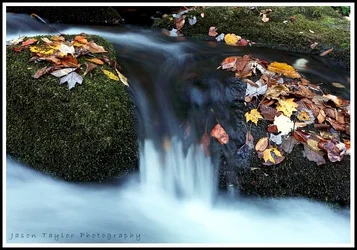
Just so you'll know, "Neutral Density" filters come in 3, well, 4, varieties. They all act to decrease the amount of light coming through the lens in a given time frame, thus allowing either a LONGER shutter speed, to obtain the classic silky water effect, or to balance a scene with a wide variation in brightness. Graduated ND filters have one half that starts out darkest at the edge, and gradually lightens towards the middle, where it turns clear. There are two types - soft and hard. A hard grad has a very clear and sharp delineation between the dark and light. A soft grad has a gradual change. Most situations call for a soft grad, so that's what most people use.
A soft grad is often used when shooting a sunset, where the dark area is used against the sun/sky/clouds top part of the image. This allows your camera to get a proper, or at least, better exposure of the foreground area, which is usually darker relative to the bright(er) sun/sky/clouds top half. Use of a grad will very often slow the shutter speed as well, so a sturdy base or tripod is often called for. You adjust the camera angle until the gradation on the filter is appropriate for your scene.





![[No title]](/data/xfmg/thumbnail/36/36132-5bd4fa365c199003273e0ff128bf42f4.jpg?1734168228)

![[No title]](/data/xfmg/thumbnail/36/36602-3001bbe07fa5517ccd4b03e049c7b844.jpg?1734169055)
![[No title]](/data/xfmg/thumbnail/32/32930-09414fc020c2a60a456ff59a05c5ef8f.jpg?1734162706)