- Joined
- Dec 11, 2006
- Messages
- 18,743
- Reaction score
- 8,049
- Location
- Mid-Atlantic US
- Can others edit my Photos
- Photos NOT OK to edit
- Banned
- #1
In my trip to Laos, we ended up several times in Akha villages. The Akha are animists; they believe that all objects have a soul and that ghosts and spirits are real. This belief sort of merges with fetishism, the belief that objects have power that can have an affect over people and circumstances.
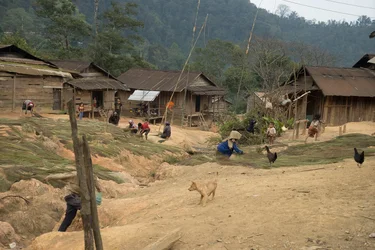
Perhaps because of this belief they don't like photographs very much and, except for specific circumstances, will avoid being photographed. At the edge of the Akha village is a spirit gate and we were warned not to touch it and even not to approach it.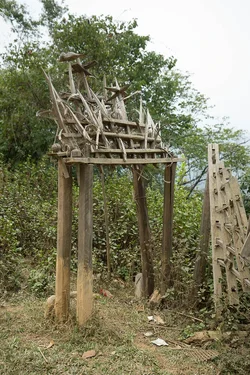
Throughout the village were this tall bamboo poles with whippy tops. We were told that those tops were tipped in honey to feed the spirits and ghosts as they flew around, to curry favor. The Akha believe in the power of medicine, not because it fights a 'disease' but becuase it is a fetish against the evil caused by spirits.
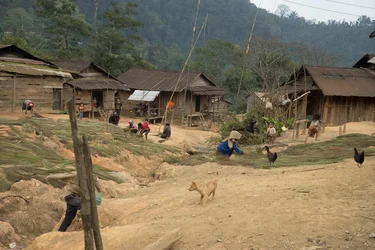
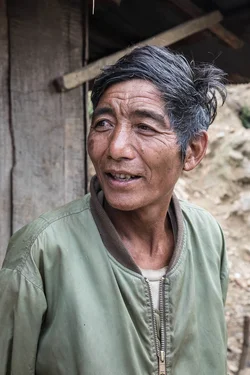
This man asked me for medicine (through the guide) and I gave him two large Empirin and, in return for this gift, he allowed me to take his picture.
He also offered me a drink of Lao-Lao, but having had an experience with that drink, I thanked him but told him I could not.
I got to thinking about this today and, after a while, really couldn't distinguish too much difference between their belief in ghosts and spirits and the more Western monotheistic belief in one man in the sky.
And surely we share some degree of this fetishism. We value, and even give some emotional power to representations of our beliefs, religious symbols, flags, etc.
And photographers share in this.
Who does not get a charge and a psychic boost over a new lens?
How many people humble-brag ad nauseum about the quality of their high end camera bodies or lenses? On another site, I knew someone who captioned every photo something to the effect of 'taken with a Leica M8' as if that somehow improved the photo.
Making fetishes out of equipment or methods should not be what photography is about.
The downside of worshiping equipment is that people new to photography somehow get the idea that equipment is more important than it is.
And so we are leading people to care about cameras much more than about photography.
Perhaps because of this belief they don't like photographs very much and, except for specific circumstances, will avoid being photographed. At the edge of the Akha village is a spirit gate and we were warned not to touch it and even not to approach it.
Throughout the village were this tall bamboo poles with whippy tops. We were told that those tops were tipped in honey to feed the spirits and ghosts as they flew around, to curry favor. The Akha believe in the power of medicine, not because it fights a 'disease' but becuase it is a fetish against the evil caused by spirits.
This man asked me for medicine (through the guide) and I gave him two large Empirin and, in return for this gift, he allowed me to take his picture.
He also offered me a drink of Lao-Lao, but having had an experience with that drink, I thanked him but told him I could not.
I got to thinking about this today and, after a while, really couldn't distinguish too much difference between their belief in ghosts and spirits and the more Western monotheistic belief in one man in the sky.
And surely we share some degree of this fetishism. We value, and even give some emotional power to representations of our beliefs, religious symbols, flags, etc.
And photographers share in this.
Who does not get a charge and a psychic boost over a new lens?
How many people humble-brag ad nauseum about the quality of their high end camera bodies or lenses? On another site, I knew someone who captioned every photo something to the effect of 'taken with a Leica M8' as if that somehow improved the photo.
Making fetishes out of equipment or methods should not be what photography is about.
The downside of worshiping equipment is that people new to photography somehow get the idea that equipment is more important than it is.
And so we are leading people to care about cameras much more than about photography.






![[No title]](/data/xfmg/thumbnail/33/33339-c5b461af62b32f6b6529f1b334d818ba.jpg?1734163231)

![[No title]](/data/xfmg/thumbnail/33/33337-23549254ce2ac92ac5cb86ac0366633f.jpg?1734163225)