What's new

What oes a polarizer filter do?

Boz Mon

TPF Noob!
Joined
Apr 2, 2008
Messages
181
Reaction score
0
Location
Illinois
Can others edit my Photos
Photos OK to edit
What does it do, and do I need one? I currently dont have any filters for any of my lenses.
 
I just got one of these but so far havent played around with it too much apart from taking a few water shots - but this is the uses from http://www.great-landscape-photography.com/polarizing-filter.html

Of all the filters available, a polarizing filter is the first one you should buy to improve your landscape photography.

So What Does It Do?

First of all it can darken blue skies turning them a deep, rich blue. Polarizing filters are also great for removing reflections in water. So if you're shooting a river scene and you want to see detail in the water or on the river bottom, a polarizer will reduce the reflections. They're also good with foliage, making leaves and such less shiny (again, cutting down on reflections). Color saturation is enhanced with almost any subject. No other filter can provide this.

The polarizing filter one thing and one thing well - it removes reflections from non-metallic surfaces:

*

Skies
By eliminating the reflection of light on the tiny water droplets present in the atmosphere the polarizer brings more saturated and slighly darker skies.
*

Water and reflective surfaces
By eliminating reflections, the polarizing filter will tend to make water and other reflective surfaces more transparent. The effect will also vary depending on the angle to the reflective surface. If you place your camera very low above a river, the effect will be very limited. If you shoot from a bridge above it, the water will look totally transparent.
*

Color Enhancement
The polarizing filter also reduces reflection from other surfaces such as foliage and thus makes their colors look more intense. It also tends to make shadow areas darker.
*

Light absorption
The main side-effect of the polarizing filter is that it absorbs 1.5 stop of light. So, if you shoot at 1/180th of a second and then add the filter, you will find yourself at 1/60th of a second. This happens whatever the orientation for a polarizer. In low light situations, some type of camera support, such as a tripod, will be needed.

 
Hmm. I was wondering about that too. Can you leave a polarizer on your lens? Or does it do funny things to other subjects?

Oh. Another thing I think they can do is alow you to shoot subjects behind glass, right?
 
Oh. Another thing I think they can do is alow you to shoot subjects behind glass, right?

Glass counts as a reflective surface in the above sense (what I quoted earlier) i'm pretty sure - The polariser is meant to knock out the reflections on it.
 
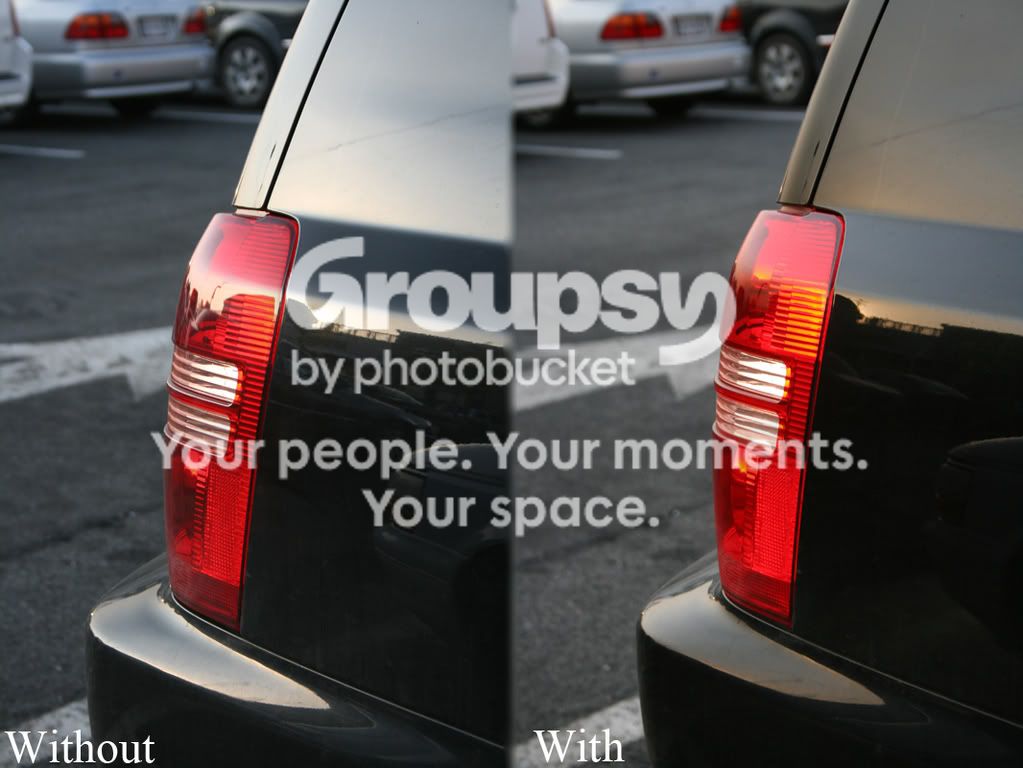
It's a must have IMO, I tried to do a comparison image with it, maybe this will help you see the difference:

jpg.jpg
 
In landscapes the polarizer will also help cut hazy skies, blue them up and bring out clouds as well as subdue reflections. I leave mine on my d80 all the time- but I always use a tripod and almost always a shutter release.
 
Hmm. I was wondering about that too. Can you leave a polarizer on your lens? Or does it do funny things to other subjects?

It does funny things to all items that polarise light on reflection. Roads will go blacker, leaves will lose specular highlights, and skin will also lose specular highlights. In the right circumstance it can make a person look like they are made of clay.
 
To eliminate reflections from glass, the camera should point at an angle to the glass and not perpendicular to it.
As for darkening the sky, the effect it the strongest when the sun is perpendicular to the lens, and diminishes gradually as the sun gets more & more in front - or behind - the lens, down to zero effect when the sun is in front or behind the lens.
When the sun is low, the sky will be bright at the sun side, and very dark at the other side.
With a very wide lens, the polarizing effect will be only at part of the pic' (or part of the sky), which typically looks bad.
As the Pol. Filter is rotated for tuning, it is a nuisance on lenses in which the front rotates.
It reduces light, so many times it can also be used as a ND filter.
For the same reason, you constantly lose 1~1.5 stops if you leave it on the lens all the time.
Many (yours truly included), regard the Polarizing and the UV or Skylight filters as the 2 basic filters.
 
1) without CP
DSC_0372sm_noCP.jpg


1) WITH CP
DSC_0373sm_CP.jpg


2) without CP
DSC_0381sm_noCP.jpg


2) WITH CP
DSC_0380sm_CP.jpg


3) without CP
DSC_0391sm_noCP.jpg


3) WITH CP
DSC_0392sm_CP.jpg


4) without CP
DSC_0411sm_noCP.jpg


4) WITH CP
DSC_0410sm_CP.jpg


misc with CP
DSC_0408sm_CP.jpg


misc with CP
DSC_0414sm_CP.jpg


With a very wide lens, the polarizing effect will be only at part of the pic' (or part of the sky), which typically looks bad.


Wow, really? How does that happen?
 
It does funny things to all items that polarise light on reflection. Roads will go blacker, leaves will lose specular highlights, and skin will also lose specular highlights. In the right circumstance it can make a person look like they are made of clay.

The first two sound like benefits, but i don't know if I want people looking like clay!
 
I love my circular polarisor, I bought it when I had my oint and shoot, it fits on my tele lens too, It makes such a huge difference in any picture with sky!

its worth having just so your sky stays blue.
 
I works best for eliminating reflections (almost completely gets rid of them in fact) when you are shooting 90 degrees from the sun.
 
Since we are talking polarizers again, I was at the store and saw a Tiffon (sp?) lens kit for the Canon XTi. It was $39.99. Is Tiffon a decent quality? I see so many "this brand is good, this brand is crap" in the last 5 months I've been here that I can't remember what stuff is good and what is not.

I don't have an XTi, but I assume I can just get a 46-52 mm adapter for my camera and use a 52 mm polarizer.

Ok, I guess if the answer is "it is crap", then my question would be is it crap for an expensive dSLR, or would it also be the same crap if you were using a cheap $200 superzoom?

Also, since I'm not using the best of cameras and I get quite a lot of purple fringing when, for example taking a bird shot from the ground into the trees angled towards the sky with wanting a wide aperture. Does a circular polarizer help to solve purple fringing problems such as this?
 

Create an account or login to comment

You must be a member in order to leave a comment

Create account

Create an account on our community. It's easy!

Log in

Already have an account? Log in here.

Back
Top Bottom