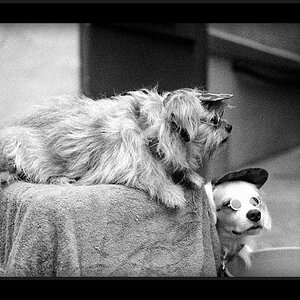
I don't see the exposure settings, but the dog is over-exposed. The highlights on his head are blown out -- which was necessary to get detail on the shadow side of his body. In short... too much difference between a good exposure for what's in the "sun" vs what's in "shade".
I can see you're in full daylight sun -- based on the intensity of the shadow.
This calls for a "sunny 16" exposure:
Sunny 16 rule - Wikipedia, the free encyclopedia
The baseline is ISO 100, f/16 and 1/100th sec. Or.... ANY EQUIVALENT exposure.
Since it's usually not preferable to shoot at f/16, suppose you wanted to shoot at... f/8. That's 2 full stops more open on aperture (f/16 -> f/11 -> f/8) which means you'd speed up the shutter by 2 full stops (1/100th -> 1/200th -> 1/400th). And that would be a great "exposure", but not a great shot.
The fierce difference between highlight and shadow will detract from the shot. This is one of the few cases where using your pop-up flash is actually a good idea. It wont be used as a primary or "key" light... it'll be "fill" light.
Your camera probably allows you to adjust "flash compensation" or "flash exposure compensation". Be careful not to confuse that with just "exposure compensation" which is different. Exposure compensation tells the camera you want to increase or decrease the whole exposure. "flash exposure compensation" (or simply "flash compensation") says you just want to alter the amount of the exposure which was contributed by your flash, but the standard ambient light exposure should remain the same.
This is one of those "salt to taste" things... I generally find that I like the "look" of my flash if I decrease it by about 2/3rds of a stop to 1 full stop.
Have a look at these sample images (apologies... I don't have a dog and didn't have a person available to be my model, so I'm using an oak tree.) Note that for these images, the sun is behind the tree.... basically, like your photo, my camera is mostly shooting "into the sun" rather than with the sun at my back.
I "coincidentally" happen to have a sunny day (this is incredibly rare... we've had almost nothing but cloudy cold rainy weather lately... with a smattering of snow just to give us variety.)
I did NOT use the light meter ... neither the meter in my camera, nor did I use my hand-held Sekonic meter. I literally just followed the Sunny 16 rule and set my exposure to:
ISO 100 (plenty of light... there's absolutely no reason to use a higher ISO. Lower ISOs are always preferred because you get the least amount of "image noise" when using lowest ISOs)
f/8 (2 stops down from the Sunny 16 baseline)
1/400th (2 stops up from the Sunny 16 baseline)
These settings give me a Sunny-16 "equivalent" exposure.
Note this is mid-day sun. I'd tweak the exposure if I were shooting near sunset during the "golden hour".
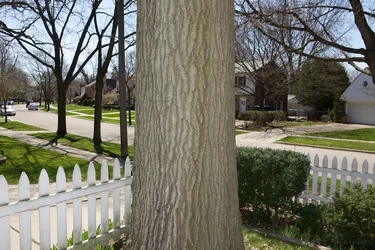
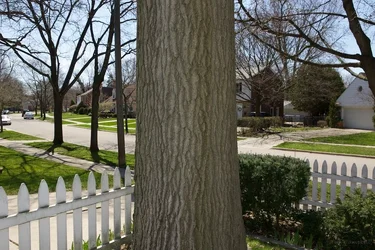
Those above settings were used in ALL THREE images you see below. The ONLY difference is what I did with the flash.
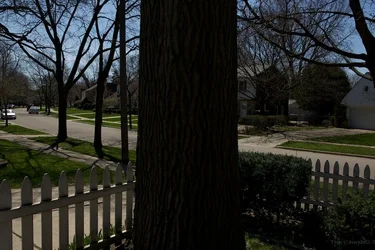
In the first exposure, I'm not using a flash. Notice the tree is in silhouette.
In the second exposure, I AM using a flash, the flash is pointed straight ahead. Notice the tree and white picket fence is brightly lit... in fact it's a bit too bright. Here the flash is behaving as if it's the "key" light. We don't want the flash to be so obvious... so we'll tone it down a bit.
In the third exposure, I am still using a flash, but I've set the flash exposure compensation to -1 (down 1 stop). That means the flash will fire with "half" the power. This fills in the shadow and creates a more natural look ... without the harsh shadow and without the harsh sun.
I could have taken a 4th shot by increasing the exposure without flash until the tree is about as well lit as you see in the third shot, but then the background would be too bright (I've done demo shots before to show people what happens, but this time I skipped that shot because I wanted to show that once you know the "Sunny 16" rule, you don't even need your light meter. In fact... if the meter disagrees with these exposure settings... the meter is wrong (meters are often wrong... there are other threads here which discuss why you can't always trust a built-in meter.)
When I'm shooting a person, I might tweak things... sometimes I think it looks better at about -2/3rds rather than the full -1.
Play with your flash outdoors ... you may be quite pleasantly surprised to find out how nice it is to use a flash.
One final note... I am using a fairly powerful flash, so I can get coverage at greater distances. The built-in pop-up flash on a camera is small and not particularly powerful. It will generally provide adequate performance at distances up to about 10 feet... don't count on it to do much more. That's perfect for portrait distances which are typically less than 10', but if you tried to do this with a group shot of a dozen or so people, you'd probably have to back up 15 or more feet and then the built-in pop-up flash wouldn't have enough power.





![[No title]](/data/xfmg/thumbnail/33/33343-857a08c1327857172779bfe49f06f638.jpg?1734163238)


![[No title]](/data/xfmg/thumbnail/37/37613-6b200847731e552bb4bf9ba3bdb80183.jpg?1734170739)