What's new

whats the secret to astrophotography?

charlotte91

TPF Noob!
Joined
Jun 12, 2012
Messages
5
Reaction score
0
Location
Queensland
Can others edit my Photos
Photos NOT OK to edit
I love to spend alot of my nights star gazing and thought wouldnt it be great to capture it on camera
soo ive been trying to work out how to take pictures of the stars
ive looked on the net and tried a few things ive found but all i get is black and the moon is just a white dot

do you need a telescope? probably a dumb question to those who know but i dont
is there a secret? anything i need to know camera setting, equipment etc
oh and i use nikon d7000 with 18-105mm lense
appreciate any advice

thanks heaps
 
Shooting patterns of stars isn't that easy because it takes a long exposure to get enough light, and if the exposure is long enough all you get are star trails because the Earth will rotate causing the stars to move. The best way to get star shots is with image stacking. Shoot a bunch of exposures and then "Stack" them with software. I've seen some amazing shots done that way with a relatively short zoom lens and a lot of patience.

The moon is easy but you can't trust your meter. Try about 1/250 second at f/8 and ISO 400 and see what happens. It should be in the ball park.
 
what do you want to shoot? some things require a telescope, but others dont.

shooting the moon isn't too bad, use the settings SCraig mentioned, and manual focus it using live view zoomed in all the way. the moon won't be very big at 105mm, but you should be able to get something with a 100% crop..

you can also do wide angle shooting, with stacking like was mentioned, which is pretty fun, the wider the lens is, the longer exposures you can take on a stationary mount (tripod) without getting star trails, but with the 18mm end of the lens you'll still be limited to somewhere around ~20-25s per exposure or so. depending on where you are at, you may have some light pollution which will make things harder, try to go to a nice dark area.

some things will require a telescope like planetary or deep space objects, as well as a GOOD tracking equitorial mount. you could also get a good astrophotography CCD sensor which is better at collecting some light wavelenghts that DSLRs aren't good at. etc, etc, etc....astrophotography is easily one of the most expensive and difficult forms of photography when you examine the high end of it, but don't let that stop you from experimenting with what you have, don't be afraid to increase the ISO, etc.

to shoot the stars, try this, go out to a dark area on a 'new moon' night where the moon isn't out, point your tripod at an interesting portion of the milky way, and (using a remote shutter release or timer) take a series of 20s exposures at ISO1600 at the widest aperture your lens can do, use live view zoomed in on a star or something to focus it manually too.'

after getting a good amount of images, you can stack them together which will combine the light from the exposures, and you can work on the post processing on it.
 
This is extremely tough photography, as the night sky has many objects with many different exposeures, so I would recommend using HDR and using a zoom lens will help you get. Lot more detail on the moon intend of a white dot. Using a tripod is also great as their are endless possibilities of what you can do with a slow shutter speed!
 
As mentioned you need to decide what the photograph and photograph just that. The exposures vary greatly from:

Sun at ISO200 1/2000th f/6.3 with a Solarfilter cutting out 99.995% of light : https://secure.flickr.com/photos/10090242@N03/7343820368/in/photostream
Moon at ISO200 1/150th f/6.3 : https://secure.flickr.com/photos/10090242@N03/7343820552/in/photostream
Wide field at ISO 800 25 minutes f/6.3 : https://secure.flickr.com/photos/10090242@N03/5671796150/in/photostream
Deep Sky objects at ISO1600 40 minutes f/6.3 : https://secure.flickr.com/photos/10090242@N03/7371100386/in/photostream

This is beyond the realm of any kind of HDR.

You need to pick what you want to shoot and then focus on that. The Moon is an easy target as it is quite bright, but other objects are significantly harder. But you can capture nebula and similar things with a standard SLR all you need is some form of control and technique. The skys the limit with regards to how to do things but here's a few tips in increasing difficulty:

1. Shooting the moon you need a tripod and the right settings on your camera. Set the camera to manual and experiment.

2. Shooting other objects you need at the very least a tripod. You also need some kind of remote trigger, preferably an intervalometer so you can set the camera to take repeated shots. With a camera on a tripod you can up the ISO of the camera. You'll get noise but we'll fix that later. Take repeated shots with shutter speeds short enough so that stars don't start trailing. Then you take the resulting files and stack them in a program like Deep Sky Stacker to create a 32bit file with low noise. Processing will then bring out the various details you are after. The shot above of the milky way was shot on a tripod.

3. The next step is to replace the tripod with a motorised equatorial mount. This will allow the camera to track the sky allowing you to drop the ISO and increase the exposure time exposing even more fantastic night time objects hidden from normal view.

From here you start getting more and more serious:

Telescope: Why settle for 105mm when you can get a 1135mm f/6.3 :)
Autoguider: A little camera + mini telescope which you point at a star. A computer tracks the star and sends a corrective signal to the motorised equatorial mount to keep it locked on the star even if it isn't aligned properly or your gears aren't perfectly round (which they never are).
Dedicated imaging camera: Even an average D4 has nothing on the sensors used for astrophotography. $5k should get you a lovely little monochrome camera with 16bit ADCs a peltier cooler to keep the sensor at a chilled -20degC a heater on the front to prevent dew forming, etc.
Dedicated software: because Photoshop doesn't work well with 32bit images, and doesn't do deconvolution and other things that form the lifeblood of astrophotography.

I did say the sky is the limit :)


But don't get disheartened. There's a world of wonders available with a simple DSLR. Here's a shot of Eta Carina that someone took with a Pentax and a 135mm lens:
Eta Carina with 135mm lens - IceInSpace

 
+1 on garbz post, and he's only mentioning the cheaper specialized astrophotography equipment...if you get into the high end you're looking at private observatories with custom 30-50" or more hyperbolic mirrored telescopes that fill the building constructed on extremely rural land. think multi-millions of dollars, and that is just for the telescope setup, which is essentially only the lens....then you've got custom imaging sensors, etc, etc.

I belong to a local astronomical society, and the group owns an observatory with 3 moderately large scopes, a 8" ~3000mm refractor, a 16" cassigrain (I can't remember the focal length or speed), and a huge (compared to my scope) 32" reflector scope. I should go take some images of the scopes at the observatory, they're pretty interesting themselves, each has their own building with a retractable roof.

I've got 2 scopes, and I've been attempting astrophotography for a couple years now, and I'm still getting used to everything, it can be pretty frsutrating at times, but when you get a good shot of something, its worth it.
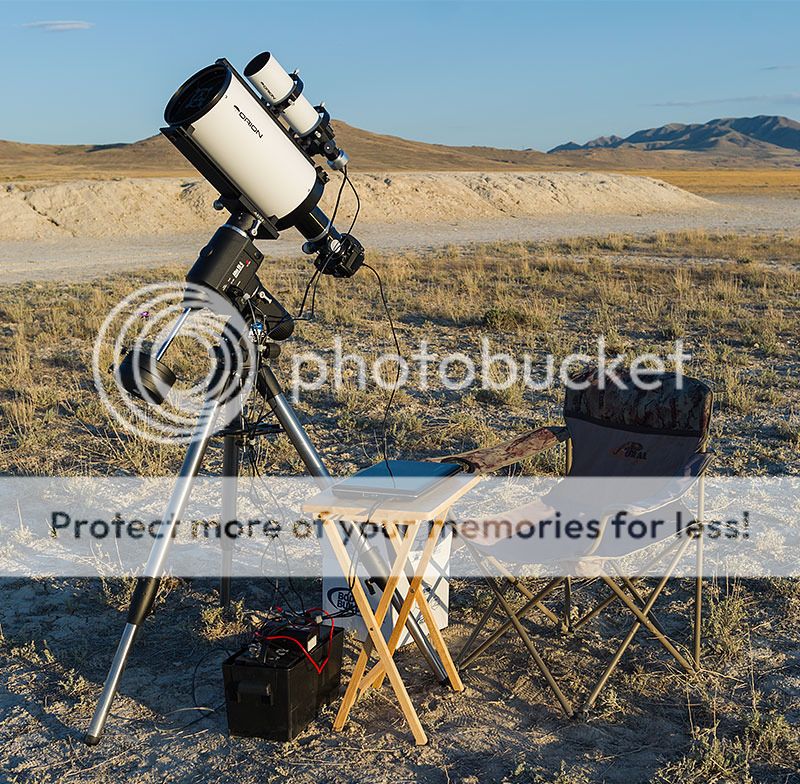
FWIW, this is my main AP telescope setup out at one of my favortite local dark sky areas:
scope.jpg
 
Back in the day I made images of constellations, like the Big Dipper, Cassiopeia, and Orion.

I mounted my 35 mm camera piggy-back on a telescope that had an equitorial mount. An equitorial mount properly aligned with Earth's axis of rotation has the advantage of only having to be moved in a single axis to counteract the Earth's rotational movement.

You might want to get the inexpensive book - Digital Astrophotography: A Guide to Capturing the Cosmos

Equatorial mount - Wikipedia, the free encyclopedia

Right ascension - Wikipedia, the free encyclopedia

Declination - Wikipedia, the free encyclopedia

Sidereal time - Wikipedia, the free encyclopedia
 
A starry sky can indeed be very fascinating.
I think this article will help you a lot: Star Trail Photography - A Complete Guide
A starry sky can indeed be very fascinating.
I think this article will help you a lot: http://shuttermonks.com/the-guide-to-star-trail-photography/

It is on star trails but it also explains how to get star shots without the trails.
However, I think that once you start shooting star trails you will never look back :)

It is a complete guide and covers the below topics:
How are Star Trails Formed?
Gear Prerequisites for Star Trail Photography
How to Choose the Right Location to Capture a Perfect Star Trail
Composition Techniques for Star Trail Photography
How to Get the Correct Exposure
Post Processing your Star Trail Images

Hope it helps!

I love to spend alot of my nights star gazing and thought wouldnt it be great to capture it on camera
soo ive been trying to work out how to take pictures of the stars
ive looked on the net and tried a few things ive found but all i get is black and the moon is just a white dot

do you need a telescope? probably a dumb question to those who know but i dont
is there a secret? anything i need to know camera setting, equipment etc
oh and i use nikon d7000 with 18-105mm lense
appreciate any advice

thanks heaps
 

Hey Aloicious, is that an Orion Starshoot and 80mm autoguider you have on there? I was looking at this package the other day. Is it working well for you? Getting an autoguider is the next step for my setup. I have a 2000mm SCT that needs some guidance :)
 
Wait so for shooting on a tripod, do you take one shot in low ISO and then more in higher ISOs for image stacking?
 
Be warned!!! Astronomy is addicting as all get out and a whole other field to sink some serious $$$ into! :mrgreen:
 
Hey Aloicious, is that an Orion Starshoot and 80mm autoguider you have on there? I was looking at this package the other day. Is it working well for you? Getting an autoguider is the next step for my setup. I have a 2000mm SCT that needs some guidance :)

yeah the guide scope is an orion ST80 refractor, with the starshoot autoguider...it works pretty well, however I need to get an extension to mount between the SSAG and scope, without a diagonal on it I don't have the length to reach focus on the SSAG, I've got it to work before rigging it up, but its not ideal. thats one reason I've had some difficulties shooting DSOs....but the SSAG itself and the scope itself are really good for what they cost. I use PHD as the guiding software.

I'm actually headed out to the observatory on monday night, I'm going to try and do some planetary imaging with the big 3000mm focal length 8" refractor (I might even put on a barlow and have close to 6000mm focal length). my goal is to end up with some good saturn images, either with the D800 and stills, or do a video and stack the frames or something. but I'm also going to try mars, and if I'm there when jupiter comes up I'm going to shoot that as well.
 
Wait so for shooting on a tripod, do you take one shot in low ISO and then more in higher ISOs for image stacking?

you can do that, whatever you want to do. you can stack images of really any settings together, you might have to play around with it and see what you like. raising the ISO will just make the sensor more light sensitive, but with more noise, if you have a faster lens then you can usually open it up and not have to use too high of ISO.
 
I'm having trouble trying to see what the benefit of image stacking is vs keeping the shutter open longer. If they move in the long exposure wouldn't they move by the time you took several shots?
 

Create an account or login to comment

You must be a member in order to leave a comment

Create account

Create an account on our community. It's easy!

Log in

Already have an account? Log in here.

New Topics

Back
Top Bottom