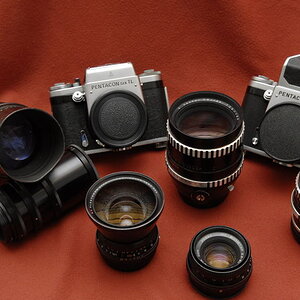
The Nikon D7000 is a little better than the Canon 60D (unless you're doing video... in which case the 60D would be the better choice). The Canon 7D is a little nicer than the Nikon D7000 but that'll eat up most of your budget even before you buy a lens.
I don't put much stock (actually I should say I don't put any stock) in any reports out of DxO (sorry Keith). I (and I'm trying not to sound biased here) find that their credibility is blown. They purport to perform careful review and testing which should stand up to scientific scrutiny, but the fact is they (a) wont actually reveal their testing methods (which totally blows all scientific credibility AND blows all credibility for purposes of being used as a benchmark standard) (but wait there's more...) AND (b) their test results often fly in the face of what we know about the laws of physics AND (c) other review sites which actually provide sample images to back up their scores (which DxO does not do.).
While I wouldn't buy the D7000 because DxO says so, I _would_ buy the D7000 because I think it has a few performance features over and above the 60D (and I really the 60D!) but ALSO because you already own a few Nikon lenses (which makes me wonder if you might also own any other accessories that work with Nikon that you haven't listed.)
I don't generally believe that "Canon" or "Nikon" is better... but if you pick on specific bodies you can find trade-offs where one might be better in some area. If one were truly better in general, you'd see a noticeable dominance in the industry among pro shooters -- but really you tend to see a pretty healthy mix. For this reason, once you invest in one brand, I probably wouldn't change brands unless there was a fairly compelling reason to do so... a feature offered by one and lacking in the other AND which you care about a great deal.
Although Canon is silent on the topic, the bets are that Canon is due to release the follow-on to the 60D (e.g. maybe a 70D).
Loads of utterly ridiculous claims made by TCampbell in regard to DxO Mark, and whose credibility is "blown". Do some research. DxO Mark has revealed HUGE amounts of its methodology and has explanatory information on its site, for those who are actually willing to read and to learn.
Here's some well-written explanation and information about how DxO Mark does its reviewing of sensors, and how to interpret the results. You know, some actual, factual, real information,written by somebody who took some time and effort to understand DxO Mark fully.
DxOMark Camera Sensor
Interesting that you mention DxO has "loads" of methodology on it's site... and then you link to Luminous Landscape (someone else's site) (oh... and it was published 10 days ago -- before that I can find nothing.) I've done the digging. I've had other people likewise do the digging. We've brow-beaten DxO on the fact that they don't ever claim HOW they score... they just keep re-emphasizing that they score the sensor and they use RAW.
Let's skip down to the list of issues at the end of the article you linked. I'd like to highlight one point:
From Peter's article:
The undocumented Master Formula
DxO does not document how the final DxOMark Camera Sensor score is computed from the individual Dynamic Range, Color Sensitivity and Low-Light ISO scores. I feel it should be provided as the overall score gets a lot of attention. With the formula, DxO countered, a manufacturer could attempt to optimize the overall score. But I still dont see benefits to leaving this formula undocumented: if DxO believes the master formula is a reasonable approximation of what photographers are looking for in a camera, they should document it with a note that it is a compromise between completeness and ease of use.
Ok... so basically the above (from your article) is what I've been saying. They don't really give us the data... they give us an overall score that we're supposed to accept without knowing exactly how they arrived at that score.
You can't really test a "sensor" anymore. There's a lot of cooking going on inside cameras and it can't really be disconnected from that process and still work. What many of us wanted to know was, to what extent is the cooking factored into the measurement and ultimate scoring?
After spending 30 years of my life in computer science, I know computers and I know how benchmarks work. In order for a benchmark to be credible, they MUST reveal their testing methods. A benchmark that doesn't reveal it's methods isn't a called a benchmark... it's called a marketing campaign.
I used to accept DxO without scrutinizing them. But then I started to notice some strange anomalies. For example: Nikon cameras that used Sony sensors were being outperformed by the Sony cameras using the same sensors even though Sony uses their SLT mirror system which kicks out about 1/3rd of a stop of light. HOW could that be? There HAS to be some cooking going on in order to arrive at this result. You can kick out the light AND keep it too. Then I started to notice cameras where reviews done by other websites (which DID show their sample images) were getting results contrary to what DxO indicated (sometimes wildly contrary.)
The 5D III vs. D800 was just the most recent one I came across that didn't make sense. DxO scores the D800 higher than the 5D III. But in every other review I've encountered, the 5D III is ahead (sometimes it's not even a close race.) I had a very difficult time justifying how DxO could score one sensor better when several other reviews, laws of physics, and my own eyes were telling me otherwise.
I realize that DxO publishes a "score". That "score" is the result of a lot of testing data which ultimately has to be weighted.
Let's pick on cars. Suppose we have a "score" as to which car is the best. To evaluate the cars, we'll test the cars and collect data such as peak horsepower, highest torque, best 0-60 performance, best 1/4 mile time, fastest speed, and other factors. Suppose one of our cars has the best time in the 1/4 mile, but it scores weaker in other categories. We give that car a "95" and no other car scores better than "91". You don't know WHY one car got the "95"... you just know that it did. You also know that when other people take the cars out to the track for testing, the other cars outperform the car that the first testing lab gave the highest score. And you scratch your head.
One of the things the Luminous Landscape article revealed was some testing data for the D800 and 5D III which showed the 5D III outperforming the D800 in dynamic range at high ISO, but since DxO has a low ISO bias, they ignore this. What's more, they average/resample pixels before scoring so while they claim to be testing the sensor natively and using RAW ... they're not _really_ using RAW.
So let's go elsewhere. While flying recently, I happened to have a copy of Pop Photo and the issue had their own reviews of the two bodies. They showed their noise / ISO test scores for both cameras in separate reviews.
The Canon got noise score (lower is better) of .9 at ISO 50, and .8 at ISO 100. The D800 got a score of 1.3 at ISO 50 and 1.1 at ISO 100. The noise score of 1.1 on the D800 was the lowest noise score it got at any ISO level. You had to increase the 5D III to ISO 800 to get that much noise.
The 5D III was rated "extremely low" (scores of 1.0 or lower) noise up to and including ISO 400.
It was rated at "very low" (scores of 1.5 or lower) noise up to and including ISO 3200 (btw, at 6400 it scored a 1.6 -- barely missing the "very low" rating).
It was rated at "low" (scores of 2.0 or lower) noise up to and including ISO 12800.
It scored "moderate" (scores of 3.0 or lower) noise at ISO 25600
It didn't become "unacceptable" (scores above 3.0) until you got to ISO 51200 (which scored a 3.1)
It scored a 4.4 at ISO 102400.
The D800 was rated at "extremely low" at ISO 50 & 100 only (scores of 1.3 and 1.1 respectively and, btw, puzzling that they let the scores of 1.3 and 1.1 slide into the "extremely" low category... normally that's just "very low". By the same yard-stick, the 5D III would have to score "extremely low" all the way up to ISO 1600, but then Pop Photo does accept advertising from these companies so they have to be careful about negatively portraying a product.)
It was rated at "very low" at ISO 200 & 400
It was rated at "low" at ISO 800.
It was rated at "moderate" at ISO 1600 and 3200
It was rated at "unacceptable" at ISO 6400 (3.7)
It scored 4.5 at "12800" (remember... the 5D III had to shoot at ISO 104200 to get that much noise and it was still technically less at 4.4)
It scored 6.6 at "25600"
They did not bother to provide a score for either 51200 nor 102400 on the D800.
Quite a different picture of sensor performance, wouldn't you say? DxO's sports/low-light score similar shows the D800 can operate at higher ISO with lower noise than the 5D III (of course there are no images to back up that claim.)
So how is it one lab gets such a radically different result than the other lab testing the same cameras? Pop Photo provides a rundown of the scores in blow-by-blow format (as do sites such as DPreview). DxO just provides a summary score and the weighting is anybodies' guess.
Oh... it turns out that according to your article at Luminous Landscape, DxO actually does pixel resampling ... they're combining pixels from the D800 before scoring it. So the score isn't really native resolution.
From Peter's article:
Resolution and DxOMark Camera Sensor score
To summarize, the DxOMark Camera Sensor score is "normalized" to compensate for differences in sensor resolution. In other words, the DxOMark Camera Sensor benchmark doesn't "punish" high-resolution sensors for having lots of small pixels that are individually relatively noisy. And similarly, the benchmark doesn't favor using large pixels despite their lower per-pixel noise. This is not some kind of ideology or marketing managers claim: it is just the result of calculating how the noise level of different input resolutions would result in noise after scaling to a single output resolution.
This waters down the value of the score. There are drawbacks to high resolution sensors. The marketing advantaging of a higher resolution sensor is, of course, it's higher resolution. It should have higher resolving power. The problem with higher resolution sensors (of the same physical full-frame size) is that they have smaller photo-sites. Smaller photo-sites tend to exhibit higher noise levels. They also become diffraction limited sooner. These are trade-offs. DxO is glossing over the details which leaves people with the impression that they'll get higher resolution and higher performance -- which simply isn't true. It would be better to just publish the "real" data and if they want to note that these scores are performed at native resolutions and that resampled images would have different results... fine.
The article you link by Peter van den Hamer on Luminous Landscape brings up the same issue: They don't disclose HOW they arrive at their score. They don't disclose WHERE they bias the weighting. They don't disclose the actual testing data. They don't even provide sample images so that you can see with YOUR eye that the images match what you'd expect based on the score given.
You've called my claims "utterly ridiculous". If they submitted their results to a scientific journal with the level of disclosure they submit to us... the journal wouldn't publish them. Their score is subjective because their opinion as to what to score and how to weight influences the final product and NOT the real data from the product being tested.
If you'd like to make your purchase decisions based on DxO, it's your money. But I'd rather read a few other reviews and see some test images that I can look at with my own eyes before I make my purchase decisions and I do NOT recommend them to others.