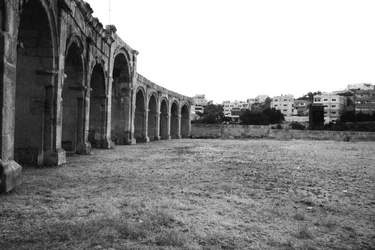
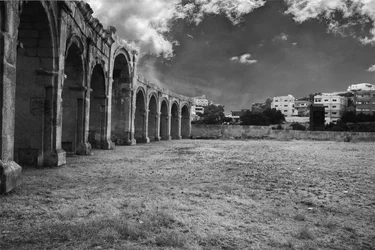
Because the area you are photographing has too large of a dynamic range to be captured by the cameras sensor. The sky is much brighter than what your camera metered for (the ground). If you shot in RAW, it might give you some leeway with the sky in terms of detail that can be recovered. If you shot JPEG, it's likely a lost cause.
I forgot the numbers but compared to the human eye our sensors suck at capturing dynamic range, that is the tonal ranges from hi to low in a single 'glance'. Your sample here has great shadow areas, dark tones along and under the stone work. The sky is way brighter in comparison. You could have shot one exposre for the sky and blended or made an HDR or used a filter with graduated density.

You could use a graduated ND filter in some situations... they are darker on top to help balance out the exposures. You could also shoot multiple exposures, and HDR them (combine them using software to optimize the different areas of exposure).
how in the world did you do that?
Layers, masks & the Clone tool.
You could use a graduated ND filter in some situations... they are darker on top to help balance out the exposures. You could also shoot multiple exposures, and HDR them (combine them using software to optimize the different areas of exposure).
Im completely inexperienced with filters. And im kind of on a budget. So i wanna get a cheap one first until i can get on of those $50-$70 ones. So my question is do you think its a good idea to just get one of these for now? or do you think they wont help?
Amazon.com: Sunpack CF-7328-GD6 Grey Graduated Density Filter: Camera & Photo