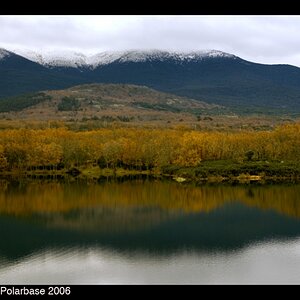
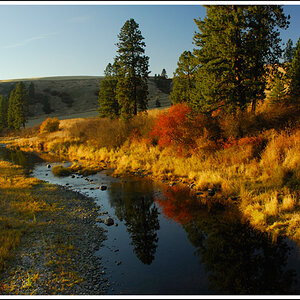
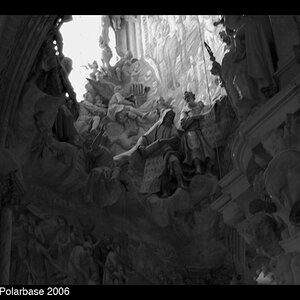
Stereoscopic is the side by side images, and a form of 3-D.
The White camera took slide film and then they were mounted side by side and you looked through a special viewer. It looked like it had depth.
Stereo Realist
http://en.wikipedia.org/wiki/Stereo_Realist
The Nimslo, which I still own, took four images and then you sent the film in for processing, they put a layer with facets over the top, and the picture looked 3-d. The print was actually sliced into very thin strips and re-assembled.
The antique stereo viewers, had two photos taken a slight distance apart, so the parallax created an illusion of depth.
Two images were used in the Wiewmaster the same way, then view with the two eyes. They were Stereo Vision. It was a modern stereo viewer, using back lighting, which made it stand out more.
The most basic 3-D image works when two identical flat images are viewed from two slightly different angles using a lens. The right eye sees the right image. The left eye sees the left image. The brain interprets the image from both eyes as depth.
Below are some common 3-D terms:
Anaglyph glasses: The traditional cardboard red-and-blue lenses used to view black-and-white 3-D movies, comics, and images. The two images are printed on top of each other, but offset. To the naked eye, the image looks blurry, but when the glasses are worn the image is clear and has depth.
Hologram: A 3-D photographic image made with a reflected laser beam on film. It has a variety of uses including security measures on credit cards.
Lenticular: A multi-layered image merged into one layer with a special lens over the image. When moved in a particular direction, the image appears animated and three-dimensional. Used on everything from postcards to comic book covers to religious icons.
Polarized glasses: Used primarily at IMAX films and 3-D laser shows, these silver lenses are cut at a 45-degree angle to show depth in two- dimensional images.
Stereoscopic: Any 3-D format.
Hope that helps?


![[No title]](/data/xfmg/thumbnail/40/40308-f92e28f094216c151f3ad1fd7453c99b.jpg?1734174716)



![[No title]](/data/xfmg/thumbnail/40/40306-ea393f71adcd88a9abb9fb16dc6af2d5.jpg?1734174714)
![[No title]](/data/xfmg/thumbnail/40/40307-b3813381d3c1ef8282c72905405b50fe.jpg?1734174715)