Different levels, different styles, different preferences. I started way back when with Corel's Paintshop. It did everything I needed at a price point waaay under Photoshop. I would have stayed with it, except it had a nasty habit of crashing in the middle of an edit.

The jury is still out on Adobe's move to be so heavily dependent on AI. Yes some of the features are useful, but so many of the Adaptive AI additions to LR are a real PITA for those of us who work multiple image in a set. The time required to update multiple AI masks can quickly exceed the time savings you achieved in the first place.
I watched the video. What it basically did was show me that Photoshop does a much better job with 1/2 dozen plus functions that are impressive but, seriously, the last time I took a photo with six people in it and then at the computer wanted to remove them all? I have never wanted to remove someone from behind a volley ball net and keep the net in the photo. All the generative fill, and expand and replace stuff -- I take photos almost daily and I edit photos every day and I'm not missing anything not having those functions. I'm a photographer. I just need to edit photos. It's going to be 10 months of daily editing photos before I encounter a single image that I think might be improved with that kind of stuff. I don't think I'm going to need to select and isolate bicycle tires any time soon.
I'm no expert at using Affinity (and won't become one), but it is an excellent and impressively capable raster editor. I've followed it since it's introduction and the core raster editor is superb. However, it's got some problems that have remained unchanged for years. It's ability to handle raw files is poor at best. In my case it's unusable. I can't successfully process most of my raw files at all in Affinity. It's the only major app I know of that doesn't do basic highlight reconstruction and I rely on that function. This newest version leaves all of it's raw processing weaknesses in place. The first step you'd take processing a raw file in LR/ACR, C1, PL-9, ON1, etc. is select an input profile. If you're real fussy you might use your own. Affinity? bupkis.
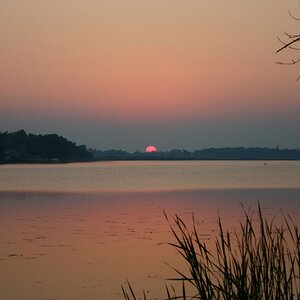
So for grins I decided to take a difficult photo and see how well I could do editing it in the newest (free) version. Picked a recent photo with tricky side/back lighting and a large shaded foreground. Couldn't use Affinity for the raw file so I converted the raw file in OM Workspace. First here's the default camera JPEG. The raw file exposure is nailed and so the camera overexposed the sky in the JPEG.
I figured that wasn't fair to give to Affinity. So I used OM Workspace and knocked the exposure slider down -.7 and both lowered the highlights and raised the shadows a bit. I saved a 16 bit TIFF and it's horrible: -- good test. So this is what I gave to the raster editor in Affinity:
And here's the photo processed using Affinity
And here's the processing stack:
First step I duplicated the background layer, masked the sky and used a Multiply blend mode to darken the sky and increase saturation. Masking the sky was easy, quick and very precise -- got every twig in the trees -- excellent job. Second step was a Brightness/Contrast adjustment layer along with a luminosity/range mask. The luminosity/range mask tool is awesome and allowed me to vary the adjustment layer's effect between the sky and foreground. Third step is an HSL adjustment layer which I used to tweak the sky and grass colors. Forth step is a pixel layer with a solid dark grey fill and an Overlay blend mode. I wanted to raise the contrast in just sections of the background -- the mask has the affected areas brushed in. Last step a vignette filter.
I had to figure out some things as I went. I knew Affinity had a luminosity mask but I had to find it and learn to use it. It's a classic layer stack raster editor with adjustment layers and filters -- a PS clone so I knew what I had to do -- finding the tools wasn't too hard.
The raw file is 15mb. So my processing overhead in terms of disk storage in C1 or PL-9 is 15mb. The Affinity file I saved to be able to save my work is 111mb so my processing overhead to use Affinity is 126mb -- a 740% increase. That alone keeps me away from all raster editors. Affinity's inability to process my raw files is a PIA. In version 2 of the original app they made a big improvement in their raw file processing and added an option similar to PS's SmartObject pass from ACR. They even one-uped PS and provided an option to pass a link to the raw file keeping disk space usage to a minimum. Both options permit returning to the raw develop module. The new free version maintains those functions but wouldn't do me any good. Most folks don't expose their raw files like I do so wouldn't have my specific problem but there's more wrong with their raw processing than just my problem.



![[No title]](/data/xfmg/thumbnail/37/37134-5a2bb173004bc7a08fdf2124814ebdc1.jpg?1734169835)
![[No title]](/data/xfmg/thumbnail/33/33876-69ae4c2723e06d63117dc3b1b6629647.jpg?1734164225)
![[No title]](/data/xfmg/thumbnail/37/37132-262f6a30f085c3ab6d83925db41b553b.jpg?1734169835)