What's new

Anyone keen to photograph some candles, for scientific experiment?

Status
Not open for further replies.
Do you realize that without resolution you don't have pixels which brightness you need to compare in order to deduce whether their brightness is the same or not across the sensor surface area receiving the light? How do you expect to deduce whether the brightness is uniform or not if you sum all the intensity into only one variable? Of course it will be uniform when your result can only hold one value. You need an array, a matrix, that can hold multiple values related to spatial distribution of received light.

o_0
 
Last edited:
HOLD EVERYTHING!!!!!!!!!! I figured out what the misunderstanding is. OP has been citing ONLY wiki, that ultra reliable source for any information on any subject.....:rolls eyes:
 
see, i'd agree. except that as far as I can tell everything he's cited from wiki is 100% accurate.

i'm pretty sure this is a matter of user error.
 
Idk, I haven't clicked on a single link in the thread. I thought it was supposed to be someone taking a picture of a candle, not a big debate about physics and astrology that near literally has nothing to do with pushing the shutter release and enjoying the result...
 
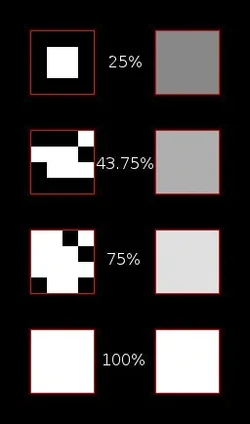
Alright, here's a stupid little picture I made. The left column of squares is from a 4x4 array of sensels from a high-resolution sensor. The right column of squares is a 1x1 array of sensels from a low-resolution sensor.

$stars.webp


As you can see, the top left square has a single star occupying the area of 4 sensels. We're lucky that our star is square so that it neatly aligns to our sensel grid. :) Each sensel receives 100% illumination from this star. The top right square is what the low-resolution sensor sees. The star occupies only 25% of the low-resolution sensel's area. The sensel registers a value of 25% illumination, which is the average illumination value of the 4x4 area of the high-resolution sensor (4 illuminated sensels / 16 sensels = 25% illumination).

The second row is like the first but has three more distant stars added to the image. These stars are twice as far as the first star in the center, so they each occupy an area of 1 sensel. Now 7 of the high-resolution sensels "see" light coming from a star.

The more distant stars each contribute only one fourth as much light (radiant power) as the first star, due to the inverse square law, but the image of each star also has only one fourth as much area as the first star, so they all produce the same illumination in the image (100% sensel values in this example). You have recently accepted this as a fact. You would be contradicting yourself if you now claimed that the distant stars would be "dim gray pixels" or something to that effect.

The low-resolution sensel on the right "sees" an illumination of 43.75% this time (7 illuminated sensels / 16 sensels = 43.75% illumination).

The third row is the same story as the second row: a few more stars are added to the mix (12 illuminated sensels / 16 sensels = 75% illumination).

Now we get to the bottom row. More stars are added (or maybe a single star at half the distance of the first star steps in front and occludes all the other stars). All 16 sensels in this sample are collecting light from some star, whether a near star or a distant star. The single sensel on the right is now completely "covered" with stars, so it too registers a value of 100% illumination (16 illuminated sensels / 16 sensels = 100% illumination).

One thing to take from this is that the illumination of "nearby" stars (stars that cannot be resolved individually) such as binary stars is indeed additive. If you had really thought about my LED traffic light experiment, you would come to the same conclusion. Each LED would have a small contribution to the illumination of each sensel in the low-resolution camera in that experiment, but many LED's would occupy a sensel. The illuminations would add up.

So regardless of image resolution, the model of the Universe proposed in Olber's paradox would be uniformly bright (neglecting phenomena such as local variations in brightness of each individual star--sunspots and the like).
 
As you can see, the top left square has a single star occupying the area of 4 sensels. We're lucky that our star is square so that it neatly aligns to our sensel grid. :) Each sensel receives 100% illumination from this star. The top right square is what the low-resolution sensor sees. The star occupies only 25% of the low-resolution sensel's area. The sensel registers a value of 25% illumination, which is the average illumination value of the 4x4 area of the high-resolution sensor (4 illuminated sensels / 16 sensels = 25% illumination).

The right side is not correct. It's an AVERAGE of all 16 pixels, but if you truly had 1x1 image that single pixel would collect all the light and have summed brightness of all the pixels on the left. The same would be true for all the other rows. Single pixel image would always be as bright as the sum of all the pixels from the left, all the light would end up at that single pixel.


The second row is like the first but has three more distant stars added to the image. These stars are twice as far as the first star in the center, so they each occupy an area of 1 sensel. Now 7 of the high-resolution sensels "see" light coming from a star.

You should have all the stars be the same size (point sources), where further ones would be less bright.


The more distant stars each contribute only one fourth as much light (radiant power) as the first star, due to the inverse square law, but the image of each star also has only one fourth as much area as the first star, so they all produce the same illumination in the image (100% sensel values in this example). You have recently accepted this as a fact. You would be contradicting yourself if you now claimed that the distant stars would be "dim gray pixels" or something to that effect.

Yes, I learned my lesson and I appreciate it. But there is only few dozen stars that have "resolvable" angular size, so for general case scenarios you should make all the stars be point light sources.


One thing to take from this is that the illumination of "nearby" stars (stars that cannot be resolved individually) such as binary stars is indeed additive. If you had really thought about my LED traffic light experiment, you would come to the same conclusion. Each LED would have a small contribution to the illumination of each sensel in the low-resolution camera in that experiment, but many LED's would occupy a sensel. The illuminations would add up.

I have no idea what point you are addressing. Illumination would add up just by having a single pixel instead of many pixels.


So regardless of image resolution, the model of the Universe proposed in Olber's paradox would be uniformly bright (neglecting phenomena such as local variations in brightness of each individual star--sunspots and the like).

You got uniform brightness when you averaged the image from the left into only one pixel. That's not regardless of resolution, that is what automatically comes with ONE PIXEL resolution. And you are neglecting little fluctuations in brightness of individual stars, as if that would make some difference, but you are completely ignoring further away stars would be dimmer than closer stars. These are not candles any more, stars are point light sources and they get dimmer with the distance
 
What is the 'wrong math'? You do realize that the logic behind the Paradox is resolution-independent, don't you?

Do you realize that without resolution you don't have pixels which brightness you need to compare in order to deduce whether their brightness is the same or not across the sensor surface area receiving the light? How do you expect to deduce whether the brightness is uniform or not if you sum all the intensity into only one variable? Of course it will be uniform when your result can only hold one value. You need an array, a matrix, that can hold multiple values related to spatial distribution of received light.

That is not what 'resolution-independent' means. In this case it means that Olbers' Paradox predicts a uniformly bright sky no matter what resolution it is viewed at. Given the assumptions of an infinite number of stars and infinite age, you can conclude that the sky will be uniformly bright without using a resolution-based model. We are having to use one because the greatest flaw in your theory concerns the addition of "grey dots" - stars whose image size has fallen below the resolution of the observing system. If the observing system had infinite resolving power, there would be no grey dots. Therefore we have to discuss resolution.

I hope that you appreciate the time and effort that people are putting into this to present a well-reasoned argument to you.

No matter what the finite resolution of the observing system is, there will be an infinite number of stars in the field of view of every skyward-looking receptor (1). Not all these stars will be visible to the receptor because of obstruction, but the entire field of view of each such receptor will be filled with stars, seamlessly (2).

The further away a star is, the lower its luminous flux will be (3) (assuming constant luminous intensity - ie obeying the "inverse square law") but the smaller its ideal image area will be (4). These two cancel each other out to maintain constant ideal image illuminance (5). This is an extension of the candle brighness discussion. The star appears as a point source because of the receptor system resolution (but see 12 later) and only because of the receptor resolution (6). It is not a point source in reality (7), so it can be considered as a source of finite area (8).

(Note that it is the stars' finite image size that limits the brighness of the sky in this discussion. If it were a true point source the sky would be infinitely bright (9).)

Now, because the surface of the receptor is seamlessly filled with star images all having the same image illuminance as a nearby star (see 5) the overall image illuminance is the same as a nearby star (10). Therefore the sky is uniformly bright; the image of it has uniform illuminance (11).

It does not actually matter that the image on the receptor is smeared by optical aberrations and diffraction because ideal theory predicts uniform illuminance, so any consistent smearing of the ideal image also results in uniform illuminance (12). It is the energy flow that is important.

 
Last edited:
That is not what 'resolution-independent' means.

That is not addressing my question. Here it is again:

How do you expect to deduce whether the brightness is uniform or not if you sum all the intensity into only one number?
 
That is not what 'resolution-independent' means.

That is not addressing my question. Here it is again:

How do you expect to deduce whether the brightness is uniform or not if you sum all the intensity into only one number?

I have addressed your question by explaining that resolution independence does not mean summing all the intensities into one number. Now you really are trolling.
 
I have addressed your question by explaining that resolution independence does not mean summing all the intensities into one number.

There is no such thing as 'resolution-independent'. I am not talking about your imaginary dictionary, I am referring to mathematics and equations used in original treatment of Olbers' paradox. And there they do sum up all the intensity into one number called 'total intensity'. Here is how it goes:

http://www.asterism.org/tutorials/tut09-1.htm

images


Since the area of a sphere of radius r is

A = 4p r2 (1)

the volume of such a shell is

V = 4p r2t (2)

If the density of each of the luminous objects within the shell is "n", then the total number of these objects in the shell must be

N = 4p r2nt (3)

Now let us ask just what amount of energy such a shell will send to the Earth. Since the shell's thickness is small, it is reasonable to assume that the entire shell is at a distance "r" from the earth. The energy, E, emitted by any source at distance r, produces an intensity, "I", over a given area, A, on the Earth of (inverse square law)

I = E/4p r2 (4)

The total intensity received on the Earth from all the sources in the shell r units away must then be the intensity produced by each source times the total number of sources or

T = IN (5)

Substituting the value of N previously calculated into the above, we find that

T = tnE (6)

We notice at once that the total energy received from any chosen shell does not depend upon its distance from us (no r in the above equation). The total energy received from all the shells is the sum of the contributions of each shell. If there are M shells this total is

S = tnEM (7)

But there is an infinite number of shells and so the total intensity on the earth must be infinite. Therefore, the nighttime sky should be blindingly bright!


--//--

How do you expect to deduce whether the brightness is uniform or not if your result is a single number?
 
Tris_d, your profile doesn't show a location, but it does appear that you may be a resident of the the lovely town of La Mancha.
 
Tris, do you not see that if I can describe a universe in which

- all the conditions of Olber's Paradox hold true
- the inverse square law applies
- and the night sky is pure white

your thesis disintegrates?

Proof by contradiction - Wikipedia, the free encyclopedia

Go on and try.

You didn't answer my question. I'm not going to go to the effort of writing up such a description if you don't first see why it would be interesting.
 
You didn't answer my question. I'm not going to go to the effort of writing up such a description if you don't first see why it would be interesting.

I thought it was obvious my invitation implies that I agree to what you said. -- I expect you will just repeat the original treatment of Olbers' paradox which would be slightly amusing, or alternatively you could come up with something different, in which case you would not only be proving me wrong, but also the original treatment of the paradox just like I do, and that would highly amusing.
 
Status
Not open for further replies.

New Topics

Back
Top Bottom