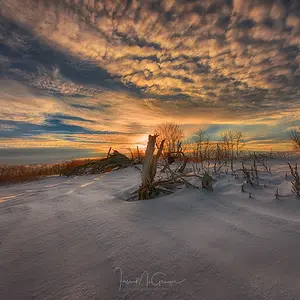
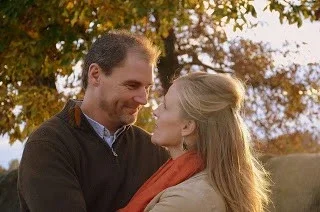
Shooting at sunset, and with the sun behind is a good technique, but as Pixmedic noted, that approach needs additional lighting help, as you're photographing the shadow side. The shadow side is usually 2-3 stops darker than the sun-lit side, and is of a different colour temperature than is the sunlit side, especially at sunset. That is because the shadow side is lit mainly by the blue sky in front of the subject, and the sky is bluer than the setting sky.
To fill in the shadows, you can either use a reflector, which can supply both some light, and some reddish colour from the setting sun. Or you can use a flash for providing fill.
The first question would probably be: how important is the background? If it is important to have it show up clearly and well exposed, say because it provides a context for understanding the subject, then you need to choose a focal length and aperture that will allow us to see the background. If the background is NOT important, and may in fact distract the viewer from focusing on the main subject, then you need to either reduce the exposure (relative to the subject), or use a focal length and aperture that will blur the background significantly, or both. Let's assume that the background was NOT important, but you wanted it the same tonality as the subject. So exposure setting for the background would be based on the matrix/evaluative metering mode. For getting the blur, you need to know that larger apertures (those with smaller f-numbers) give thinner depths-of-field and blur the backgrounds/foregrounds more. Also, longer focal lengths have thinner depths-of-field than wider focal lengths at the same aperture. So choosing a focal length of (say) 135mm or even 200mm and an aperture like f/2.8 or f/4 would throw the background into a nearly-unrecognizable blur.
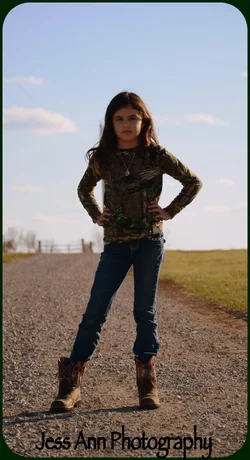
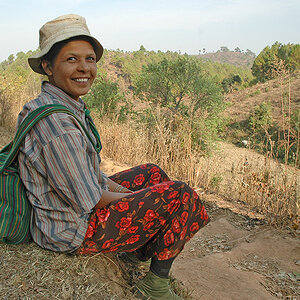
The exposure for sunset is about 1/125sec at f/4 at ISO100. You "could" spot-meter off her face and get the right exposure for the shadow side, (say, around 1/15 sec. at f/4 and ISO 100), but now the background will be 3 stops brighter and washed out. As noted earlier, with the sun behind the subject, the face is lit primarily by the blue sky and the light bouncing back from the foreground. If you used a large reflector (say, a 4x4 piece of white foamcore), you could bring the shadow side up 1-2 stops and provide enough light to clearly see the girl's features, while still keeping her face "in shadow". Then, your exposure for the background stands, but you will now have light in her features.
If you decided to use flash, in this specific case (since we're using a long aperture to blur the background), you'd need to use an off-camera flash, with an orange gel (because the colour of the flash is bluish, and you want to have it more or less match the redness of the light of the setting sun), and you'd need to adjust the power to give you enough exposure. What is "enough power" will again depend on how you want the girl's features to look. If the intent is to have some shadow, but with well lit features, then the power setting should be set to give perhaps a 1 stop under-exposure. If you want the features to be well exposed, then you may want to increase the power to make that exposure equivalent to the background.
As you can see, there are a lot of factors to take into account when constructing the image, and a lot of decisions to make before pressing the shutter. The links that Keith gave you will fill in some of those gaps of knowledge. Then you need to get the right equipment to allow you to put the light where it needs to be.




![[No title]](/data/xfmg/thumbnail/41/41800-9fad93555f178073cae2f303c5ef4e23.jpg?1734176111)