What's new

Can someone please explain further what METERING is?

rateeg

TPF Noob!
Joined
Nov 13, 2010
Messages
315
Reaction score
7
Location
Australia
Can others edit my Photos
Photos OK to edit
Hi.
Im really quite confused with metering, all i know is it's the center of focus.
Either on the center or the whole frame.

Is there any other use of it?
And any tips on using it?
 
Hi.
Im really quite confused with metering, all i know is it's the center of focus.
Either on the center or the whole frame.

Is there any other use of it?
And any tips on using it?

Have you looked this up at all?

You can meter one small spot on the frame (spot metering). You can take a counterweighted average (60/40 center/outlying areas), and the new cameras do matrix and evaluative metering as well (smarter than former modes).

It's useful when manually setting exposure or exposing for a flash. You can use a cameras built in meter or an off-camera light meter in order to get what the scene calls for as a 'correct exposure' - but it's not perfect and it's designed to expose to get 18% gray, regardless of the scene.

When taking pics in the snow and stuff, it's helpful to keep an eye on your meter. A snowy scene will come out grayish, since the meter is trying to achieve an 18% gray tone in the white snow. In that case you'd want to 'overexpose' 2/3 to a full stop to get the snow to be white.
 
Metering is like the autopilot in a plane. Or like a compass. It tells you which way to go to stay on course.
The center weighted metering examines the center area in order to make the determination on how to stay on course.
Spot metering examines a spot in order to make the determination on how to stay on course.

The only use of metering is to suggest how to probably get an acceptable photograph. Then it adjusts camera settings automatically unless you are in manual mode. Acceptable in several different ways. i.e. an acceptable spot, acceptable center or acceptable other areas. Acceptable is like staying on course.

Put your metering setting to include a large area of the frame unless you know for a fact how to use it otherwise. With experience you may learn why. The camera default setting is probably the best choice.
 
Metering is basically measuring light to determine correct exposure.

Meter types fall into two basic categories: Reflective Metering (measuring light bouncing off of your subject) or Incident Metering (measuring light falling onto your subject). All cameras, I believe, pretty much use Reflective Metering, measuring light bouncing off of a subject. But Reflective Metering can be fooled in certain situations and you may be better served by Incident Metering.

Within a camera’s Reflective Metering system, it may offer you three metering modes: Full Frame metering (which measures light in the entire frame), Center Weight Metering (which bases most of its decisions on light near the center of the frame) and Spot Metering (which bases its exposure decisions on a selected spot in the frame). What you are shooting will determine which metering mode you should choose.

Your camera should have a chapter of metering modes and how to use them. Not all cameras offer all metering modes. Good luck.
Excellent explanation. :thumbup:
 
Metering is basically measuring light to determine correct exposure.

Meter types fall into two basic categories: Reflective Metering (measuring light bouncing off of your subject) or Incident Metering (measuring light falling onto your subject). All cameras, I believe, pretty much use Reflective Metering, measuring light bouncing off of a subject. But Reflective Metering can be fooled in certain situations and you may be better served by Incident Metering.

Within a camera’s Reflective Metering system, it may offer you three metering modes: Full Frame metering (which measures light in the entire frame), Center Weight Metering (which bases most of its decisions on light near the center of the frame) and Spot Metering (which bases its exposure decisions on a selected spot in the frame). What you are shooting will determine which metering mode you should choose.

Your camera should have a chapter of metering modes and how to use them. Not all cameras offer all metering modes. Good luck.
I would just add strobed light metering to incident and reflected light and that in spot metering mode the spot is pretty small, as ssmall as only 2% of the frame.

So Matrix or evaluative metering looks at the entire scene and takes an average.

Center-weighted looks at the entire scenen too, but weights the average to the middle (circular) 60 or 70% of the scene, while spot metering only looks at that small area under the spot. (Many cameras let you change the size of the spot. At maximum it's metering maybe 10% of a scene.

So spot metering is the most accurate, but if you want to meter various parts of the scene you have to meter multiple times as you point the camera at those parts of the scene you want to meter.

This is one of the things I cover on my blog: http://kharrodphotography.blogspot....d-max=2010-01-01T00:00:00-06:00&max-results=9
 
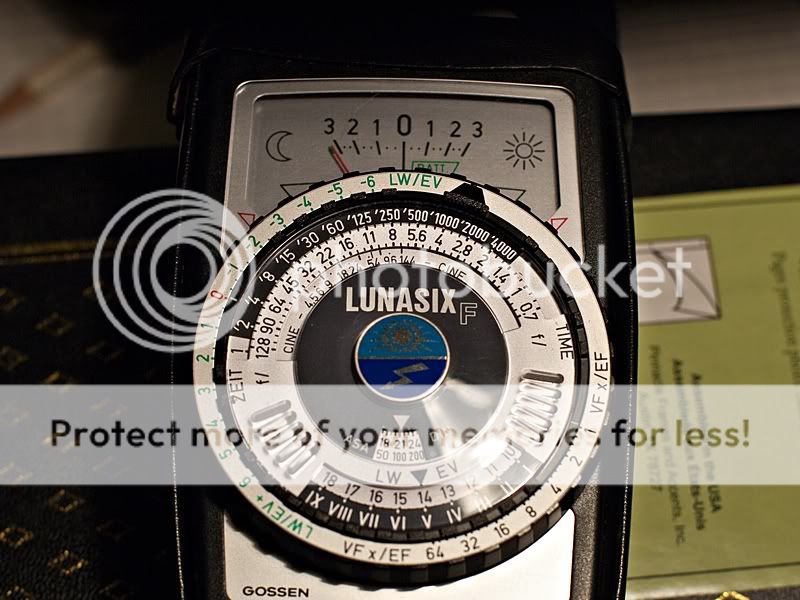
I think it is to bad most folk never learned the exposure triangle by using a light meter. A light meter makes it so easy to understand. I will present an example here.

First you would set the ASA/ISO speed (white triangle below centre) on the meter, in this case 100 & then take a light reading of the subject. The meter would then tell you which combination of shutter speed & aperture would properly expose the subject. In the photo below you see the shutter speeds (time) in the black ring & the corresponding f stops in the white ring below. So, in the case of this reading any of the following exposures would equal the same result.
60/f16
125/f11
250/f8
500/f5.6


P1050178.jpg


If the meter had been set @ ASA/ISO 200 the readings would be:

125/f16
250/f11
500/8
& so on.

I hope some folk will find this helpful.
 

Create an account or login to comment

You must be a member in order to leave a comment

Create account

Create an account on our community. It's easy!

Log in

Already have an account? Log in here.

Back
Top Bottom