What's new

Do I need a new lens?

If the eyes are shadowing too much to dark patches you could try a flash/reflector at a long angle and off to one side to send light up under their face a little to relive (not remove) the shadowing effect.
 
im not sure if understand your question but if your shooting with a 35mm prime or a 50mm its normal that if you move back like 15 feet from you subject and take a full body shot and then you crop it around the face, you wont have the same amount of details or sharpness, catch light or any other details that would show on a tighter frame shot taken at like 3 feet from the subject.


To take a full body shot of 1 person (5.9ft tall)) with a 50mm on a crop sensor (1.5x) camera you need to be at around 20ft from your subject (from the test i made in my studio)
so at 35mm you would need at least 16 feet for a full body shot.

If you take the same full body shot with a wide lens like a 24-70 at 24mm obviously will be closer to your subject to get the same full body shot but the perspective will be different.
 
but can't you fix that in post?

I could never use an 85mm in my "studio" space. aka living room. With my 35mm I'm butt to my sliding door as it is to get a full body shot.
 
you need around 35 ft to get a full body shot with a 85mm.
 
Ok, I messed around with 35 and 50 with crop and full frame. First of all Canon's crop factor is 1.6X. 35 x 1.6 = 56mm So it is not exactly 50mm. It is also hard to put the location of the sensor exactly the same because the bodies are quite different. I put 2 photos in different layer and try to resize the cropped sensor one because it is actually around 56 mm. So I give up. But I tell you this. 50mm will look as natural in both crop and full sensor. 50 mm in a crop sensor is basically EXACTLY the same image as 50mm in a full frame but you crop out the 37.5% of the width and the height. Putting a 31.25mm (50/1.6) on a crop sensor will not give you the same as 50mm on a full frame. It is too hard to test it at home. No matter how hard you try, you wont be able to put the 2 images on the top of eachother because the 31.25mm will give you a slight different distortion. PERIOD.
 
Can you put the side-by-side comparison images, similar to what I did? I think my images were sized to 400 pixels wide. It wouold be interesting to see.
 
I wonder if a distortion correction tool could be used to lessen the difference - something out of lightroom of even DxO labs RAW converter.
 
My test samples are trash K. When I put the different bodies on the tripod, it is not exactly the same because probably the 5D sits a little higher. I have to think about this for a while. Also, when you dont pick exactly the same focus point, your view totally changed too (larger or smaller). It is very complicated and I am giving up hahaa.
 
A couple of thoughts for your worries. Could pick a static focal point with the higher sitting camera first, say like a knuckle on one of your light stands. Using a bubble level, make sure all is square and secure and redundant. Easier I think, would be to set the focal point with the higher body and then raise center column or even a slight horizontal twist of your tripod as needed to hit the exact same point. I would also shoot in protrait orientation so viewing the side-by-side shots on a monitor would be easier.


Just my 2¢.
 
perspective will never be the save even with the match the focal lenght,
 
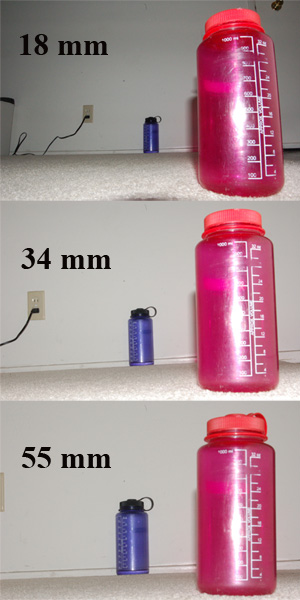
Photo quoted from Wikipedia (http://upload.wikimedia.org/wikipedia/commons/e/e5/Focal_length.jpg)

Focal_length.jpg

Does this photo make sense? Imagine that the pink water bottle represents an outstretched hand, or a leg extended toward the camera; with the short focal length lenses, whatever is close to the camera appears disproportionately LARGER than background objects in terms of "real life" expectations of size and spatial relationships. A shot done inside of a large room with an 18mm lens can make the room appear to be MUCH larger than it actually is. It can also make a person's nose appear unusually large and prominent, in relation to the size of their ears.

The second thing to look at is how when the camera is moved farther away from a foreground object, and the lens focal length is increased to compensate for the increased camera-to-subject distance, it is possible to create the same,exact image size of a foreground object. BUT,and this is a critical thing to notice---the angle of view BEHIND the foreground subject grows narrower as focal length increases. A third behavior to note is that as focal length increases, the apparent distance relationship between foreground and background changes. Longer lenses appear to "compress distance", and longer lenses increase the magnification of distant objects, while shorter focal length lenses appear to "expand distances".

The above example is a very good illustration of why short focal length lenses and close shooting distances make such sucky people photographs...
 

Create an account or login to comment

You must be a member in order to leave a comment

Create account

Create an account on our community. It's easy!

Log in

Already have an account? Log in here.

New Topics

Back
Top Bottom