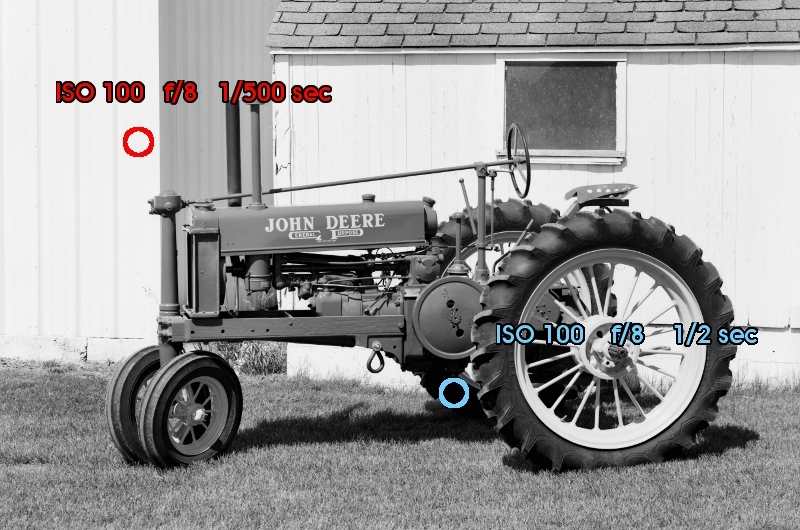
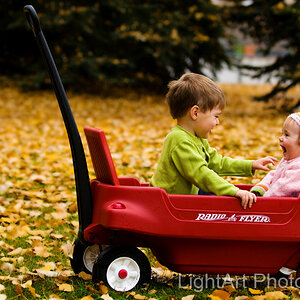
Let's try this: Here's a scene. It has a lot of dynamic range to it. I'm just going to toss numbers out since I don't know what, exactly, the true numbers were since I took this 3 years ago. But let's just use this as an example.
Let's say you want to photograph this scene, and want to know what the dynamic range is in it. You pull out a spot meter (or, if your camera has that feature, you set the internal meter to SPOT). You scan the scene for what you think is the darkest portion of it. You aim your meter at where the blue circle is and you come up with an exposure of ISO 100, f/8 at 1/2 second.
Now you look for the brightest part (the red circle). You meter it, and come up with ISO 100, f/8 at 1/500 second.
I used ISO 100 and f/8 for both exposure to simplify the math. Starting at 1/2 sec, if you decrease exposure by 1 stop, you have 1/4 sec. 2 stops = 1/8. 3 stops at 1/15. 4 stops at 1/30. Five stops for 1/60, six stops for 1/125, seven stops at 1/250 and 8 stops at 1/500, which is the shutter speed for the brightest portion of the scene.
The dynamic range of the scene would then be 8 stops. If you took two images, one at ISO 100 f/8 1/2 sec and another at ISO 100 f/8 1/500 sec, the first exposure would render the area in blue the same brightness as the red area would be in the second shot.






![[No title]](/data/xfmg/thumbnail/30/30991-43abf4dfee0a54010692c71c43f40981.jpg?1734159055)
![[No title]](/data/xfmg/thumbnail/37/37605-90c8efaef5b7d1f52d4bf8e7dfd33673.jpg?1734170732)