What's new

Film black and white vs digital black and white

This thread hasn't seen a lot of action for a couple of weeks but I'd like to dive in anyway.

There's no good answer to the analog v. digital debate. It's so dependent on individual aesthetics, required functionality, method preference...

One thing I'll add that hasn't been said is that I feel at a certain point, images created and modified solely in digital format become less about photography and more about graphic art. I believe there's a spectrum, from the more traditional film, wet developing and printing to the modern digital imaging and editing. There's overlap for sure, and I'm not sure where the line in the sand is to be drawn. And that's as far as I care to get into this debate at the moment.

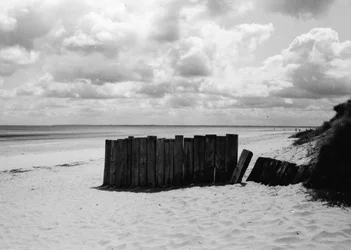
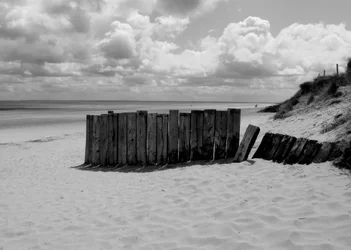
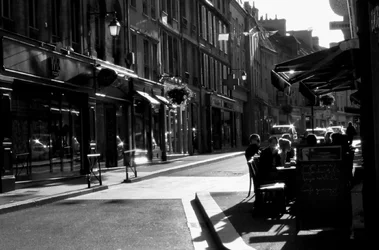
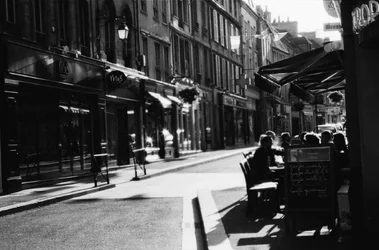
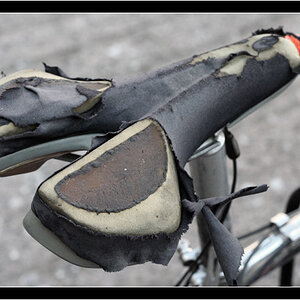
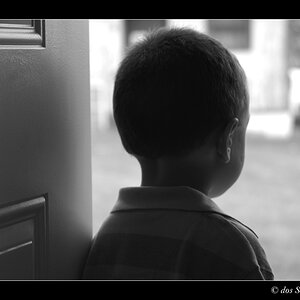
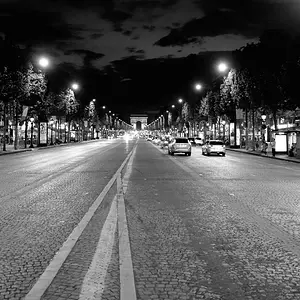
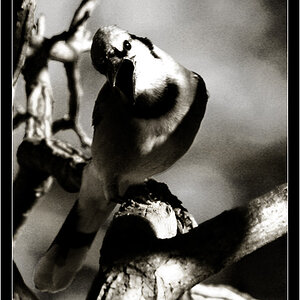
What I would like to do is to present some images and I'm interested to read thoughts about the differences. There are two scenes and two pictures for each scene. The film was originally shot in black and white (Tri-X). The digital images were converted to B&W and I tried to make them as similar as I could in terms of lighting and contrast without going too crazy. I'm not identifying which is digital and which is film. No, it's not a test to see if you can tell which is which: I'm truly interested in what you like or dislike about each version and I don't want your biases (one way or another) to get in the way.

View attachment 47255View attachment 47256View attachment 47257View attachment 47258
 
One thing I'll add that hasn't been said is that I feel at a certain point, images created and modified solely in digital format become less about photography and more about graphic art.... There's overlap for sure, and I'm not sure where the line in the sand is to be drawn.
I can't agree with you more.
I would like to see your samples, but there is something wrong with your attachments, can you try to upload them once more ?
 
Hmmm - when I uploaded last night, they were showing but now I just see attachment links. Weird. Let me try uploading them in a different configuration.

Scene 1a
$Beach and windbreak 3.webp

Scene 1b
$Beach and windbreak b.webp

Scene 2a
$Cafe 1.webp

Scene 2b
$Cafe 2.webp
 
Yes, you're right, there is no way to tell with 100% certainty What's film, what's not. Here is the problem, all of them are digital now, there is no other way to show a picture on the computer.
The whole discussion about digital and film b&w photography is a bit off. It is not, how the final print looks: computer can simulate a lot, no problem here, it is the whole mental process of creating b&w image. If you load in your camera b&w film you have to think b&w: you have to see the world the same way film and chemical process will record it. If you don't know your film and process, you cannot expose the film in a way it will support your vision, just to align the needle of light meter is not enough, that is good for snapshots. Modern dslrs have much, much more sophisticated method of deciding the exposure and still can't read photographer's mind. But that is still good enough for digital sensor. Shooting digital sensor you cannot think in b&w the same way like with film. Basically you are shooting color slide, you may have b&w vision of the picture in your head, but your exposure it for something else.
B&w process starts on computer with: "what we have here...ah... let see how it looks in b&w", and maybe you on your way to create a great b&w image, but the creation is not photographic anymore, it's digital arts.
So, discussion between the men what is better to use for b&w images is pointless; use what is better for you in sens of satisfaction (from the POV of enthusiast, not professional of course).
 
Yes, you're right, there is no way to tell with 100% certainty What's film, what's not. Here is the problem, all of them are digital now, there is no other way to show a picture on the computer.
The whole discussion about digital and film b&w photography is a bit off. It is not, how the final print looks: computer can simulate a lot, no problem here, it is the whole mental process of creating b&w image. If you load in your camera b&w film you have to think b&w: you have to see the world the same way film and chemical process will record it. If you don't know your film and process, you cannot expose the film in a way it will support your vision, just to align the needle of light meter is not enough, that is good for snapshots. Modern dslrs have much, much more sophisticated method of deciding the exposure and still can't read photographer's mind. But that is still good enough for digital sensor. Shooting digital sensor you cannot think in b&w the same way like with film. Basically you are shooting color slide, you may have b&w vision of the picture in your head, but your exposure it for something else.
B&w process starts on computer with: "what we have here...ah... let see how it looks in b&w", and maybe you on your way to create a great b&w image, but the creation is not photographic anymore, it's digital arts.
So, discussion between the men what is better to use for b&w images is pointless; use what is better for you in sens of satisfaction (from the POV of enthusiast, not professional of course).

I only bothered to examine the first set and I won't take on the 100% factor but I'm 99% certain the Scene 1a is scanned film and the Scene 1b is from a digital camera.

Joe
 
I only bothered to examine the first set and I won't take on the 100% factor but I'm 99% certain the Scene 1a is scanned film and the Scene 1b is from a digital camera.Joe
I rely on your experience Joe, can you give me some pointers ? How do you see it ? It's the sharpness ?
 
I can't tell... In both cases, "B" looks to have more range (more shadow detail), but that could be the processing, so there is really nothing to go on... The highlights look the same to me in A and B.
 
I only bothered to examine the first set and I won't take on the 100% factor but I'm 99% certain the Scene 1a is scanned film and the Scene 1b is from a digital camera.Joe
I rely on your experience Joe, can you give me some pointers ? How do you see it ? It's the sharpness ?

I just looked at the second set. Scene 2a is digital and Scene 2b is scanned film. The OP reversed the order on the second set -- film/digital then digital/film. You have to look close and you can see the film grain in the film shots, but the real give-away for scanned film is always the spotting. It's easier for a camel to go through the eye of needle as Jesus said than it is to clean all of the cr*p off a piece of film before you scan it. And then if you take it into Photoshop and start cloning out all those spots you're either going to miss a few or you're going to start being thankful that you only average one keeper per 36 exp. roll. In the two film shots I just spotted the pieces of scanned lint the OP failed to spot out.

Joe
 
Yes, you're right, there is no way to tell with 100% certainty What's film, what's not. Here is the problem, all of them are digital now, there is no other way to show a picture on the computer.
The whole discussion about digital and film b&w photography is a bit off. It is not, how the final print looks: computer can simulate a lot, no problem here, it is the whole mental process of creating b&w image. If you load in your camera b&w film you have to think b&w: you have to see the world the same way film and chemical process will record it. If you don't know your film and process, you cannot expose the film in a way it will support your vision, just to align the needle of light meter is not enough, that is good for snapshots. Modern dslrs have much, much more sophisticated method of deciding the exposure and still can't read photographer's mind. But that is still good enough for digital sensor. Shooting digital sensor you cannot think in b&w the same way like with film. Basically you are shooting color slide, you may have b&w vision of the picture in your head, but your exposure it for something else.
B&w process starts on computer with: "what we have here...ah... let see how it looks in b&w", and maybe you on your way to create a great b&w image, but the creation is not photographic anymore, it's digital arts.
So, discussion between the men what is better to use for b&w images is pointless; use what is better for you in sens of satisfaction (from the POV of enthusiast, not professional of course).

I only bothered to examine the first set and I won't take on the 100% factor but I'm 99% certain the Scene 1a is scanned film and the Scene 1b is from a digital camera.

Joe

Opposite way round on scene 2 b is film a is digital
 
The first has rather dramatic grain and rather opaque shadows.

The differences between the pictures are clear, but they consist of things I don't care much about. I don't care about the fine details of the tonal rendering curve, and that's pretty much what all the differences are. I do like some translucency in the shadows and a touch of texture in the whites, but I'm not fanatic about it. The upshot is that I have no preferences in your samples, really, and I know precisely why.
 
I like how my B+W come out. Never shot film, but I couldn't tell the difference anyway. As for gsgary's example, that's such a misrepresentation of digital vs film. You could easily match that film b+w with a digital camera.
 
I like how my B+W come out. Never shot film, but I couldn't tell the difference anyway. As for gsgary's example, that's such a misrepresentation of digital vs film. You could easily match that film b+w with a digital camera.
There is no problem with matching, with flexibility of digital technology it is no problem to surpass.
 
Scene 1A = film
Scene 1B = digital

Scene 2A = digital
Scene 2B = film

There was no processing of the film images once they were scanned in, which yes, included some missed pieces of dust from the scanning. No matter how hard you clean the film and the scanner screen, there really is no way to avoid pieces of dust.

I find that software does a pretty decent job turning digital color shots into black and white as long as you don't rely on the auto settings (but that's pretty much for any 'fix' - I despise Auto Correct) and know how to go in and mess with histograms and curves and have time to mess around. I'm either less impressed or less skilled with color modifications. They tend to look too fake too fast for my tastes.

The problem with trying to say 'digital surpasses' or 'film surpasses' is that it assumes that everyone does/should have the same set of criteria for judging a photograph. Personally, I find the incessant demand for uniform sharpness or post-processing bokeh in digital imaging to be a bit boring. I like grain. I like imperfections. The film cafe scene is one of my favorite shots, including that spot of "notalgia blur" in the center of the image that was the result of a smudge on the lens that I didn't know about until I processed the film. Others might be really bothered by that because they want everything sharp. Or they might want more contrast or more detail in the shadows or highlights. We all like different things about photography - both making and consuming - and these are very personal, subjective aesthetics, so it's essentially a moot debate. There's no way to objectively and logically 'win' this one.

It kind of reminds me of something a few years back: someone posted a picture by Henri Cartier Bresson on Flickr without saying who the photographer was. The comments that came in about what he should do to improve his photography if he wanted to be a professional were fairly amusing. Why You Shouldn't Give Too Much Weight to Anonymous Online Critics
 
The whole discussion about digital and film b&w photography is a bit off. It is not, how the final print looks: computer can simulate a lot, no problem here, it is the whole mental process of creating b&w image. If you load in your camera b&w film you have to think b&w: you have to see the world the same way film and chemical process will record it. If you don't know your film and process, you cannot expose the film in a way it will support your vision, just to align the needle of light meter is not enough, that is good for snapshots. Modern dslrs have much, much more sophisticated method of deciding the exposure and still can't read photographer's mind. But that is still good enough for digital sensor. Shooting digital sensor you cannot think in b&w the same way like with film. Basically you are shooting color slide, you may have b&w vision of the picture in your head, but your exposure it for something else.
B&w process starts on computer with: "what we have here...ah... let see how it looks in b&w", and maybe you on your way to create a great b&w image, but the creation is not photographic anymore, it's digital arts.
So, discussion between the men what is better to use for b&w images is pointless; use what is better for you in sens of satisfaction (from the POV of enthusiast, not professional of course).

I agree - I shoot differently when I have B&W loaded than when I have color. When using a digital, as you said, it's "let's see how this will look" and it becomes - for me anyway - a less thoughtful process.

Part of the issue is that neither film nor digital cameras work the way the human eye works, so it's always a challenge, no matter what the tool, to create an image that matches what you see or what you imagine in your mind. I personally take more satisfaction when my film image comes out the way I imagine it because shooting film requires me to think more while digital just allows me to shoot more. Like you, I'm not talking about professional photographers who are of course very skilled and thoughtful with their tools and images. They have to be. But I don't think my experience with digital is so different from that of the casual digital 'photographer' who can get some cool bird shots with sport mode and continuous shooting but can't even tell you what an aperture is. ;) For me, post processing is more about minor little fixes rather than the start of major alterations that result in an entirely different image.
 
The fact that no one jumped out and said that photo by HCB was great means 2 things to me.

1 - They said it's not great, because they really think it's not and they weren't influenced by a house name
2- Standards change with the times. And that photo just isn't up to snuff with our current standards.

Me personally, I don't really think that it's a great photo either. Just because it's a photo by the revered HCB, doesn't mean I'm automatically going to think it's amazing.
I also think that he was a fraud, and a lot of his decisive moment photos were staged. But hey, that's just me.
 

Create an account or login to comment

You must be a member in order to leave a comment

Create account

Create an account on our community. It's easy!

Log in

Already have an account? Log in here.

New Topics

Back
Top Bottom