What's new

Frozen in motion.

JustJazzie

Been spending a lot of time on here!
Joined
Jan 21, 2013
Messages
3,793
Reaction score
1,732
Location
Bailey, Colorado
Can others edit my Photos
Photos OK to edit
Well, my new camera and lens will be here any hour now, and as soon as the battery is charged I'll be underway. The most interesting things around here to shoot in motion are my kiddos, and LOTS of birds. I've done a little research on moving subjects, and of corse remember the "basics" from photo class via 2000 and something, but I'd really like some user tips for catching motion. What's your technique for shooting birds? Do I zoom my lens and then try to find the bird? Find the bird in the viewfinder and then zoom? Or do I find the bird and wait for it to fly??
what shutter speeds are nessessary for panning?

All tips and tricks are appricated!
 
Panning: one of the VERY few times I will EVER use shutter speed priority automatic. Panning looks good at different speeds, depending on the subject matter. The best panning is often when the subject is in afternoon or morning sunlight that is fairly strong and has a good, strong direction to it, so that they cast a shadow on the ground, and they are in good light, but the background is clean, and not all cluttered with junk. Big, white things in front of darker backgrounds create big, long, light-colored smears when panning.

Panning works well if the background is a simple thing, like a distant hedge or patch of trees, and the subject is in sunlight, so that the background just becomes a simple color-wash. Other backdrops that work are grass or sand, and simple scenes; avoid busy backgrounds with strong geometric shaped things. At slow speeds, like 1/3 second, panning shots become impressionistic. At slow speeds, when the mirror goes up, the tendency is to slow, or even stop the camera, usually ruining the shot. I used to shoot a lot of panning shots of bikes and motos,and I found that sighting over the top of the pentaprism's hotshoe can work very well, as a way to keep the camera swinging along and tracking the subject exactly. This becomes a BIG deal at slow speeds in the 1/2 to 1/8 second range. s the speeds go up, the actual shot is pretty easy to track.

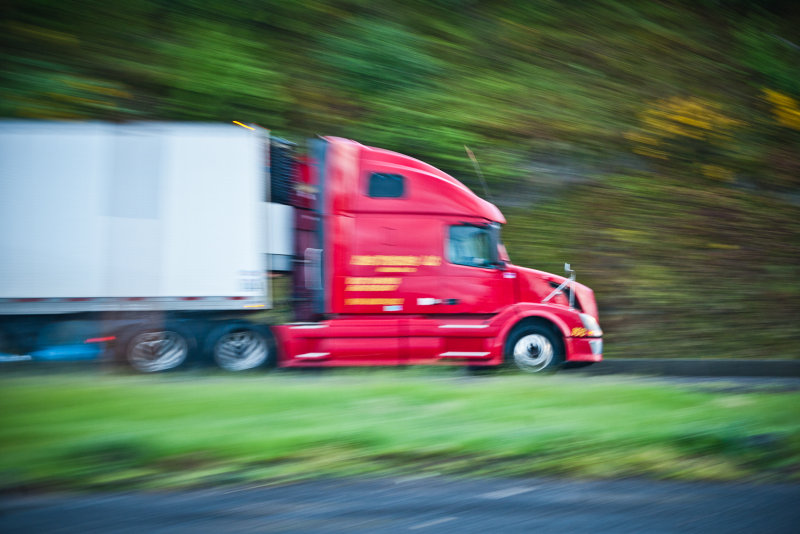
The last panning shot I did was this one.
155745080.jpg


It was a HEAVILY overcast, intermittently rainy day, and this was about an hour before sunset, shutter speed of 1/50 second,f/4.5, ISO 500, and a semi-truck moving at probably 65 MPH, directly parallel with me and about 150 feet away, across the other side of the freeway. As you can see, I did NOT track his progress perfectly, so there's a bit of a "Zooming" effect. Look at the front wheel on the tractor; can you see the black spider?

I hope you enjoy the HECK OUT OF the new camera Jazzie!

 
Well, my new camera and lens will be here any hour now, and as soon as the battery is charged I'll be underway. The most interesting things around here to shoot in motion are my kiddos, and LOTS of birds. I've done a little research on moving subjects, and of corse remember the "basics" from photo class via 2000 and something, but I'd really like some user tips for catching motion. What's your technique for shooting birds? Do I zoom my lens and then try to find the bird? Find the bird in the viewfinder and then zoom? Or do I find the bird and wait for it to fly??
what shutter speeds are nessessary for panning?

All tips and tricks are appricated!

i find it hard to zoom in all the way on a bird (that is stationary) and attempt to catch it flying away. Maybe for the couple of times I've tried it, i was too close to the bird. He was gone before I could find him in my lens.
Best advise is to keep practicing. There are a million objects to practice with.
If you can perfect running kids, let me know your secrets!
 

Attachments

  • $image.webp
    $image.webp
    315 KB · Views: 150
For bird photography:

- Set your auto focus to continually track the target (AI Servo on Canon)
- Set your shooting mode to burst/continuous
- Set the ISO to auto
- Use either Aperture or Shutter priority modes. Typically, Aperture priority is going to get you a little motion blur if that's what you're into. People typically use wide Apertures (lower number) to let in more light and get a good background blur going. Otherwise, if you want to stick with Shutter priority, throw it on 1/1000th or faster if you want to try to grab the subject in motion. You can bring it down slower than that if you aren't dealing with a panning subject.

As far as tracking a panning target, it's one of the more difficult things to master as a photographer. Birds are especially fickle, so prepare yourself for 95% disappointment in the shots... but the other 5% will make you keep coming back for more.
 
Well, my new camera and lens will be here any hour now, and as soon as the battery is charged I'll be underway. The most interesting things around here to shoot in motion are my kiddos, and LOTS of birds. I've done a little research on moving subjects, and of corse remember the "basics" from photo class via 2000 and something, but I'd really like some user tips for catching motion. What's your technique for shooting birds? Do I zoom my lens and then try to find the bird? Find the bird in the viewfinder and then zoom? Or do I find the bird and wait for it to fly??
what shutter speeds are nessessary for panning?

All tips and tricks are appricated!

Personally I've found my best results come from using single point autofocus and leave the focus point dead center - I shoot a little wide so I can crop the photo in post for whatever my desired composition might be - for shutter speed 1600 or 2000 generally seem to work best if I have enough light available to completely stop the motion. Much slower than 1600 and I usually start getting noticeable blur around the wingtips.

My camera also has a 9-point autofocus setting as well, which works great when shooting something in the open sky but if they are moving in front of trees or other background clutter I notice that the miss rate goes up using 9 point, sometimes the auto system gets a little confused and will focus on the wrong thing. So generally I use the single point unless I'm pretty confident I'll be shooting into open sky with no background clutter.

Oh, almost forgot, I prefer Shutter speed priority (S on Nikon, I think it's Tv on Canon) and set my shutter speed and let the camera pick the ISO.
 
Panning speed depends on what your shooting and what effect your looking for. I find with birds in flight that If I zoom to tight on small fast birds I will tend to lose tracking of them in the viewfinder rather quickly and end up with nothing but a background. I start out a little wider but not to wide the bird looks a far distance away but just wide enough to keep in the frame for maybe a couple seconds or so.I hold down the shutter release and fire off as fast as the camera can in continues focus.It's not about spray and prey but timing and panning along with the BIF that it stays in the frame as I pan left to right or vice versa.I fire off enough shots in focus and to hope capture different wing or flight positions.

I generally use 1600 on up to 4000 depending on the size of the bird but regardless even with the faster shutter speeds if your timing is off or you don't pan smoothly with your subject it can still result in a blurred image or parts cut off or nothing at all in the frame and there is no recovery for that. So I leave some wiggle room and crop later.I miss a lot more then I get and believe me its a real challenge.

Just an example but this Male House sparrow I shot a 1/4000 and one of the first times a small bird that didn't do a 360 degree turn on me.
IMG_0559 by DarkShadow191145, on Flickr
 
Last edited:
Well AF is out for me, but the settings I would use anyway even with AF. For BIF's, I use 1/2500 - 1/4000, lenses are always wide open at F/2.8, F/4.5 or F/5.6 depending on the lens that's mounted. I always lock ISO, never been happy with what the camera chooses with auto ISO (yuck !!). On APS-C its set at ISO 200-400. That's just part of the technique though and everyone has different ideas for sure. For stationary birds, I always try and get down to ISO 100 and let the shutter speed drop. Prefer to always shoot with the sun at my back and try and avoid other types of lighting, again just a preference.

Know your subjects well, little movements can often tell you what they will do or what direction they plan to take off on. That comes with time, but can be very useful to just watch and learn. Love the subjects and it will show. Learn to relax when shooting, not all stiff and tense, be stubborn and patient and those tools are free.

Always remember that a bird on the ground or on water will take off, you need to be ready for it, you need to have the settings set for it because once it starts to move and you have the wrong settings, forget it. That's the patient part. I'll happily sit and wait for hours waiting for what I want. You only have a split second to react.

Anyway, all the best and good luck with the new gear.

Danny.
 
I wish I could thank everyone individually, but I'm mobile so I can't quote that much right now. Thanks to everyone who took the time to offer me wonderful advice!! Tomorrow I'll be reading my manual, re reading the tips here, and if I get that done in time, I'll try to catch some birds too!
 
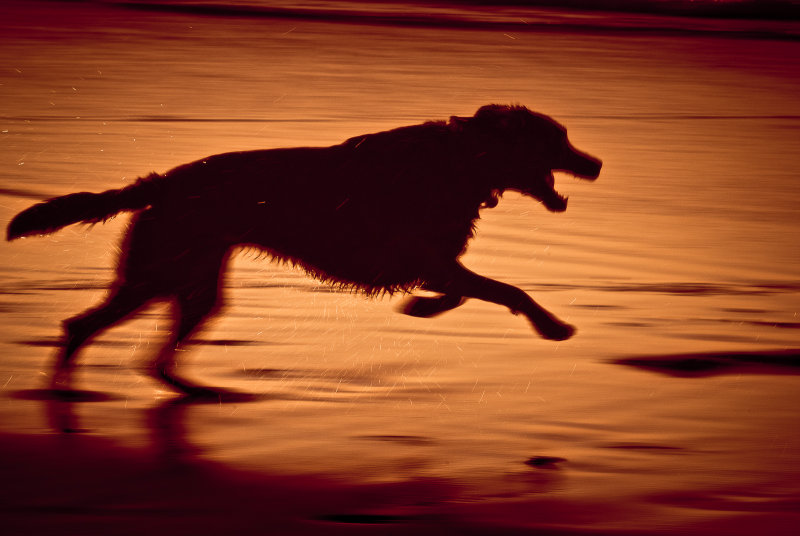
My MOST-recent panning shots were made this Friday, at the Oregon coast. I shot this with a 200mm lens, just before we had a simply gorgeous, orange "fireball" sunset over the Pacific Ocean. Speed was 1/100 second, aperture was f/22, and camera was a BRAND-NEW, first-day-ever-shot, six year-old Fuji S5 Pro that I had been keeping in storage since,well, late 2008. This camera is supposed to be **the** king of highlight dynamic range, capable of holding more highlight detail than any other camera, so I figured, hey...a black dog against the setting sun...that's a pretty good test of dynamic range! I had not read the manual, and the controls on this thing are VERY weird and non-Nikon-like, so I slapped the thing into Program mode, and spun one wheel until I got to f/22. The guy told me the dog's name is Quinn.

156223032.jpg


[Looks MUCH better seen on my pBase site at 1,600 pixels wide DSCF0084_1100 at f22 ISO 320.JPG photo - Derrel photos at pbase.com ]
 
My MOST-recent panning shots were made this Friday, at the Oregon coast. I shot this with a 200mm lens, just before we had a simply gorgeous, orange "fireball" sunset over the Pacific Ocean. Speed was 1/100 second, aperture was f/22, and camera was a BRAND-NEW, first-day-ever-shot, six year-old Fuji S5 Pro that I had been keeping in storage since,well, late 2008. This camera is supposed to be **the** king of highlight dynamic range, capable of holding more highlight detail than any other camera, so I figured, hey...a black dog against the setting sun...that's a pretty good test of dynamic range! I had not read the manual, and the controls on this thing are VERY weird and non-Nikon-like, so I slapped the thing into Program mode, and spun one wheel until I got to f/22. The guy told me the dog's name is Quinn. [Looks MUCH better seen on my pBase site at 1,600 pixels wide DSCF0084_1100 at f22 ISO 320.JPG photo - Derrel photos at pbase.com ]

VERY cool shot Derrel!! I love the open mouth! Thanks for sharing.

We are supposed to go to the (top fuel I think, but it might be alcohol cars... ) races for the Fourth of July. I'm hoping to get some panning with my nex7, I figure it might be easily feasible since the cars stay in the same focal plane the entire time. ( or is that wrong?) Then I get to try my hand at some fireworks. They have cancelled them in CO the last few years due to dry weather and forest fires, so I *think* my last attempt at fire works was with my dimage Minolta point and shoot. It's been SOOO wet this year that I really think they will go ahead with them. I guess fireworks are a little off topic, sorry for the digression.
 
IMO, birds in flight and actual panning are two completely different things. With panning, you are trying to blur certain aspects of the picture to give a sense of motion. With birds in flight, generally any blurring is frowned upon, as you want to keep the bird nice and sharp.
But, for either subject, I do use some of the same settings and techniques. I like to use a continuous focus, single autofocus point, and continuous firing of the shutter. Find your subject, nail it with the center focus point, and burst fire as it goes by.
For birds, shutter speed will vary widely depending on what species you are shooting. A gull can have a much slower speed than a humming bird for example. I usually start at about 1/1000 and go from there, but if you have the light, 1200+ generally works for anything but hummers.

For actual panning, you are trying to blur certain aspects for a sense of motion. Shutter speed will depend on the speed of the subject. Last time I did panning was at a dirtbike track, and got decent results at around 1/100, but if you are doing top fuel cars, you'll likely be faster than that. But you'll have less up and down movement to fight so you will be able to push a slower speed blurring even more of the background. Try to pick a spot with an even focal point, and no elevation change. The more the movement is just going by you nice and flat and nothing else, the easier it will be. Use a single point AF, and keep that point on the same exact spot on the car as it goes by (like a headlight, side mirror, number, something easy to track). Burst fire and keep moving through with the pan as it goes by.
 
I've been a big fan of panning for years. What speeds are necessary depends on several factors; speed of subject, size of subject in frame (magnification), desired creative result, and direction of motion in relation to the lens axis. You can past at 1/500 second on a race car, or at 1/40 second...the final effect will be different! There are sharp-shapr pans, and ghost-edged panning shots, like my running dog above, where strong RIM-lighting creates a weird "ghosting" effect along the edge. You can pan for a loooong time, like say 1/3 second on a bicycle, and it looks like a watercolor rendering of an impression of a dream of bicycle being ridden (insert Jazzie :giggle here). You can go all "Ernst Haas", and shoot bullfighting and sailboats at 1/3 to 2 seconds and create surreal/abstract "renderings" or "impressions". Michael Reichmann did a piece of Spain's bullfighting, mostly at 1/6 second.

The closer the subject is, and the bigger it is in the viewfinder, and the more it is going directly across the frame (parallel to the sensor plane), the faster the speed needed to sort of stop the movement. When you pan at slow speeds, there's a tendency to slow down the panning, and that spoils the shot. By slow speeds, I mean 1/2 to 1/10 second or so.

I GREATLY prefer to use a VR lens for slow-speed panning work. It reallllly helps when the pans are done slow if the lens can correct out up-and-down camera movement that is not desired.
 
I've been a big fan of panning for years. What speeds are necessary depends on several factors; speed of subject, size of subject in frame (magnification), desired creative result, and direction of motion in relation to the lens axis. You can past at 1/500 second on a race car, or at 1/40 second...the final effect will be different! There are sharp-shapr pans, and ghost-edged panning shots, like my running dog above, where strong RIM-lighting creates a weird "ghosting" effect along the edge. You can pan for a loooong time, like say 1/3 second on a bicycle, and it looks like a watercolor rendering of an impression of a dream of bicycle being ridden (insert Jazzie :giggle here). You can go all "Ernst Haas", and shoot bullfighting and sailboats at 1/3 to 2 seconds and create surreal/abstract "renderings" or "impressions". Michael Reichmann did a piece of Spain's bullfighting, mostly at 1/6 second. The closer the subject is, and the bigger it is in the viewfinder, and the more it is going directly across the frame (parallel to the sensor plane), the faster the speed needed to sort of stop the movement. When you pan at slow speeds, there's a tendency to slow down the panning, and that spoils the shot. By slow speeds, I mean 1/2 to 1/10 second or so. I GREATLY prefer to use a VR lens for slow-speed panning work. It reallllly helps when the pans are done slow if the lens can correct out up-and-down camera movement that is not desired.

Do you know where my :giggle: comes from? My other forum has a smiley for that, and I use it so much over there that I forget this forum (and my text messages) don't convert my :giggle: into an emoticon.

As for the race cars- I'm just gonna play around with it, but I think the image I have in my head is more of a tac sharp race car with a streaked background.... I've got my 50 1.8 and my 18-200 3.5-5.6 zoom. Any advice on which will be more useful for that? Aperture or zoom?
 

Create an account or login to comment

You must be a member in order to leave a comment

Create account

Create an account on our community. It's easy!

Log in

Already have an account? Log in here.

Back
Top Bottom