There are a few options you could consider:
1) If flowers are your main intent and you're not aiming to get super close you might do well with a Sigma 70-300mm APO macro lens (make sure its the APO and not the older version of the lens). There is also the slightly more expensive 70-300mm DG OS which has anti-handshake technology to help handholding, though its a bit more in price, though Camera world currently has a good deal on it:
Sigma 70-300mm f/4-5.6 DG OS Lens from £225.00, UK Camera Price Comparison
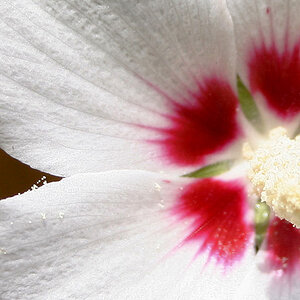
Those lenses will get you to around half life size in magnification, which in practical terms means you'll get about this much out of a shot:
IMG_0058 | Flickr - Photo Sharing!
The additional bonus of this lens is that its long focal length for macro work gives a good blurred background effect (longer focal length lenses in close up/macro give increased blurring when shot at the same aperture over shorter focal length macro lenses)
2) If you can push your budget a little more to the £300 area you can open up your options with either the Tamron f2.8 macro or the Sigma 70mm f2.8 macro lenses. These are true macro lenses which will let you get to the full lifesize (1:1) magnification ratio. Which if you compare at the hoverfly level gets you to around this:
IMG_0437 | Flickr - Photo Sharing!
A good option for selective detail on the flowers.
Both are good quality lenses and will be sharper than the zoom mentioned above (though it should be noted that the zoom does rather well for a cheaper zoom lens, at least in its macro ranges). The Tamron is an oft popular choices with those starting macro photography.
3) Nikon 40mm micro; a cheaper prime option, offering good quality at a more affordible price, but there is a cost to that. The lens is fully capable of shots like the othe two prime lenses, but its distance from the lens to the subjet at those magnifications is very tiny, which makes not just focusing but also lighting much more challenging; not too bad for static subjects like flowers, but you will still have to work with your camera shadowing your subject much of the time. I'd honestly consider this more suitable for shots like you can see from the zoom lenses; by which point whilst this is a good quality lens, the creamier and more smooth backgrounds of the zooms will (for most people, though its not an exclusive desire) rank them higher than this lens, which is at the extreme other end of the scale and will render with less blurring of detail in the out of focus background areas.



![[No title]](/data/xfmg/thumbnail/38/38723-12789924db409b40399a402700ac823c.jpg?1734172598)