Put simply: Don't light it.
Less simply, there are a variety of techniques to help you not light it.
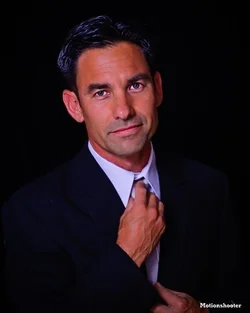
Generally speaking, you need to start thinking in terms of having 2 (or more) zones of light. You control the light in each zone separate from the other zone(s). So, for instance, your subject is in one zone, your background is in another and, ideally, the light from one zone does not influence the other.
To make the completely dark background you're looking for, its zone gets no light RELATIVE to how much light the subject gets. Various ways to achieve this all involve tightly controlling shutter, aperture, ISO and light sources.
The first thing to do, usually, is to get the model as far from the background as possible. That allows more independent control of the two zones of light. The background light you want in this case is none - no light at all. If you can achieve that, you're well on your way. However, given the fact that you'll have to light up the model, there's a real good chance that some light from that is going to bounce around in the room and end up lighting up that background to some extent. The further apart the two are, the less light will be able to reach the background because of the inverse square law.
Lighting the model from angles, rather than from dead ahead helps as well. The light flying past the model then goes off to the sides of the area of background that's in your shot behind the model. It's a lot like a flashlight beam - it lights what it's pointed at primarily, and the stuff to the sides isn't lit so well. On top of that, dead-ahead light is usually not very flattering anyway, unless you're using a ring light.
Speaking of flashlight beams, a snoot or barn doors can be used to help control the direction of light from the flash(es) onto the model, and that will help control spill from getting to the background.
There's also ambient light from windows, doors, lamps and so forth to contend with. Any that are lighting up the background should be blocked off, covered, shut off, closed down or whatever you can do to stop them from lighting up the background. That can be as simple as temporarily placing something, or someone, between the light source and the background.
Which brings us to the next common working technique, which is to block off the portion of the light that's intended to light up your model in the model zone, but is flying past your model and affecting the background. This is done with flags, and they can be anything that blocks the light, from cards to posters to blankets to - use your imagination. That's exactly what the flaps on a barn door do. Just hang or stand them in such a way that they block the light from hitting the background, and they'll be a big help to keep that background black. Illuminator arms atop light stands work real well for this sort of thing, but it's usually pretty easy to rig something up in a pinch.
Of course, you've got to have control over your exposure. Even with all those techniques in play to control the light, if you shoot long exposures with wide open apertures and flashes at full power, it's unlikely you'll get deep black backgrounds. I generally start with the techniques above, combined with my camera's shutter sync speed and ISO dialed in together to get the background the color and depth I want. Then I set up my subject light(s) and aperture for the DOF and exposure I want to achieve with the subject. That gets me real close to where I want to end up, if not spot on. From there, a little tweaking here and there may be necessary, but not much.
Used well, those techniques will allow you to turn any background pure black, even a white background. It must be said however that if your goal is a deep black background, you'll certainly get there a LOT easier if you start out with a black background. I have and use several backgrounds; Black, white, gray, gray mottled, a blueish mottled, etc., plus I use colored gels a lot to get virtually any colors I want from those backgrounds. I set up what will work best for the shot I'm trying to achieve.
Hope that helps.











![[No title]](/data/xfmg/thumbnail/37/37657-01deca3769b38b716838942ccbfce66a.jpg?1734170812)
![[No title]](/data/xfmg/thumbnail/32/32943-1a3c3a399438cf2fc6a21415e9bdedcf.jpg?1734162774)