What's new

How to Pre-Visualize like Ansel Adams

grahamclarkphoto

TPF Noob!
Joined
Mar 21, 2013
Messages
34
Reaction score
16
Location
San Francisco, CA
Can others edit my Photos
Photos NOT OK to edit
The concept of previsualization in photography is where the photographer can see the final print before the image has been captured. Ansel Adams dedicates the beginning of his first book to previsualization, and is often quoted as saying "Visualization is the single most important factor in photography". Understanding then the significance of this approach is of high value for photographers of all kinds, as it has the potential to unlock greater creative vision, and give greater control (and predictability) over the print process.


Although I'm still just a beginner, I have consolidated some of my thoughts on this here. Hopefully others can find it useful!


If you have any questions or comments please don't hesitate to reply to this thread and I'll do my best to reply!


Graham
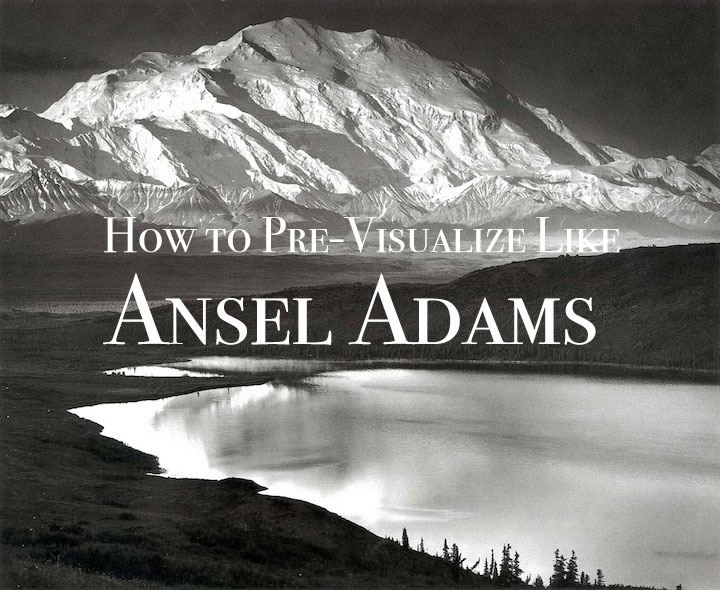

Ansel_Adams_Denali.jpg
 
Graham,
Good post. I find it interesting that Ansel is connected to pre-visualization almost as if he created it. I've always felt that any good photographer has to know what they are going to end up with in the final photo. I think the ability to pre-visualize an image is a must have tool for photographers is as essential as owning a camera. Now explaining how it works is like explaining a smell ( describe the smell of pizza) yeah, you can scratch the surface, and it is a process you can learn. But you know it when you do it. I'm not saying it in a bad way, the industry needs to talk more about it as a creative tool. I guess pre-visualization is right up next to individuality, and it is hard to charge $900 for a seminar to tell people to do your own thing. Again, good post.


My 2 cents,
 
Your support for dry-shooting is a bit anachronistic.
AA expressed these thoughts when he shot mainly large format film and dry shooting was an economic necessity.
Actually shooting images just adds to the experience by enabling to gauge just how you are doing the mind-muscle exercise.

I assume those are AA images.
Although you can possibly use them under Fair Use Doctrine, I think that FUD requires also that you cite the author and the source for the pictures.
 
Pre-visualization is but one way to make photographs, it should be noted. You tend to wind up with quite formal work out of the process.

Your discussion isn't bad, but the wheels do fall off a bit when you get to the important part. Master your camera. OK. Dry shoot. OK. "See" the image. Wait, isn't that what you're supposed to be explaining how to do? Now you're just telling me to do it.

I would expand it a bit with more discussion of the kinds of relationships that can be seen, the kinds of techniques that can be used to emphasize and de-emphasize actual and emotional aspects of the scene, and some discussion of how to practice seeing. My own recommendation to people who want to take pictures, on how to practice seeing, is to a) look at pictures and b) go out without a camera at all and look. What is in front of what? How big does one thing look relative to another thing? How do these things change when I stand tall, or when I squat down? How do I feel when I look at that thing, and what sort of photographic technique could express that? Is that a leading line? How does it change when I move to the left? Which of those two objects is darker? How will this scene look in 2 minutes when that cloud moves? How will it look in two hours when the sun is there, instead of there?

For an alternative viewpoint, read Henri Cartier-Bresson, who is in some ways diametrically opposed to Adams' viewpoint. He's still "seeing" the picture in his mind's eye (or at any rate claimed to be) but was compressing the whole process to an instant, and operating largely on a honed instinct. Almost a spinal reflex.

ETA: Not to toot my own horn but, well, ok, TOOT! TOOT! I have written a few items on this sort of thing:

http://photothunk.blogspot.com/2012/07/learning-to-see.html
http://photothunk.blogspot.com/2012/09/learning-to-see-ii.html

If you choose to read my little essays, and if you find anything good in them, feel free to borrow ideas or whatever.
 
This is quite an interesting read. I think everyone can pre-visualize their images, or at the very least in their minds see what they want. The difficult part is being able to translate what they visualize the image looking like and then being able to record it. I see images all the time, how I want it to look, and in my mind, I can see exactly what the background has to be , how the light has to be, but it takes time to put it together and line everything up right, and this doesn't always happen.
 
I am in the Cartier Bresson 'school' in that I think that an good street shooter must be able to 'see' the scene, not even as it would be through the lens, but as it will be in the final result.

I believe that if one must look through the view finder to discover the correct angle and proper framing, that person will never be a good street shooter. The technique of 'real' previsualization, absent camera, can be described and it can possibly be learned but it can't be taught. By that I mean that if the individual doesn't have the innate ability, they won't be able to learn to do it.

Whatever the ability is to see through the scene to the final image even before the camera is raised, only some proportion of people have it. In my experience, I have taken perhaps 70 or 80 individuals out on excursions to learn and practice street photography and only one or two of those has persisted and turns out what I think is decent work.
 
Doesn't everyone do this?

But I agree with having the skill to translate your visualization into reality is important. Hence why I can hear a ripping guitar solo in my head but my fat fingers don't allow my to play it.
 
I am confident that 100% of photographs ever made where not pre-visualized in this sense. Statistically speaking, that is. Of course some were, but the number is so small as to be less than the probable error in any sample.
 
I am confident that 100% of photographs ever made where not pre-visualized in this sense. Statistically speaking, that is. Of course some were, but the number is so small as to be less than the probable error in any sample.


Maybe I am just stupid but you are saying that people don't know what a photo is going to look like before they take it?
 
Yes, that is exactly what I am saying. I am being a bit sneaky, though. "Most" photographs are taken with a cell phone or a P&S, and you may not be including those in your notion of what constitutes a photograph.

Most people see something cool, and go SNAP. If they imagine anything, they imagine it will look like the actual scene. Then they are typically pretty disappointed, or would be if they actually looked at the result, which they don't.
 
Yes, that is exactly what I am saying. I am being a bit sneaky, though. "Most" photographs are taken with a cell phone or a P&S, and you may not be including those in your notion of what constitutes a photograph.

Most people see something cool, and go SNAP. If they imagine anything, they imagine it will look like the actual scene. Then they are typically pretty disappointed, or would be if they actually looked at the result, which they don't.

That's right. People don't ask questions anymore before shooting, as in:
- What do I want to shoot?
- How do I want the result to look like?
- How am I going to achieve this?

Asking questions make you be more critique aswel. You critique your own way of photographing, you critique your photo when viewing on your display, you delete this immediately and remake your photo until you're satisfied, before going further for the next shot.
 
Large format requires pre-visualization because it takes so much time to set up
 
Most people see something cool, and go SNAP. If they imagine anything, they imagine it will look like the actual scene. Then they are typically pretty disappointed, or would be if they actually looked at the result, which they don't.

That's it right there^
 

Create an account or login to comment

You must be a member in order to leave a comment

Create account

Create an account on our community. It's easy!

Log in

Already have an account? Log in here.

New Topics

Back
Top Bottom