What's new

How to Pre-Visualize like Ansel Adams

Large format requires pre-visualization because it takes so much time to set up

And your mind has to flip it right side up :lol:
 
I disagree that everyone can previsualize a photographic image. That's what photographers are born with and develop over time. Some people have no creative vision. They can see something in their minds, and they can see it in front of them, but they have no lightning bolts and can't put two and two together when it comes to photography, just like I can't put two and two together when it comes to calculus or some other mathematical language that makes no sense to me. You can't give or teach someone creative vision. You could teach them for 20 years on how to see creatively or why an image is good, but if they don't have a vision to start with, they won't get it. You can only help them develop what they already have.
 
Previsualization, when time permits, combined with knowledge and skill with the equipment can produce great results.

Note that I have listed 4 elements here...
1. An artistic/abstract minds' eye (versus a more nuts and bolts kind of thinking)
2. Time
3. Equipment knowledge (what can and can't be done with what you have)
4. The skill to properly use your equipment.

Ansel Adams, and other highly regarded photographers had all of the above and produced outstanding results. I'm more familiar with the work of O. Winston Link who, in the '50s would set up numerous flash bulb units, wire it all together, and take a nighttime picture of a passing Norfolk & Western Railway steam engine and train going by. To my knowledge, many of these were well thought out and pre-staged with vehicles, people, and even 'set up' with Norfolk and Western Railway so that the train crew would not be startled by a blinding flash of light. Remember, back then, ASA (ISO) was like...25 or so. So lots and lots of light was needed. He also did his own darkroom work, and each print was individually produced with equally thought out dodging and burning and whatever other 'magic' he had in his bag of tricks. From 'pre-visualization' to finished print was probably measured in WEEKS! Ansel Adams et al most certainly had comparable dark room skills as well. These men (and women?) were true artists. The results they produced were 'art' in anyones' book.

The problem is, in todays' world, everyone wants 'instant gratification'. Even if we have the TIME to 'see' a picture in our mind, it's hustle, hustle, hustle to see the result whether on a computer screen, or even the LCD on the back of the camera. There are still those who actually TAKE THE TIME to pre-visualize, set up, stage, whatever, and get 'the shot'. Not a flurry of 6 FPS shots of something with auto-bracketting everything...but one shot! Just like was done 60 years ago. I'm sure many here saw the video about a month ago of the man who constructed a giant camera inside his truck and the film plate is something like 30"x48". For him, it's one well-thought out shot or, at most, a small handful of shots of a particular subject. How many of us actually have such vast amounts of time to do this? One can only wish that we did.

Then, enter the event photographer. Whether 'the paraparazi' of the famous, the press, or even a wedding photographer, the perfect 'time' to make a shot is perhaps, at most, 2 seconds to get 'the money shot'. Everything else is just 'pictures'. Considering a wedding photographer, experience has told them where to be, what the 'money shot(s)' are, what settings for a dark church, or a beach, etc. It's a learned process. Yes, there's some pre-visualization, but it's more in knowing what's needed to get the shot properly exposed than what the finished print would look like.

Equipment knowledge...It's always been true that it's the photographer, not the equipment. And so it is with the Ansel Adams' of the world. Considering what was available in the 40s' (think Ernie Pyle), or the '50s, they worked miracles with the comparably 'archaeic' equipment of the day. They knew full well what could and could not be photographed. How many pictures of that day were shot in daylight versus night time? No flash at night? No shot. Plain and simple. There have been several Youtube videos of late showing the photographic results from a seasoned pro using a simple point and shoot camera and getting great results...many with a highly artistic result. Did they pre-visualize? Absolutely. But I think it was more in their composition skills and knowing the limitations of the point and shoot they had in their hands. How much no-flash photography can be done at night with a point and shoot? Still possible. I did just that 8 years ago, one 15 degree night doing long exposures in 'bulb'. A tad noisy, but still acceptable.

And the skill to use it? Would a 16 year old make a good race car driver at Indianapolis? Of course not. Skill is aquired. It is both learned and applied, analyzed, modified, and experienced again...as many times as possible. Call it learning the 'tricks of the trade'. Ask any carpenter. Having tools that can make 'perfect' cuts and drive nails with the pull of a trigger is one thing. Knowing WHERE to make the cut or WHERE to drive the nail is learned. Like they repeat over and over on This Old House on PBS...measure twice, cut once. After a while, it becomes automatic. And no, I don't mean the 'Auto' mode setting on the camera! I took low light shots less than a week ago with my 5D3 that I wouldn't even have attempted with the 60D I had 5 months ago. Actually, I WOULD have attempted it with the 60D. The results would have been OK, but more likely a throw away. Having the gear that CAN take such a shot, and having the experience/knowledge/skill to use it was the rest of the equation.
 
Ansel Adams, and other highly regarded photographers had all of the above and produced outstanding results. I'm more familiar with the work of O. Winston Link who, in the '50s would set up numerous flash bulb units, wire it all together, and take a nighttime picture of a passing Norfolk & Western Railway steam engine and train going by. To my knowledge, many of these were well thought out and pre-staged with vehicles, people, and even 'set up' with Norfolk and Western Railway so that the train crew would not be startled by a blinding flash of light. Remember, back then, ASA (ISO) was like...25 or so.These men (and women?) were true artists................ The results they produced were 'art' in anyones' book.

This is the same as saying that all composers from the 17th century were great because Bach and Handel are well known and attributing their success to the fact they has to write all their scores by hand. Like photographers, it was their talent that overcame technologic obstacles.

This is like calling a bug a feature.
The reason they did things the way that took time was because they couldn't do it any other way. The reason we think of them as 'artists' is because it is only their work that has survived. Probably 999 out of 1000 photographers who worked the same time-consuming way have disappeared.

In point of fact, if you look at AA's work, the vast proportion of it was boring and disposable. Technically perfect but otherwise uninteresting. Unfortunately, once anyone has put a great deal of work and time into something, it is difficult to discard it as unworthy.

The problem is, in todays' world, everyone wants 'instant gratification'. Even if we have the TIME to 'see' a picture in our mind, it's hustle, hustle, hustle to see the result whether on a computer screen, or even the LCD on the back of the camera. There are still those who actually TAKE THE TIME to pre-visualize, set up, stage, whatever, and get 'the shot'. Not a flurry of 6 FPS shots of something with auto-bracketting everything...but one shot! Just like was done 60 years ago. I'm sure many here saw the video about a month ago of the man who constructed a giant camera inside his truck and the film plate is something like 30"x48". For him, it's one well-thought out shot or, at most, a small handful of shots of a particular subject. How many of us actually have such vast amounts of time to do this? One can only wish that we did.

Then, enter the event photographer. Whether 'the paraparazi' of the famous, the press, or even a wedding photographer, the perfect 'time' to make a shot is perhaps, at most, 2 seconds to get 'the money shot'. Everything else is just 'pictures'. Considering a wedding photographer, experience has told them where to be, what the 'money shot(s)' are, what settings for a dark church, or a beach, etc. It's a learned process. Yes, there's some pre-visualization, but it's more in knowing what's needed to get the shot properly exposed than what the finished print would look like.

Again, you are mistaking the technology for the result.
Since you made a generalization, I feel free to make one. I think that if I asked 1000 glass plate photographers if they wished to have an apparatus that would weight one hundredth of their current load, would take many pictures and by means of which they could edit and develop these pictures while sitting at a desk, drinking coffee, my intuition is that 1001 would try it.
AA used a Nikon FM and was a consultant to Hasselblad until he dies, using all their equipment.

So the technology, which makes some actions possible, has also changed even the process by which we compose. Because we now can capture a scene quickly, we have trained ourselves to compose our thoughts and actions more quickly. Because I can the freedom to change, expose, crop and edit with a freedom that didn't exist formerly, now I can capture scenes that photographers could conceive of capturing 50 years ago.

If you don't think that the new freedoms have increased the amount of wonderful images, you haven't been looking at the Internet. If you don't think that the freedom to edit and compose has increased the amount of wonderful images, you should look at any un-culled collection of slides from 30 years ago.

Yes, we have gazillions of bad images because the technologic barriers to photography have, in the main, been dissolved and the Internet has made the vast amounts of mediocre photography visible. But don't try to pick out one variable, 'time', from the past and blame that one factor for all the changes.

 
Last edited:
This is a very odd post IMO. Adams technique for previsualization was very precise and technical. I don't think there's a lot of artsy-fartsy, hippy dippy wiggle room there, and everything was documented with detail in The Negative. The whole point of Adam's Zone system was to remove technical ambiguity concerning how the image should look. Adams was very interested in recording objective reality within the limitations of photography.

It seems that over the years of hero worship Adams approach, philosophy and technique have been essentially buried to fit our contemporary ideas about art, artistic process and photography.
 
The Zone System is all about how to realize a visualization.

Adams and his school execute(d) a three step process:

1) Look at the world.
2) Devise a mental construct, an idea of a photograph.
3) Create a physical instance of that photograph.

The Zone System is all about going from 2 to 3, and even has some ideas about properties of the mental construct in #2 (i.e. it makes fairly precise and graspable the possible tonal values, so that you can think about them).

It is almost completely silent on the subject of passing from #1 to #2, however, which is the step we normally call "pre-visualization". That's the hard part, the part that's not easily reduced to a technical manual.
 
There were two things I enjoyed long before they were "cool": Ansel Adams and Blue Jeans.

Backing up Lew's post: ADAMS: There’s no end in sight. Electronic photography will soon be superior to anything we have now. The first advance will be the exploration of existing negatives. I believe the electronic processes will enhance them. I could get superior prints from my negatives using electronics. Then the time will come when you will be able to make the entire photograph electronically. With the extremely high resolution and the enormous control you can get from electronics, the results will be fantastic. I wish I were young again!
 
Certainly though I think that Adam's techniques can be applied to digital and currently there really is no consensus on how this should be carried through - there isn't even really any consensus on how to meter and process for digital photography, with many people sort of seeing digital as a sort of wide dynamic range slide film.

I think over time people will start to better think of processing and exposure as the continuum that Adam's had, and not view processing as an inconvenient step to correct mistakes made in the field.
 
I have, apparently, been noodling on this for about a month. The problem of getting from "I wish I could make a picture of some sort" to a clear mental image of that picture is a tricky one, and I wrote out some ideas on how this process works, and what you can do to speed it along:

Photos and Stuff: Whence Inspiration?
Photos and Stuff: Inspiration Thought Experiments

I will probably rattle on for another few hundred words on the subject over the next couple of weeks, or until I see a shiny object of some sort.
 
I have, apparently, been noodling on this for about a month. The problem of getting from "I wish I could make a picture of some sort" to a clear mental image of that picture is a tricky one, and I wrote out some ideas on how this process works, and what you can do to speed it along:

Photos and Stuff: Whence Inspiration?
Photos and Stuff: Inspiration Thought Experiments

I will probably rattle on for another few hundred words on the subject over the next couple of weeks, or until I see a shiny object of some sort.


Great articles! I must say however that a point of view on the theory of music is stronger when it comes from a trained musician as opposed to a music critic, who may not be able to accomplish what they preach. To that degree Ansel Adams has a unique point of view and something concrete to present as evidence. It's my personal opinion that the concept of pre-visualization is a very natural process for one who has control over the hardware elements of the image making process, however it's often easy to interpret it as complex by many.

"With practice, we become proficient in handling the image-management & value control procedures; the interval between our first perception of the subject and the completion of visualization and the required technical procedures becomes surprisingly short." Ansel Adams

"Why limit yourself to what your eyes see when you have an opportunity to extend your vision?" Edward Weston

"The concept of the photograph precedes the operation of the camera. The print itself is somewhat of an interpretation, a performance of the photographic idea." Ansel Adams

"The key to the satisfactory application of visualization lies in getting the appropriate information on the negative. This can be compared to the writing of a musical score, or the preparation of architectural designs & plans for a structure." Ansel Adams

"The recognition - in real life - of a rhythm of surfaces, lines, and values is for me the essence of photography; composition, should be a constant of preoccupation, being a simultaneous coalition, an organic coordination of visual elements. " Henri Cartier-Bresson

"When a situation seems clearly beyond the range of all known techniques, the best photographers don't try to force rigid, preconceived ideas. Instead, they assess what kinds of photographs they can make under current conditions." Galen Rowell

"Vision, Sensitivity, an Understanding of Life; these are all necessary tools for those who would create something through the camera lens." Edward Weston

"Constricted by preset images, photographers who mechanically attempt to reproduce a rigid, pre-established vision forestall new discoveries. Their awareness is saturated with expectations that block the possibility of seeing the unexpected." Philip Gross

"Out in the field I try not to hold expectations. I try to achieve an openness. The senses heighten so that I'm totally immersed in what's happening at that moment. I want to be receptive to an image coming together." Keith Lazelle

"Each time we create a new sense of order out of chaos as we visualize a fresh image of the natural world, we intuitively rely on a lifetime storehouse of memories & associations." Frederick Evans

"Seeing photographically involves not only a sensitivity to composition & timing, it also calls for awareness of how the scene will translate into the photograph." Galen Rowell


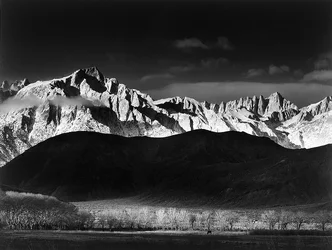
$adams-valley-photo.webp
 
Last edited:
Technically we're not supposed to post photographs where the copyright belongs to someone else. If you hold the copyright, if there is no copyright, or the right to post it has been granted by the copyright holder you're pretty much OK. Otherwise, forum policy is to use a link instead.

I think there are plenty of people who would argue that the music (and anything else) critic, by offering a parallax view, provides a lot of genuinely new insight which is actually inaccessible to the artist. That said, I do take pictures from time to time. I am a wearer of many hats. I'm a better critic than photographer, but mainly because I'm a pretty good critic. Being dismissive of critics is an amateur move, frankly.
 
I must say however that a point of view on the theory of music is stronger when it comes from a trained musician as opposed to a music critic, who may not be able to accomplish what they preach. To that degree Ansel Adams has a unique point of view and something concrete to present as evidence. It's my personal opinion that the concept of pre-visualization is a very natural process for one who has control over the hardware elements of the image making process, however it's often easy to interpret it as complex by many.

"Constricted by preset images, photographers who mechanically attempt to reproduce a rigid, pre-established vision forestall new discoveries. Their awareness is saturated with expectations that block the possibility of seeing the unexpected." Philip Gross

"Out in the field I try not to hold expectations. I try to achieve an openness. The senses heighten so that I'm totally immersed in what's happening at that moment. I want to be receptive to an image coming together." Keith Lazelle


As I said above (but never tire of repeating because it's fun to point at an icon) I am of the small but vocal group who are of the opinion that Ansel Adam's complete body of work is over-rated as an artistic achievement as opposed to a technical one. Ever since seeing a traveling show of some 300+ pictures of his I have been of that mind; there are some number of his pictures that are truly magnificent but the vastly higher proportion are just mundane, meaningless and unexciting but seemingly elevated to some high plane because of their technical perfection and their maker.

It is my opinion that many photographers, both then and now, who employ technically demanding procedures either in the taking or the processing of their pictures develop an excessive estimation of the worth of the final product - as if the volume of work is somehow additive into the worth. Look at the awe with which most of us regard platinum or carbon prints or work done with a view camera. What we often see is technically good if only because the act of using a technically demanding process serves to weed out those who aren't attentive to detail.

Several years ago I was active on a small website, since moribund, and one of the members produced very nice color, very sharp images with the finest digital equipment available then. Not happy with the detail he progressed first to 6 x 6 then 4 x 5 view cameras and when last I read of his work his was working with 8 x 10 view cameras, developing the film himself and then doing contact prints or having them drum scanned. None of the pictures of his that I saw had the least bit of humor, drama, detail or meaning - they were technically perfect and nothing else.

It is actually that pull or push towards technical perfection that is damaging to photography as art. In the struggle to gain some measure of competence with their tools, many nascent photographers replace artistic achievement with technical achievement as a goal. And that quickly becomes empty, like a woodcarver thinking that a perfectly sharp chisel or a perfectly smooth surface is the endpoint.

As to Andrew's opinion of the difference in viewpoints of critics vs. photographer, I tend to agree with him. I see a critic as a kind of geographer while the artist, in the same metaphor, is a canoeist. I am quite surprised that Graham even thinks that photographic critics should have to be actual performers in any way; we don't expect that of critics of any other art. All artists are too close to their own work to be totally objective about it. There is that constant pull of artist to his own creation that keeps diminishing the distance that a critic must have.

Even beyond that point, I don't think of myself as any sort of critic. I can give 'critique' on individual images or even a body of work but I totally lack the wide ranging overview and sense of the currents that real 'critics' must have to be sensible.
 
Last edited:
I go back and forth on Adams. The one print on my wall that was NOT shot by a family member was shot by Adams.

What most people miss about Adams is how far his images diverge from reality. The business of "pre-visualization" gets distilled down to a bunch of technical steps, because people tend to think that the part where you imagine the picture is trivial. They see Adams' photo of Half Dome, and they completely miss how completely unreal it is. They miss the obvious (to me) fact that Adams saw Half Dome, and then re-imagined it almost completely as a black and white image that looks almost completely unlike Half Dome and yet simultaneously just like Half Dome. Pre-visualization is reduced to "how would that look if I stuck a frame around it awww who cares it's a landscape with pretty pretty trees it'll be beautiful now where's my meter?"

Over time, Adams' own visualization method seems to have reduced to "How would that look with my patented Ansel Adams Style applied?" and then later to "Who the hell cares what it would look like with my patented Ansel Adams Style applied, I'm doing it, and the rubes will buy it pretty much no matter what".

Originally, though, he has some pretty inspired ideas. The Ansel Adams Style does a thing to rocks and sky that's pretty spectacular, and which was pretty innovative, and which -- just to review -- looks nothing like rocks and sky do in real life.
 
I go back and forth on Adams.

Here I was, thinking I was the only person who didn't have a strong opinion about Adams, one way or the other. I agree that he did some interesting things with natural scenes. I always think of him whenever a traditionalist decries "manipulation" in digital processing, as though none of us ever did that in the darkroom (watching or reading about Adams working on a print would make their hair stand up). However, when I look at photographs I never spend much time with his, but I probably should because there is always something one didn't notice before (or there should be).
 

Create an account or login to comment

You must be a member in order to leave a comment

Create account

Create an account on our community. It's easy!

Log in

Already have an account? Log in here.

New Topics

Back
Top Bottom