What's new

How to stop a birds wings.

A full stop of shutter speed faster than 1/800 is 1/1600.

Going from 1/800 to 1/1000 is not much of a change.
 
As mentioned.. flash with a remote trigger! You will get better exposures (yours are underexposed), clarity, and the ability to stop even a hummingbirds wings if needed.

Or kick the ISO up two or three stops, properly expose (a snowy white background will automatically underexpose a stop or two... remember it uses gray as the metering color.... not white.) and live with the noise you will get.

Flash is better!
 
I to be honest did pre-focus on the feeder. If I could however, humbly disagree with you I will (even though I guess the proof is in the image :confused: ). I only say that because I set up the feeder so that it would give me an equal distance or plane from where they fly in and out of on and x axis so to speak. I feel that the bird is well within that "plane" So, not to argue but more to plead my case and maybe make both you and Sparky consider if there may be something else ie. Image Stablization or the like.
I have not done a back focus test and to be honest I am having a hard time recalling whether I have any sharp images. Another project for me to do. :-P
There is absolutely NOTHING wrong with that. Anyone who has shot action shots of any kind has most likely done the same thing at one time or another. I do it a lot shooting races by focusing on a particular point on the track and waiting for the car or motorcycle to get to that point. I also do it with birds when I know it's where they are going to be. I shot a bunch of Hummingbird photos a couple of months ago and did the exact same thing.

The D7000 has enough resolution that you can afford to zoom back in a touch and give yourself a little wider field of view. This gives you a little bit more time to see the bird coming into the field of view, and a bit more depth of field. I have the same lens and same body, and usually shoot birds at ISO 1600 and f/8. The lens works great there and there is hardly any noise. The noise is low enough that I very seldom do any post-processing noise reduction. ISO 3200 should also work quite well with some noise reduction afterwards.

One thing I have noticed about that lens is that it looses a lot of contrast when there isn't a lot of light. Both of your tests appear to have been shot on overcast days and that's part of your loss of contrast. I normally just use my 70-300 when it's overcast because I have come to know that anything shot with my Sigma is going to look washed out and low contrast. Pick a day with bright sunlight, even if your feeders are in the shade, and you'll see a world of difference.

Also, when using a tripod that is locked in place turn image stabilization off. It can induce softness in the image when there is no motion to compensate for.

And finally, waste shots. I normally take bursts of several shots when shooting birds. It costs nothing to take them and throw them away, but many times the first shot isn't as good as another one in the burst, or I find one in the burst where I like the head or wing position better.

Birds are tough to shoot. Keep at it, you're doing fine.

Yeah I'll keep cracking at it. I am glad that you chimed in BTW because I knew that you have both the D7K and the Bigma. Thanks for the Help.

I've only messed with birds at the feeder a few times, but I'll throw out what I've learned the hard way - as simple as it seems, how clean is the window you are shooting through? We pay a ton of attention to the glass attached to our camera, but have you cleaned your windows, between the panes if possible? If you have newer windows, what kind of coating has been applied to the glass? It may not be the camera at all, but the 'filter' you are putting in front of it.

I actually clean this window fairly frequently (last time being yesterday morning) because I have a suction cup feeder on this window. That of certainly doesn't mean that it is perfectly clean of course. Also the windows are not new so who knows they very well could be affecting what is seen through the lens. Thank you for your input.

Your drawing tells me much even without where I see the bird as in place. The red line is your plane of focus. The B and arrow is where I see the bird as being. Either way, you have the bird beyond your plane of focus. View attachment 26663

Very well Mlee, I will succumb to your opinion as the horse has be throughly beaten.;) Thank you for helping me. :thumbup:

A full stop of shutter speed faster than 1/800 is 1/1600.

Going from 1/800 to 1/1000 is not much of a change.

Yeah I know it isn't much. I was doing research at another photography site :hangs head in shame: lol, and one of that sites "top" bird shooters said that his advice was to shoot at 1/1000 of a sec. That is why I did that as opposed to doing one full stop. However, I do admit that after just now reviewing that particular site I can say that he said to start at 1/1000 and go from there. duh me!
 
As mentioned.. flash with a remote trigger! You will get better exposures (yours are underexposed), clarity, and the ability to stop even a hummingbirds wings if needed.

Or kick the ISO up two or three stops, properly expose (a snowy white background will automatically underexpose a stop or two... remember it uses gray as the metering color.... not white.) and live with the noise you will get.

Flash is better!

Yeah I'm learning that I guess I'll have to get out my flashes. It's not ideal for me. There are several people here on this site who capture AMAZING images of birds (yourself included) and I just can't see them taking out their flashes to capture the images that they do. I'm starting to feel that my other disadvantage is the lost stops due to the lack of speed with the Bigma.
In either case, I'm gonna take my flashes out tomorrow and see what I can do with that. That feeder ring is usually empty within a half an hour so I have a half an hour to get it done right. I usually get about ten bluejays when I fill the ring. They do not play around.
 
I've only messed with birds at the feeder a few times, but I'll throw out what I've learned the hard way - as simple as it seems, how clean is the window you are shooting through? We pay a ton of attention to the glass attached to our camera, but have you cleaned your windows, between the panes if possible? If you have newer windows, what kind of coating has been applied to the glass? It may not be the camera at all, but the 'filter' you are putting in front of it.

Exactly! Even if your window is as clean as a whistle, in AF, your camera's sensor will read that glass as a measuring point because it can't "see" through the glass, like a human eye, to the subject beyond it. The solution would be to use manual focus, but only Superman can manual focus that fast , right?

Then what you do, is stick something, like an ornament in the birds general location or flight path, manual focus on that object, remove the object and then wait for your fine-feathered friends to return. I'd also mount your rig on a tripod and use some sort of remote control so you don't have to trip the shutter directly-your hand on your camera *might* be contributing a bit to your percieved "softness!"

Back in the day, manual focus worked just fine for cinematographers who had to shoot through matte paintings that were painted on glass- on location!!!!
 
skyy38 said:
Then what you do, is stick something, like an ornament in the birds general location or flight path, manual focus on that object, remove the object and then wait for your fine-feathered friends to return. I'd also mount your rig on a tripod and use some sort of remote control so you don't have to trip the shutter directly-your hand on your camera *might* be contributing a bit to your percieved "softness!"

Thanks for the advice. The techniques that you mentioned are all techniques that I implemented while taking those recent photos.
 
As mentioned.. flash with a remote trigger! You will get better exposures (yours are underexposed), clarity, and the ability to stop even a hummingbirds wings if needed.

Or kick the ISO up two or three stops, properly expose (a snowy white background will automatically underexpose a stop or two... remember it uses gray as the metering color.... not white.) and live with the noise you will get.

Flash is better!

Yeah I'm learning that I guess I'll have to get out my flashes. It's not ideal for me. There are several people here on this site who capture AMAZING images of birds (yourself included) and I just can't see them taking out their flashes to capture the images that they do. I'm starting to feel that my other disadvantage is the lost stops due to the lack of speed with the Bigma.
In either case, I'm gonna take my flashes out tomorrow and see what I can do with that. That feeder ring is usually empty within a half an hour so I have a half an hour to get it done right. I usually get about ten bluejays when I fill the ring. They do not play around.

Then forget about the flashes and see if you can borrow some double headed halogen work lights and use those instead of having to put up with "noise". Each one of these work lights supplies 1000 watts total, so that should be sufficient to get enough light on your subjects. Heck, you could probably pick up TWO of these units from craigslist for beer money! If you find that the halogen is a little too "yellow" for your needs, you could pick up some gel material that approximates the rough color of the birds, so they aren't "highlighted" so much.
 
I've only messed with birds at the feeder a few times, but I'll throw out what I've learned the hard way - as simple as it seems, how clean is the window you are shooting through? We pay a ton of attention to the glass attached to our camera, but have you cleaned your windows, between the panes if possible? If you have newer windows, what kind of coating has been applied to the glass? It may not be the camera at all, but the 'filter' you are putting in front of it.

Exactly! Even if your window is as clean as a whistle, in AF, your camera's sensor will read that glass as a measuring point because it can't "see" through the glass, like a human eye, to the subject beyond it.
That's incorrect. It can see through the window just fine. Anyone with a window and a DSLR with AF can confirm this in 2 seconds.

Nonetheless, you are correct that the focus point should be achieved and locked in before the action, not during, for the best shot at getting THE shot.

Moving on to address halogen lights and other "fast shutter" schemes...

Stopping fast action, like bird wings, popping balloons, and the like, is achieved with flash(es), which can stop the action at as fast as 1/30,000 of a second, which is MUCH faster than any other scheme involving lots of constant (ambient) light and a fast shutter can ever hope to achieve.

Like it or not, believe it or not, that's it. That's the "secret". Ask ANY photographer out there how they're stopping a hummingbird's wings dead in place if that's what they're doing, and they'll tell you the same thing - flashes. Same with popping balloons, capturing pellets penetrating through everything from eggs to crayons to whatever, and so on.
 
As mentioned.. flash with a remote trigger! You will get better exposures (yours are underexposed), clarity, and the ability to stop even a hummingbirds wings if needed.

Or kick the ISO up two or three stops, properly expose (a snowy white background will automatically underexpose a stop or two... remember it uses gray as the metering color.... not white.) and live with the noise you will get.

Flash is better!

Yeah I'm learning that I guess I'll have to get out my flashes. It's not ideal for me. There are several people here on this site who capture AMAZING images of birds (yourself included) and I just can't see them taking out their flashes to capture the images that they do. I'm starting to feel that my other disadvantage is the lost stops due to the lack of speed with the Bigma.
In either case, I'm gonna take my flashes out tomorrow and see what I can do with that. That feeder ring is usually empty within a half an hour so I have a half an hour to get it done right. I usually get about ten bluejays when I fill the ring. They do not play around.

Then forget about the flashes and see if you can borrow some double headed halogen work lights and use those instead of having to put up with "noise". Each one of these work lights supplies 1000 watts total, so that should be sufficient to get enough light on your subjects. Heck, you could probably pick up TWO of these units from craigslist for beer money! If you find that the halogen is a little too "yellow" for your needs, you could pick up some gel material that approximates the rough color of the birds, so they aren't "highlighted" so much.

Those Halogen work lights are basically measured in Watts per Second.... so if you are shooting at 1/1000 of a second, how much light are you actually getting? Do the Math "1000 watts per second divided by 1/1000 of a second = ? watts of light for the exposure ! ( The equation is rough, but it demonstrates the idea! This is why low end constant lighting sucks for anything that moves)
 
Yeah I'm learning that I guess I'll have to get out my flashes. It's not ideal for me. There are several people here on this site who capture AMAZING images of birds (yourself included) and I just can't see them taking out their flashes to capture the images that they do. I'm starting to feel that my other disadvantage is the lost stops due to the lack of speed with the Bigma.
In either case, I'm gonna take my flashes out tomorrow and see what I can do with that. That feeder ring is usually empty within a half an hour so I have a half an hour to get it done right. I usually get about ten bluejays when I fill the ring. They do not play around.

Then forget about the flashes and see if you can borrow some double headed halogen work lights and use those instead of having to put up with "noise". Each one of these work lights supplies 1000 watts total, so that should be sufficient to get enough light on your subjects. Heck, you could probably pick up TWO of these units from craigslist for beer money! If you find that the halogen is a little too "yellow" for your needs, you could pick up some gel material that approximates the rough color of the birds, so they aren't "highlighted" so much.

Those Halogen work lights are basically measured in Watts per Second.... so if you are shooting at 1/1000 of a second, how much light are you actually getting? Do the Math! (this is why low end constant lighting sucks for anything that moves)

much more eloquently stated than had I said it
bigthumb.gif
 
Hard to freeze motion with static light... you need strobe!!
 
Then forget about the flashes and see if you can borrow some double headed halogen work lights and use those instead of having to put up with "noise". Each one of these work lights supplies 1000 watts total, so that should be sufficient to get enough light on your subjects. Heck, you could probably pick up TWO of these units from craigslist for beer money! If you find that the halogen is a little too "yellow" for your needs, you could pick up some gel material that approximates the rough color of the birds, so they aren't "highlighted" so much.

Those Halogen work lights are basically measured in Watts per Second.... so if you are shooting at 1/1000 of a second, how much light are you actually getting? Do the Math! (this is why low end constant lighting sucks for anything that moves)

much more eloquently stated than had I said it
bigthumb.gif

Then give me a "Like.. Dammit! lol!
 
I am surprised nobody has suggested the obvious.

Kill the bird and attach its wings to some stationary object! It worked for Audobon, it can work for you!
 
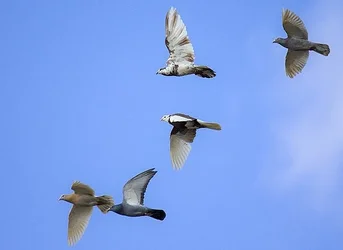
Here is a pic I had taken sometime back. Though it is not that much sharp but the motion has successfully been frozen. The key, I think, is a bright sunny day and a fast shutter speed.
$pigeons.webp
 

Create an account or login to comment

You must be a member in order to leave a comment

Create account

Create an account on our community. It's easy!

Log in

Already have an account? Log in here.

New Topics

Back
Top Bottom