Consider the following shot:
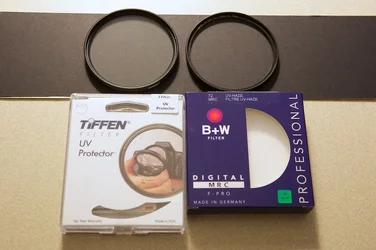
I've placed the boxes for these filters in front of them so that you can see what they are. On the left is a "cheap" UV filter. On the right I have a "good" UV filter.
Ignore, for the moment, that these are UV filters and your question is about ND filters, polarizers, etc. What I REALLY want you to see is the glass.
On the left, the cheap filter doesn't have good coatings. Try to look "through" the filters to the black matte board. The cheap filter definitely looks like there is glass in that ring.
Meanwhile, on the right, the "good" filter's glass is nearly invisible. It almost looks as though I've put the filter ring on the black matte board with no glass inside it.
THAT is the difference between a good filter and a bad filter. The bad filter WILL DEGRADE the quality of your shot. If you can see light bouncing off the surface of the glass... it's because the light you can "see" didn't actually pass "through" the filter. The glass is transmitting less light and reflecting more light. What you want is glass that transmits more light and reflects as little as possible.
If the filter can "reflect" light, then it also means that when it's on your lens, it can create "ghosting". Ghosting happens when light bounces off the front element of your camera lens, hits the inside surface of your filter, and bounces off that surface AGAIN and back into the camera. You get a weak "ghost" artifact of a subject (which paranormal researchers love to declare as something else) - when in reality it's just the physics of light and low quality glass.
Good filters have anti-reflective coatings, high transmission of light in the visible spectrum, and "even" transmission of all visible wavelengths (it he filter allows more "reds" to pass through than "blues" then it will end up applying a warm color cast -- you don't want your filter doing that.)
These same properties will apply to all filters regardless of type... neutral density filters, graduated neutral density filters, circular polarizers, etc.




![[No title]](/data/xfmg/thumbnail/42/42462-2adb6efc01a19638fca25cd3000f5575.jpg?1734176997)
![[No title]](/data/xfmg/thumbnail/31/31046-f1d28c614676726741e90ce5b420a03e.jpg?1734159151)
![[No title]](/data/xfmg/thumbnail/38/38261-db20f6f92ee8f0d4c5cf1536e308638b.jpg?1734172147)
![[No title]](/data/xfmg/thumbnail/32/32808-9d1f657a1903d3bdbd67ea830397d62c.jpg?1734162491)