Actually, manual focus is fine. I use it all the time when I want to be absolutely sure of the focus placement. However, to facilitate that, I usually also have the camera on a tripod, and I use live-view at 5x or 10x to get the focus where I want it. It is also a good opportunity to scan the edges of the frame to see if I'm including anything extraneous, and whether the overall placement of the subject in the frame looks balanced. This approach works well with still life, people under your control/direction, landscape... but not so much with moving subjects. So you pick your battles.
As far as this image is concerned, you're not letting the picture tell us what YOU found compelling about this dandelion head. If it's the roundness of the head compared to the spikiness of the grass, then a much tighter crop would signal to the viewer what they are supposed to look at. If the idea was to show a lonely flower, then a way to do that would be to put the flower at a corner, and not at the center since at the center the flower is the center of attention. Picture-making is partly technical, and partly story-telling, where the arrangement of the elements allows us to figure out what you wanted us to see. Think of a single picture as a short story, with a beginning, middle and ending. The beginning is where your eye goes when it first sees the image, and we're kinda hardwired to look to eyes (if the subject has eyes), or the brightest or sharpest portions of the image. After landing on the starting point, the eye will explore the image, and other elements of the image (lines, curves, broad areas) tell us where we should look next - this usually is the foreground and/or background that allows us to figure out the context. Finally, we leave the image, and a "good" photograph will have a natural exit point for the eye gaze. Obviously, not every image follows this script, but it is a useful metaphor to use when constructing a single image.


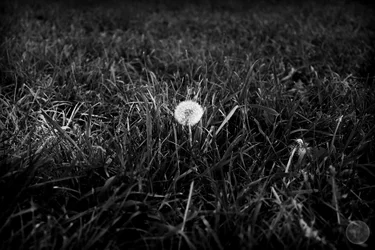


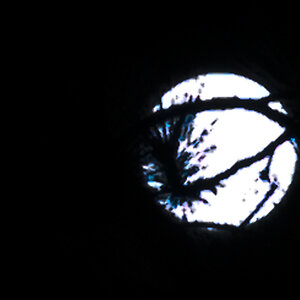
 I wanted to make it look dark cause i am sad these days so i wanted to use it to express my feelings... so i failed. About the focus off... it might be cause i was stupid and used manual focus.




![[No title]](/data/xfmg/thumbnail/34/34691-2fa9779b0e77f698b193a633b9242553.jpg?1734165697)
![[No title]](/data/xfmg/thumbnail/40/40312-7470c3c8f9e3a40e6b44c423096f188d.jpg?1734174718)