What's new

low light sport photography nikon d5100

Like others have said, a fast lens would help quite a bit. As far as color cast that can be fixed in post, maybe you should post one or two so we can take a look. You might also want to try auto-iso, it might help with exposure and you can still control aperture and shutter speed. If you find yourself on the shorter end of the 70-300, Sigma makes a 50-150 F2.8 that is DX only but used versions can be found in the mid 500 range. It's a shame you don't have a body with a focus motor, I have a cheap 80-200 F2.8 in the buy and sell section. I've been shooting with the D600 while my D7100 is being repaired and the D600 is a very nice body. Just keep in mind what focal length you shoot at most. If you are always shooting at 300mm now, you will be cropping more on the D600, which in my humble opinion negates a little bit of the benefit of full frame.
 
50mm f/1.8 AF-S G: focuses FAST, and allows you to shoot at decent ISO levels and then to CROP-IN at the computer on an image that is SHARP.

85mm f/1.8 AF-S G: focuses FAST, and allows you to shoot at decent ISO levels and then to CROP-IN at the computer on an image that is SHARP.

These two lenses are small, and light, and easy to hand-hold, and are affordable and are MUCH faster than an f/2.8 zoom lens. Do not discount the benefit of shooting loose, then cropping.

Not sure exactly what your budget is, but these two lenses are plenty good for the forseeable next decade of use. The 50/1.8 AF-S focuses FASTER than the f/1.4 of the same series...and that makes no sense, but it is what it is.
 
I have used the 50 & 85 1.8 for indoor volleyball. The price and speed are great if you can live without zoom.

Have only had a DSLR for a year but volleyball made me learn (or try to learn) a lot about low light situations. I used this trick to understand the available light and pick a lens. I took a few pictures in the venue/gym. Did not worry about the speed, fstop or iso, just used any combination to get a good picture. I input a those 3 into an iPhone app called "expositor" to find out exposure level. You could also do this manually.

My gym picture was 1/60, 5.6, 3200 with my trustee kit lens. I could get a f2.8 lens and up my speed to 250. Or I could get a f1.8 lens, up my shutter to 320 and drop my iso to 1600.

Derrel and the others explain it better. If your picture is dark and you can't drop your shutter speed or use flash you need to get the fastest lens you can and use whatever iso it takes.

My nikon gives with one hand, but then she takes with the other. f1.8 gives you light but takes away DoF. I had a lot of bright and out of focused pictures the first time out.
 
I mentioned using a light meter on your phone to test lens aperture & ISO settings in your situation.
I'm a newbie at light meters but it can really help in understanding ISO, Aperture and shutter speeds without having to take tons of photos and comparing them.

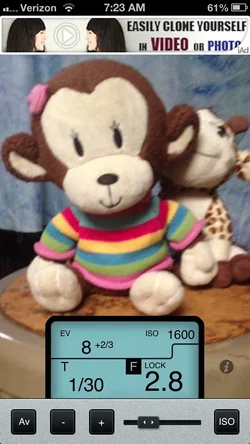
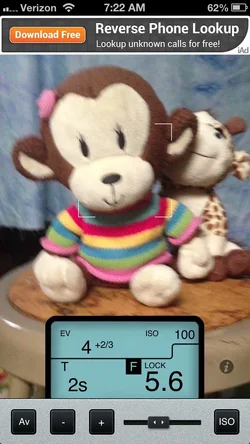
So to very poorly emulate your situation, I selected this fast moving monkey and giraffe :) jumping up and down on a stool in my basement.

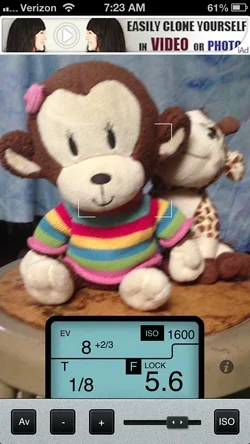
Here's an example in Low light and using a iPhone light meter

In a low light situation, one flourescent behind me in my basement - quite dim

On the first one. I check the lighting with ISO 1600 and aperture 5.6. The light meter tells me the proper exposure would be shutter at 1/8
2nd - ISO 1600, f/2.8 then shutter at 1/30
$IMG_3646.webp$IMG_3647.webp
So the larger aperture opening of f/2.8 allows me to go from 1/8 shutter to 1/30.


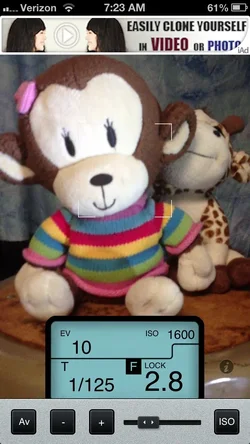
If I add a little light to the subject - which is still low light but MORE than before
ISO 1600, F/2.8 the shutter speed increases to 1/125
$IMG_3648.webp

Each light meter results gives me the manual settings for the camera, and the exposure is fine without having to hunt and peck settings.
$IMG_3649[1].webp

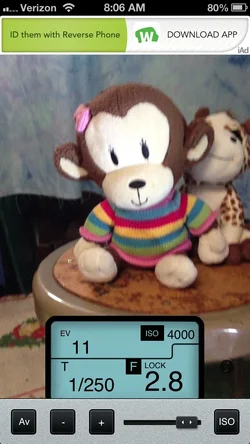
I could also bump up the ISO, which will allow me even faster shutter speed.
So I now push the ISO to 4000, f/2.8 and the resulting shutter speed is 1/250
$IMG_3650.webp

But this example shows you low light and different aperture settings.
It can also show you the limitations of your current equipment based on the lens itself.
Of course, the cameras ISO capabilities also come into play.

 

Attachments

  • $IMG_3645.webp
    $IMG_3645.webp
    77.3 KB · Views: 120
Last edited:
... If I add a little light to the subject - which is still low light but MORE than before ISO 1600, F/2.8 the shutter speed increases to 1/125
Actually you didn't add a "Little" light, you quadrupled it. Your photos show EV 8 to EV 10 (shutter speed from 1/30 to 1/125 = same thing) or two full stops. One stop doubles the light so two stops is 4 times as much light at the sensor. It may still be relatively dim but that was a significant change in light.
 
... If I add a little light to the subject - which is still low light but MORE than before ISO 1600, F/2.8 the shutter speed increases to 1/125
Actually you didn't add a "Little" light, you quadrupled it. Your photos show EV 8 to EV 10 (shutter speed from 1/30 to 1/125 = same thing) or two full stops. One stop doubles the light so two stops is 4 times as much light at the sensor. It may still be relatively dim but that was a significant change in light.
okay, I didn't turn on all my basement lights though.

I still consider my basement "dim" even with all my lights on.
I guess it depends on one's definition of "dim"
fyi, if I point it to the glass block with the rising sun, my shutter goes to 1/8000 ... EV is 17-1/3 .. that's adding ALOT of light
 
Last edited:

Create an account or login to comment

You must be a member in order to leave a comment

Create account

Create an account on our community. It's easy!

Log in

Already have an account? Log in here.

New Topics

Back
Top Bottom