What's new

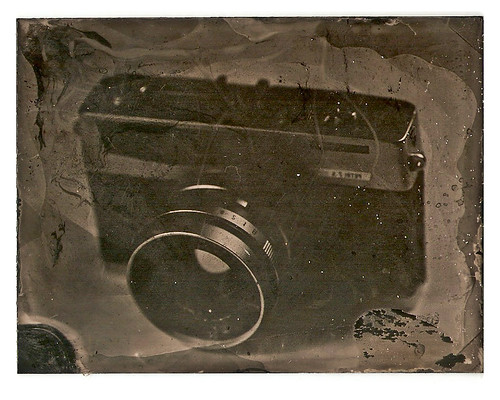
My first tin type, wet plate collodion

It is remarkably hard to get this stuff straight.

Taking a class and watching someone do it might be a good idea?
Yeah, I could see that happening. I did however make a plate! So I'm determined to keep going teaching myself. :D

There's a guy in NC that does these.
harrytaylorphoto.com - Tintypes/Ambrotypes from the Cape Fear

I could probably contact him and see if he would offer a workshop.

Are you familiar with Mark Osterman? He did a tintype excursion on the Erie Canal sponsored by the Eastman House and was posting photos of it over the summer. He teaches workshops but I don't remember offhand if he has instructions or resources on his website. I think it would be an interesting process to learn.

I'll check him out, that name sounds familiar.
I've mostly been reading about the solution chemistry but have been also looking at some other people's process / workflow.
 
My tips are:

be insanely clean. no, cleaner than that. cleaner than that, too.

A friend of mine was trying to figure out where this HONEYCOMB pattern was COMING FROM and eventually realized that he was resting the cleaned plate on a paper towel some time after the final wash and before flowing the collodion. That was enough. Stuff that you literally do not even notice even when you're paying close attention will screw you thoroughly. A biochemist probably develops the right habits, but pretty much nobody else does.

work as slowly and with as much attention as possible, and only change one thing at a time!
 
Well, I was able to make a slight improvement tonight.
And I have learned that daylight makes a WORLD of difference, but unfortunately learned this after the sun went down.

This exposure was 2.5 minutes f/8.


10029955675_cdcb0e957a.jpg


I need to figure out why I get dark spots in the photos... They're underexposed and probably under-developed.
This one I developed for 45 seconds in a tray and agitating like a mad man.

I think this would have been perfect if shot outside with day light.

Will shoot some more over the weekend with sun light. (I guess the next camera to photograph is the D3s. :lol:
 
Now you're getting somewhere! Let the sun shine...

Do you think you could be getting some dust spots? They remind me of that, when I was using a shared darkroom I learned to dust the enlarger first so I didn't have to SpotTone later.

Nice website you posted, maybe if that photographer doesn't do workshops he'd let you sit in on one of his working sessions sometime.
 
Now you're getting somewhere! Let the sun shine...

Do you think you could be getting some dust spots? They remind me of that, when I was using a shared darkroom I learned to dust the enlarger first so I didn't have to SpotTone later.

Nice website you posted, maybe if that photographer doesn't do workshops he'd let you sit in on one of his working sessions sometime.

Thanks, feels good to see an image.
I am cleaning and re-using plates, because I'm more interested in getting exposures and developing time controlled.
The specs here are probably dust or junk in the water bath after developing. You can usually tell if it's from dust before
by seeing comets from the developer pour. That's a good suggestion about sitting in, maybe he'd do that. After all I can also help with timers or positioning stuff.
It's almost a 2 person job.

The next one I post will hopefully be much better. (I spend about 10 hours each day practicing and documenting what I do and how I change the process.)
I'm down to a new batch of collodion that I've mixed that I have removed the Iodide tincture solution and just use collodion+bromo-iodizer.

After soaking the sacrificial plate in my silver nitrate bath for 16 hours, I was able to get my pH back up to 4.
20130930_180731_zps068cc386.jpg


Overtime, it may get more alkaline and work better for my positives.

More to come! I think more photographers should dabble with this. It's so much fun. :D
 
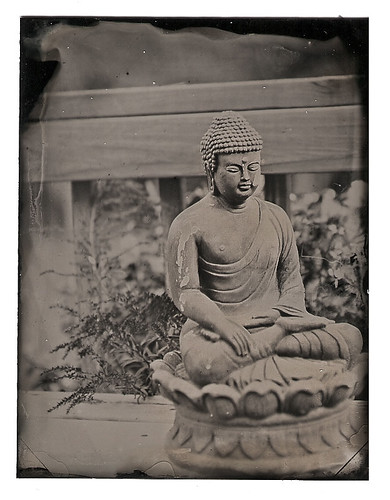
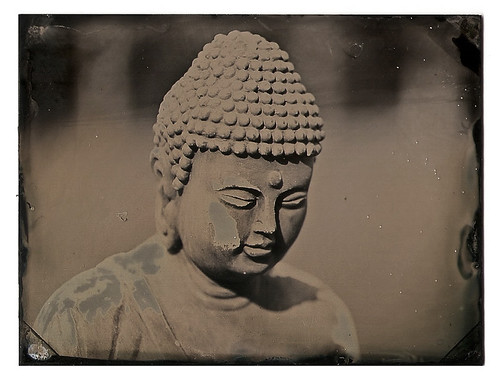
Made a couple plates today.
I think I have the processing under control now.
Next will be composition, of course.

I was mostly focusing on the processing and less on composition.
Now, I will focus mostly on that.

Here are the plates:


10105895926_8661328853.jpg


10105896296_dac6d9f06f.jpg


It's coming along!
 
I am completely and T-totally envious right now!!!


I've REALLY wanted to do this for a while, but with a Holga instead.
How to Use a Holga as a Handheld Wet Plate Camera


It's really easy once you get the hang of it.
What got me at first was the emulsion sensitivity. You need UV!
Without UV light, you're not getting anything.

Bostick-Sullivan sells everything you need if you want to get started too:
Bostick & Sullivan - Supplies For Platinum, Palladium and Alternative Photographic Processes
 
when I had all my supplies, I was a little over $330.

But, remember with this amount of chemistry, you can make hundred of plates.
 
Those are fantastic! I really want to learn this but I can't just yet, so I'm totally living vicariously through you. Such exciting work 'we' are doing! ;)
 
Those are fantastic! I really want to learn this but I can't just yet, so I'm totally living vicariously through you. Such exciting work 'we' are doing! ;)
Are we bold enough to do a family portrait next?

I'm visiting some family next week at the beach, and I'm contemplating bringing my darkroom with me. :D
 
What was the total investment in chemicals like?

You can get a kit for $280
http://www.bostick-sullivan.com/cart/product.php?productid=1077&cat=366&page=1

However in addition to chemicals there are additional items needed besides a large format camera. Things like plate holder, sensitizing tank, drying rack, and or course plates.

Plate Holder
http://www.chamonixviewcamera.com/wetplateholders.html

Plates
http://www.lundphotographics.com/cgi-bin/commerce.cgi?preadd=action&key=TN001

Sensitizing Tank
http://www.lundphotographics.com/cgi-bin/commerce.cgi?preadd=action&key=TT001

Drying Rack
http://www.lundphotographics.com/cgi-bin/commerce.cgi?preadd=action&key=DR002

As side from camera and lenses my rough estimate is about $500. At least that is what I'm planing on saving up to get the needed supplies.
 
What was the total investment in chemicals like?

You can get a kit for $280
Bostick-Sullivan :: Wet Plate Collodion :: Pre-Mixed Wet Plate Collodion Kits :: Complete Wet Plate Collodion Set For 4x5"

However in addition to chemicals there are additional items needed besides a large format camera. Things like plate holder, sensitizing tank, drying rack, and or course plates.

Plate Holder
wetplateholders

Plates
LundPhotographics - StandardThickness0024gageTin

Sensitizing Tank
LundPhotographics - TravelingTank4x5

Drying Rack
LundPhotographics - DryingRackSmall

As side from camera and lenses my rough estimate is about $500. At least that is what I'm planing on saving up to get the needed supplies.
Thanks for posting some links!
You introduced me to Lund Photo Graphics, and I just ordered some plates from them.

I've been buying sheets and cutting them to size with a shear at work. These now will come pre-cut to 1/4 size.
Thanks very much. :)
 
Very cool!
 
Last edited:

Create an account or login to comment

You must be a member in order to leave a comment

Create account

Create an account on our community. It's easy!

Log in

Already have an account? Log in here.

Back
Top Bottom