- Joined
- Jul 8, 2005
- Messages
- 45,715
- Reaction score
- 14,785
- Location
- Victoria, BC
- Can others edit my Photos
- Photos OK to edit
- Moderator 🛠️
- #1
A few weeks back I made a ‘brag-post’ about some new gear I’d received. One of these items was a long-awaited ultra-wide zoom, Nikon’s new 16-35mm f4 VR. At that time, I said that I would post a review of the lens, so here it is. Please note: This is not a technical or scientific review; if you want detailed specifications, resolution of lines/mm, etc, there’s lots of that available. This is a review by a user, for other users in practical terms. Complaints or issues with the test procedures may be made by calling 1-800-WAHHHHHH
At first glance, an ultra-wide, f4 zoom with VR seems a bit of an odd-ball; I certainly thought so, but it was my lens of choice for several reasons. There are only three contenders in the Nikon line for this area. There is of course, the gold-standard 14-24 f2.8, and the 17-35 f2.8. The 14-24 was eliminated immediately for two reasons: (1) No front filter threads, and (2) high price. I don’t use the ultra-wide end often enough to really justify the cost. Next was the 17-35. This beast has been around a long time, and is an excellent lens, but it is old technology, and I might as well get that one extra millimetre.

I did a lot of research prior to ordering and all things seemed to indicate that it was an excellent lens with the following caveats: (1) Extreme barrel distortion at 16mm, and (2) slower than the other professional choices being an f4 lens. There is some minor pincushion distortion at 35mm, but I really don’t care as I’m into the 24-70 range by then. On that note, the 16-35 is surprisingly similar in size, weight and appearance to the 24-70, and it’s not ‘til you mount the lens hoods that it’s obvious which is which.

16-35 f4 (Left) 24-70 f2.8 (Right)

16-35 f4 (Left) 24-70 f2.8 (Right)
The build quality is everything you would except from Nikon’s “Gold-ring” line and has a nice solid feel to it, and the same smooth focusing and zoom as the 24-70.
Pixel-peeper performance: I don’t have the facilities to do a proper lens-resolution test, but a page of newspaper can give a good idea.:

Newspaper from minimum focusing distance, f4, 100% crop, UL corner

Newspaper from minimum focusing distance, f8, 100% crop, UL corner

Newspaper from minimum focusing distance, f8, 100% crop, cent
Performance in the corners, at least at this level doesn’t look especially good, however this test is a pretty extreme circumstance. Camera to subject distance is only a few inches, and this really isn’t the way the lens is intended to be used.
Barrel distortion:

16mm, f4, approximately five feet camera to subject

18mm, f4, approximately five feet camera to subject

20mm, f4, approximately four feet camera to subject
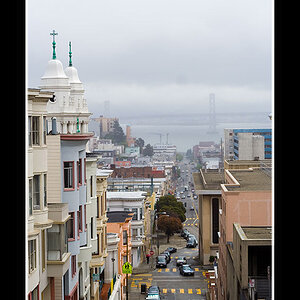
Pretty ugly isn’t it? Of course one has to ask one’s self: How often is one likely to take photographs of vinyl siding at a distance of four feet? I know this is a first for me. Now, let’s compare this to a ‘real-world’ example of a scene where this lens is likely to be used at 16mm:

Conclusion: When tested under the worst possible conditions, the lens is a so-so performer at best. When used the way it was intended, it’s an outstanding piece of glass. My feeling is that this lens is an excellent choice for anyone who wants a reasonably priced, ultra-wide zoom with very good (but not spectacular) performance in the real world. I’m pleased with this lens; naturally I’d like a little better performance in the corners and less barrel distortion wide open, but you can’t have everything, and the cost saving over the 14-24 f2.8 more than makes up for the slight performance loss.
~John
At first glance, an ultra-wide, f4 zoom with VR seems a bit of an odd-ball; I certainly thought so, but it was my lens of choice for several reasons. There are only three contenders in the Nikon line for this area. There is of course, the gold-standard 14-24 f2.8, and the 17-35 f2.8. The 14-24 was eliminated immediately for two reasons: (1) No front filter threads, and (2) high price. I don’t use the ultra-wide end often enough to really justify the cost. Next was the 17-35. This beast has been around a long time, and is an excellent lens, but it is old technology, and I might as well get that one extra millimetre.
I did a lot of research prior to ordering and all things seemed to indicate that it was an excellent lens with the following caveats: (1) Extreme barrel distortion at 16mm, and (2) slower than the other professional choices being an f4 lens. There is some minor pincushion distortion at 35mm, but I really don’t care as I’m into the 24-70 range by then. On that note, the 16-35 is surprisingly similar in size, weight and appearance to the 24-70, and it’s not ‘til you mount the lens hoods that it’s obvious which is which.
16-35 f4 (Left) 24-70 f2.8 (Right)
16-35 f4 (Left) 24-70 f2.8 (Right)
The build quality is everything you would except from Nikon’s “Gold-ring” line and has a nice solid feel to it, and the same smooth focusing and zoom as the 24-70.
Pixel-peeper performance: I don’t have the facilities to do a proper lens-resolution test, but a page of newspaper can give a good idea.:
Newspaper from minimum focusing distance, f4, 100% crop, UL corner
Newspaper from minimum focusing distance, f8, 100% crop, UL corner
Newspaper from minimum focusing distance, f8, 100% crop, cent
Performance in the corners, at least at this level doesn’t look especially good, however this test is a pretty extreme circumstance. Camera to subject distance is only a few inches, and this really isn’t the way the lens is intended to be used.
Barrel distortion:
16mm, f4, approximately five feet camera to subject
18mm, f4, approximately five feet camera to subject
20mm, f4, approximately four feet camera to subject
Pretty ugly isn’t it? Of course one has to ask one’s self: How often is one likely to take photographs of vinyl siding at a distance of four feet? I know this is a first for me. Now, let’s compare this to a ‘real-world’ example of a scene where this lens is likely to be used at 16mm:
Conclusion: When tested under the worst possible conditions, the lens is a so-so performer at best. When used the way it was intended, it’s an outstanding piece of glass. My feeling is that this lens is an excellent choice for anyone who wants a reasonably priced, ultra-wide zoom with very good (but not spectacular) performance in the real world. I’m pleased with this lens; naturally I’d like a little better performance in the corners and less barrel distortion wide open, but you can’t have everything, and the cost saving over the 14-24 f2.8 more than makes up for the slight performance loss.
~John
Last edited:


![[No title]](/data/xfmg/thumbnail/36/36602-3001bbe07fa5517ccd4b03e049c7b844.jpg?1734169055)


![[No title]](/data/xfmg/thumbnail/36/36603-a830ccec573081105d6aafcccc650605.jpg?1734169056)
![[No title]](/data/xfmg/thumbnail/30/30863-8c53522e4ed851e96cb7411e74b9fe59.jpg?1734158825)