What's new

Photos look flat!

Well said pgiz. That is the essence of what photographic lighting is all about.

And that applies to using whatever type of light is being used light.

The bottom line is the OP needs to learn a lot more about photographic lighting.
Someone can spend months scouring the Internet for and then trying to assemble snippets of information, or they can get the info all concentrated in a book:
Available Light: Photographic Techniques for Using Existing Light Sources
Lighting for Digital Photography: From Snapshots to Great Shots (Using Flash and Natural Light for Portrait, Still Life, Action, and Product Photography)
The Luminous Portrait: Capture the Beauty of Natural Light for Glowing, Flattering Photographs
 
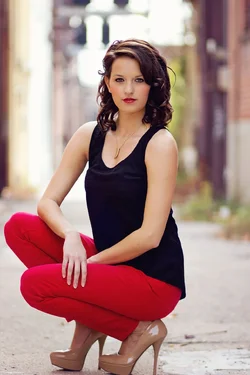
If you look at the picture you like, you can see that this professional photographer used three light sources: the window, a largish souce camera right, and a fill light (also quite large) camera left, high. The picture was arranged to make it appear that the primary light was from the window, but the shadows and highlights (on her lip) show the direction of the sources. If the window was truly the only light source in the image, her face would be mostly in shadow. If the window was in fact, quite wide, then the light source camera right would be the window. If the window was narrow, then a light source (camera right) becomes necessary. The fill light was dimmer than the main light source(s), to allow the shadows to exist, but not to be so deep as to hide the features. If you look at how the shadow falls on her right eye, you can see that the light is probably high, and quite large since the shadow is gradual. You can also often see the light setup by looking at the catchlights in the eyes.

It may appear that the image is taken casually, but if you deconstruct the pattern of light and shadow, you can often see that there are multiple light sources and that there was a lot of effort put into getting the right balance.
 
OK Here is a second example (I know I way over did it on skin retouching lesson learned) Here at the time I was taking it I thought it was great lighting. But, once I opened them up again with the flatness..... $f1web.webp

Compared to this......$136515432425738147_psDTE7NR_c.webphttp://pinterest.com/pin/136515432425738147/

I know this sounds confusing and I truly do appreciate everyones advice here. But it just seems my photos are lacking the snap and d quality all of these have......
 
Well, in that image, the front light is very even, and there are no shadows. In the other image you showed (and just post the link next time, as per forum rules, if it's not your image), there is more light on the right side of the face, and therefore there is a subtle shadow. It's the shadows that give the contours.
 
Wow. Lighting really has me worked up.....I just see all these wedding photographers who have to take pictures in mid day horrible lighting and their pictures come out better than mine do in a controlled lighting environment! It is VERY frustrating.
 
Think of it this way: Shadows define the shape. Good photography blends the highlights AND the shadows to give our eyes the visual cues as to what is where. Then our mind sorts this and builds an internal three-dimensional model of what we think we are seeing.

Another nuance is the degree of "sharpness" to a shadow - a small source (noon sun, bare flash) creates harsh, hard shadows. A large source (as in open sky or a large softbox) creates very indistinct shadows. In between is the shadow that's just right - not too hard, not too diffuse. The photographers you see who can take good shots even in mid-day sun, obviously understand how to fill in the harsh shadows (with reflectors, fill lights) to make the end-result attractive.

I suggest you "reverse-engineer" the lighting setup of the photographers you admire, and then try to duplicate it - you'll find that there is a real skill in determining how to determine the how close, how large, how much fill for a given situation. It may take you a number of days or weeks of practice before it starts to come together.
 
Now tell me how to do all that setting up with my never stop moving or wiggling 6 month old?
 
Now tell me how to do all that setting up with my never stop moving or wiggling 6 month old?

FWIW at my sister in laws wedding the photographers did several poses with strobes and power packs, softboxes, etc. But when it came time for the small children, he used a speedlite on camera and one off camera handheld by an assistant. I'm sure it takes a great deal of experience to do this successfully, but, I think he determined the best solution for children in this case was to use small portable flash units and be able to move just as often and just as fast as the small children. The pictures turned out great.
 

Create an account or login to comment

You must be a member in order to leave a comment

Create account

Create an account on our community. It's easy!

Log in

Already have an account? Log in here.

Back
Top Bottom