What's new

selfie

leeroix

No longer a newbie, moving up!
Joined
Aug 31, 2011
Messages
1,058
Reaction score
429
Location
California
Can others edit my Photos
Photos OK to edit
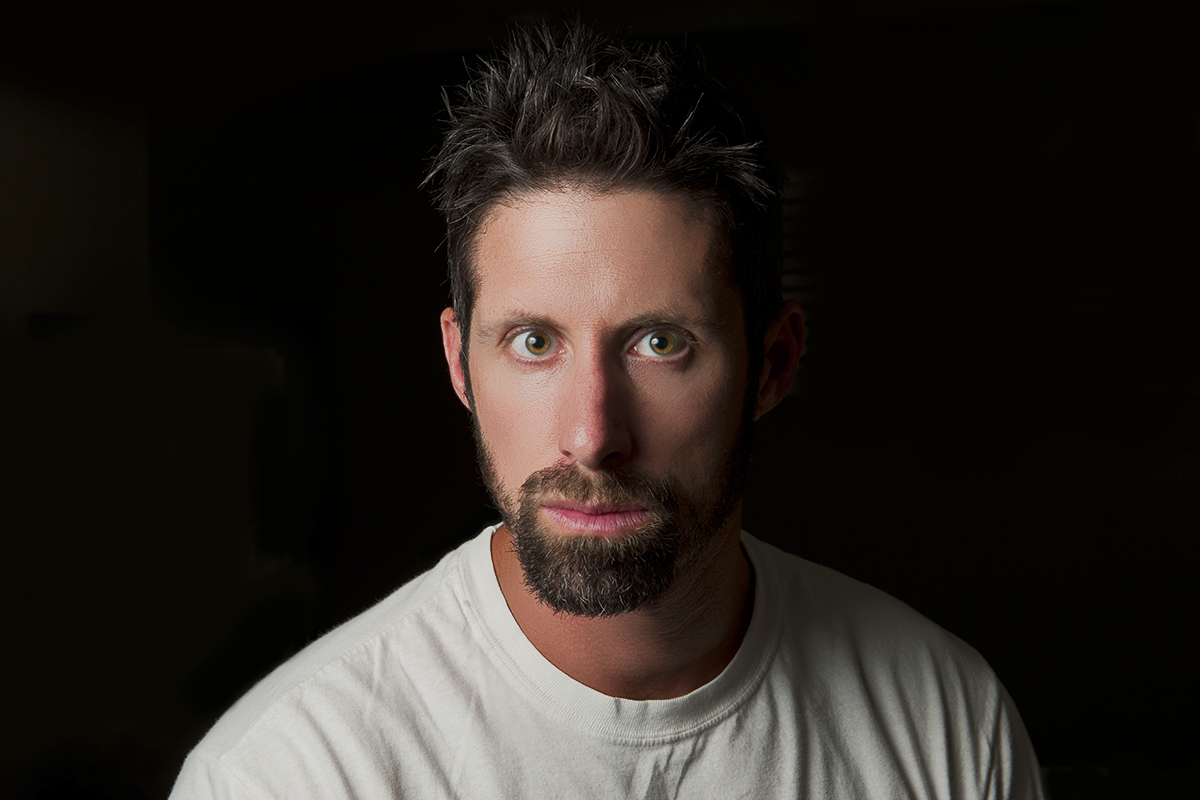
Bored. Playing around with my old umbrella. No other subjects around. Don't like to be on this end of the camera.

Me by keips66, on Flickr
What can I do better?
 
What can you do better? Not sure really...I've heard you're hell on wheels when it comes to driving...and they say you're a beast when it comes to drinking shots...I heard you're pretty good at fishing too... ;-)

But seriously...there are a few things we can literally "see" from this. One is that the light is falling off in intensity very rapidly, so I am going to assume the umbrella was fairly close to you when this was shot. Now, a lot of people preach the old saw that, "The closer a light is to the subject the softer the light is." Well, let's take note that the other side of that coin is, "The closer a light is to the subject, the more f/stops' worth of light you lose over very short distances."

Let's start at the forehead:good skin definition, then a very hot, almost specular highlight, then good skin definition, then a very slight shadowing as your forehead begins to curve, and then on the right hand side of the frame, TOTAL darkness. Same on the chin and your beard: good detail, and then, across a distance that's only as wide as your chin, ZERO detail...just blackness.

On your face, at the nose level, we go from good detail on the left side of the photo, the highlight just to the left of the nose, then the nose with good detail, and then right into shadow cast by the nose itself, and on the far right side the ear's outline is just barely visible in the deep shadows. This rapid light fall-off across the face's width causes a weird rendering of your facial shape; on the left side of the face, your face's shape and outline looks "one way", while the other side, the shadowed side, shows a totally different facial "shape". Since facial symmetry is a HUGE boost to attractiveness, this highly asymmetrically-shaped face rendering makes you look much less attractive than you COULD look!

I think for people to get the most out of this as a learning exercise, it'd help to know the diameter of the umbrella, shoot through or reflecting, and approximate distance it was placed from you.

As to what you could have done "better". Well, selfies are difficult...very hit or miss, with lots of "misses" on many days. Without a large reflector or wall to provide fill-in on the shadowed side, this lighting setup is going to cause exaggerated facial shape differences with the light this close--but if you had moved the light farther away, the fall-off would have been more-gradual, with less shadowing. If you would have moved the light more around and to the front of your face, it would have created a different look. Not necessarily better, but definitely "different". The thing is, we have no idea what kind of a "look" you were trying or hoping to create, so not much can be said except about the pure, technical ways light behaves, and how we can influence the degree of light fall-off and shadowing based on distance of the light to the subject.
 
A rim light would help separate you form the back drop and even add a little more detail in the shadows on the dark side.

Nice exposure, light placement and the catch light in your eyes is very nice. good job
 
^Nice write up. Definitely some things to consider for my next session. My umbrella is something from the early 1970's - a dingy white-ish 30" shoot through. It was about 24" from my right and slightly above. I thought about setting up a reflector on my left to help with the left side of my face, but sadly, I couldn't find anything to use. I wish I had another speedlight or maybe some Alien Bees or something to give me more options. - a rim light would be nice. I do see how the shadows play tricks with symmetry so this was a good lesson in that aspect. I also have a 36" silver umbrella. - What would that do?
 
^Nice write up. Definitely some things to consider for my next session. My umbrella is something from the early 1970's - a dingy white-ish 30" shoot through. It was about 24" from my right and slightly above. I thought about setting up a reflector on my left to help with the left side of my face, but sadly, I couldn't find anything to use. I wish I had another speedlight or maybe some Alien Bees or something to give me more options. - a rim light would be nice. I do see how the shadows play tricks with symmetry so this was a good lesson in that aspect. I also have a 36" silver umbrella. - What would that do?

Umbrella size and umbrella type plays a major factor in head-and-shoulders type shots, done indoors at closer distances. When shooting a shot like the above, a 30 inch umbrella will have sharper shadows, and less "wrap" than say a 40 or 43 inch umbrella. I own two 30 inchers, and four 40-inchers. I prefer the 40 inch size for their slightly softer light. Some people rave about 60-inch umbrellas, but they're so damned BIG they're hard to use in anything except high-ceilinged rooms.

I own two real "silver" umbrellas, the Speedotron silver metallized umbrella, this one Speedotron 24537 34" Metalized Reflector Umbrella 24537 in the 34-inch size and I also have a brand new, like 40 year-old used model I picked up last month and have not tried. What this type of umbrella does is creates a more-crisp light...the light is a bit "harder"...it creates more specularity, meaning it creates hotter highlights, and this makes skin "glow" more than white surface umbrellas would.

Also, shoot-through versus reflecting is "different". Neither type is necessarily better, but each is definitely "different". In a word, shoot through often allows/encourages users to position the light closer to the subject's face, which causes very rapid fall-off in light intensity due to 2 factors; the inverse square law as mentioned above (not by name) and secondly, most shoot-through umbrellas when used with a speedlight have a very hot center of their beam, and the edges are very weak light. This typically leads to a hotter, more-specular highlight forming on rounded parts of human faces. Most shoot-throughs have a sort of signature that's very much like other shoot-throughs have.

Reflecting umbrellas, in dull white interior, or even the semi-silvery-but-mostly-whitish sort of "satin or silk-like" interior, diffuse and scramble the light MORE than a shoot-though tends to. Because the shaft is extended, these are often by necessity, positioned TWICE AS FAR AWAY from a subject as a similar-sized shoot-though would be. Also, because the whole "bowl" of the umbrella is reflecting the light, it tends be MORE-diffused light than a shoot-through. Not "better", not "worse", but simply different kind of light. Because of the shaft sticking out, a reflecting umbrella's greater distance on a headshot or head and shoulders shot will almost always make the light fall off less-rapidly, due to distance. The light is lower in intensity, but it drops away to shadows much more-slowly, even being moved back 16 to 30 inches farther away than is possible with a shoot-through.

 
Last edited:
Awesome. I will go home and learn :)
 
I’ve done all kinds of “selfies” like this to practice strobe technique, but damn does it get tiresome seeing your own mug over and over again. My experience with light fall-off while using umbrellas mirrors exactly what Derrel described.

As an aside, perhaps only tangentially related to this thread, I’ve found I don’t really care for the “closer umbrella = softer light” advice because it’s usually provided on its own without any other qualifying explanation. Over time and with practice I’ve come to understand what is meant, but I can vouch that it can be confusing for a beginner.

Beginners are always told that they’ll get “harsh shadows” from a small light source like, say, a bare strobe. At the same time, they’re told they’ll get “soft light” from a “large apparent source” like, say, a close-up shoot-through umbrella. But, that close umbrella, with all of its purported softness, also has the “rapid fall-off” characteristic. So, unfortunately for the beginner trying to get his/her head around things, both the “small source” and the “large source” can lead to a high contrast result, which is precisely the characteristic most of them are probably seeking to avoid or minimize when they say they want “soft light”. I realize it’s not the same phenomenon at play in each case, but my point is, IMO, some of the common bite-sized one-liner guidelines that get thrown around so often on blogs and websites can lead to more head-scratching than enlightenment.
 
^Good point. I realize that I need some other modifiers to disperse the light more evenly. Derrels post was my ah ha moment. I realized that light fall off was drastic with a snoot, but ALSO possible, although not a drastic with the shoot through umbrella. And I'm now aware of the hot spot in the center or where the flash is aimed. Ideally, Id like to get a large soft box, or one with a grid. In the end, it just comes down to experimenting and figuring out what works, and what doesn't, and what give you certain effects.
 
Did you do lots of smoothing or were you just born with silky smooth skin?
 
^ha! I cleaned up a few blemishes, and some light smoothing but thats about it. Not too shabby for 35.
 
I’ve done all kinds of “selfies” like this to practice strobe technique, but damn does it get tiresome seeing your own mug over and over again. My experience with light fall-off while using umbrellas mirrors exactly what Derrel described.

As an aside, perhaps only tangentially related to this thread, I’ve found I don’t really care for the “closer umbrella = softer light” advice because it’s usually provided on its own without any other qualifying explanation. Over time and with practice I’ve come to understand what is meant, but I can vouch that it can be confusing for a beginner.

Beginners are always told that they’ll get “harsh shadows” from a small light source like, say, a bare strobe. At the same time, they’re told they’ll get “soft light” from a “large apparent source” like, say, a close-up shoot-through umbrella. But, that close umbrella, with all of its purported softness, also has the “rapid fall-off” characteristic. So, unfortunately for the beginner trying to get his/her head around things, both the “small source” and the “large source” can lead to a high contrast result, which is precisely the characteristic most of them are probably seeking to avoid or minimize when they say they want “soft light”. I realize it’s not the same phenomenon at play in each case, but my point is, IMO, some of the common bite-sized one-liner guidelines that get thrown around so often on blogs and websites can lead to more head-scratching than enlightenment.

Very well-stated, cynicaster.

Another comment on the soft light versus shadowing issue, and on the more-diffused highlights from say dull-white reflecting umbrellas as opposed to shoot-throughs with their hotter and more-specular highlights, and then silver-finished reflecting umbrellas and their somewhat specular highlights; when we work in full color or want to make the light soft, so it does not show a lot of texture, we might prefer the softer, more-diffused lighting of a white-surfaced, reflecting umbrella. Maybe even a very large umbrella.

But, if we're shooting specifically for Black & White finished images, it can actually look better if the umbrellas we use give a "crisper" light, or create more rapid shadow creation. One of my old 1980's book-learning and self-taught lighting lesson guru's was famous celebrity and advertising shooter Gary Bernstein (Liz Tayor's personal photographer for years on end). He wrote a book or two, and did a monthly column in Peterson's Photographic. One of his popular tips that always stuck with me was his suggestion that when shooting for B&W, he preferred to almost always use smaller umbrellas, or smaller light modifiers, be they parabolic reflectors, Halos, or whatever.

I still think Photoflex's 30-inch reflecting umbrella, THIS exact one, Photoflex UMRUT30 Convertible 30in White Umbrella UMRUT30 is a good speedlight umbrella. yes, it's smallish...but it produces just the right light, and I've had a couple for 10 years or so...they're very good for their size.
 
^Nice. Really appreciate all your insight :) what was that book named?
 

Create an account or login to comment

You must be a member in order to leave a comment

Create account

Create an account on our community. It's easy!

Log in

Already have an account? Log in here.

Back
Top Bottom