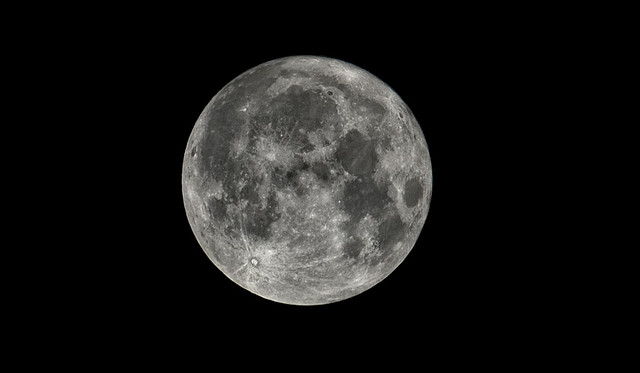
Actually, it is 0% larger and 0% brighter. The mass of the moon is not changing, it is not like it is colliding with an asteroid 30% the size of the moon and it also does not produce any light so it is never bright to begin with.
It may appear 14% larger and 30% brighter though. Those numbers were given out by NOAA so I am gonna stick with their calculations on this one.
The mass of the moon has nothing to do with it. I'm sure the 'larger' reference is to the angular size of the moon as it appears to an earth-bound observer, and the 'brighter' simply means that since it looks larger, then one can assume it's brighter. But it's not.
To prove this, go out and take a photo of your car on a sunny cloudless day as close as you can and still get the entire vehicle in the frame. Use your widest angle lens. Now note the exposure (ISO, shutter speed, & aperture) needed to produce a nice pix.
Now walk across the street and take another photo. Is your car any 'darker'? Do you need to bump up the ISO, open the aperture, or slow down the shutter? No. Is your car any smaller? No, you can still fit into it... it's not one of those toy cars the Shriners drive the parades all of a sudden.
Walk down the block as far as you can and take another photo. Do you need to adjust any of those settings simply because you're 100 feet away? No. Can you sell it on
ebay as a Matchbox? Hardly.
If I was one the moon with a tele lens with enough power to pick your car up where it sits, MY exposure of your car would be exactly the same as yours when you're 10 feet from it.
Fact is, when the astronauts were walking around on the surface of the moon, they used the same EV we would shooting it from here. If getting closer to the moon somehow makes it brighter, then all the astronauts who made the trip there (26 by my count) would have been rendered blind.